Silicon Valley doesn’t follow longevity trends. It builds systems. The conversation moves toward tracking, optimization, integration, and systems thinking.

Hayes Mansion in San Jose
Between Feb 18-20, INNOCOS hosted one of the most high-signal longevity events of the year: the INNOCOS Beauty, Tech & Longevity Summit in San Jose, Silicon Valley. It brought together brand founders, scientists, MDs, and industry operators to pressure-test what’s real in longevity right now – what’s working, what’s measurable, and where the category is heading next.
As Arnaud Auger (Director, Cathay Innovation VC fund) put it:
“Longevity is not about staying old longer, it’s about staying young for longer. It’s not about adding more years to your life, it’s adding more life to your years.”
Longevity is moving from niche biohacking into a mainstream consumer mindset and beauty is getting pulled into that gravity.
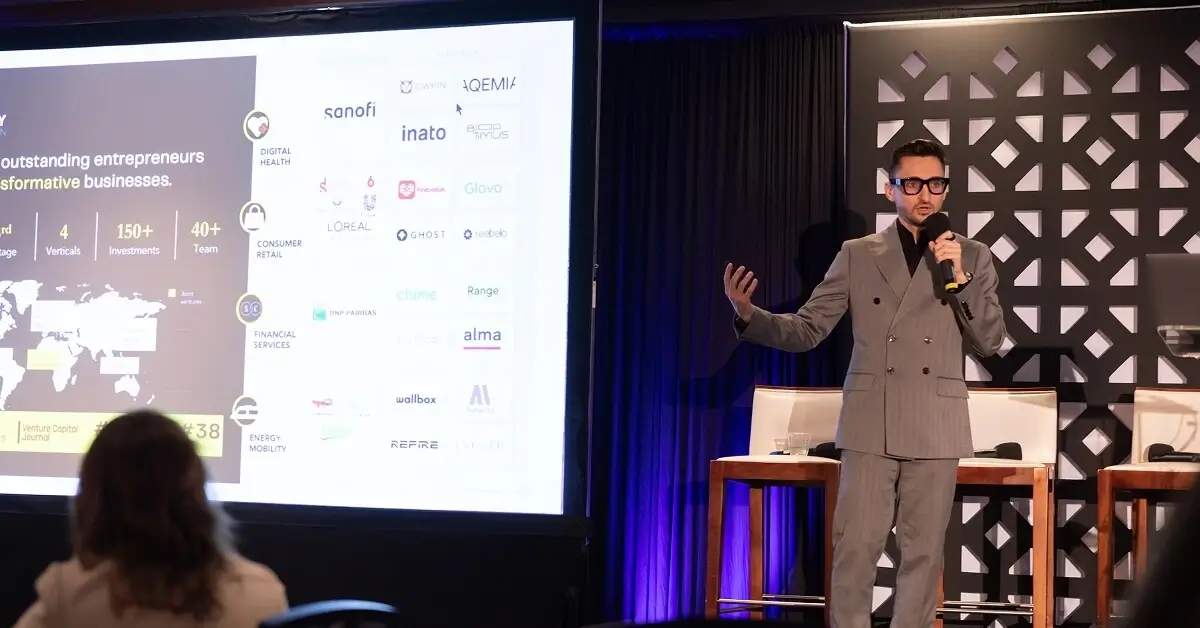
Arnaud on how longevity is reshaping consumer behavior
Longevity Is Now a Consumer Behavior Shift - Not a Luxury Niche
There was a clear pattern across the Silicon Valley talks and interviews at the INNOCOS Silicon Valley Summit: the biggest longevity trends are no longer living at the level of high-end aspiration. It is being operationalized in everyday consumer decisions, especially in how people evaluate products and decide whether to repurchase.
What emerged in San Jose is that loyalty is no longer driven by branding alone. It is driven by outcome visibility.
Alisar Zahr from Revision Skincare reduced frequent purchase to one simple condition:
“The biggest driver of frequent purchase? It is that it works… they’re seeing a clinical benefit.” – Alisar Zahr, VP, Revision Skincare
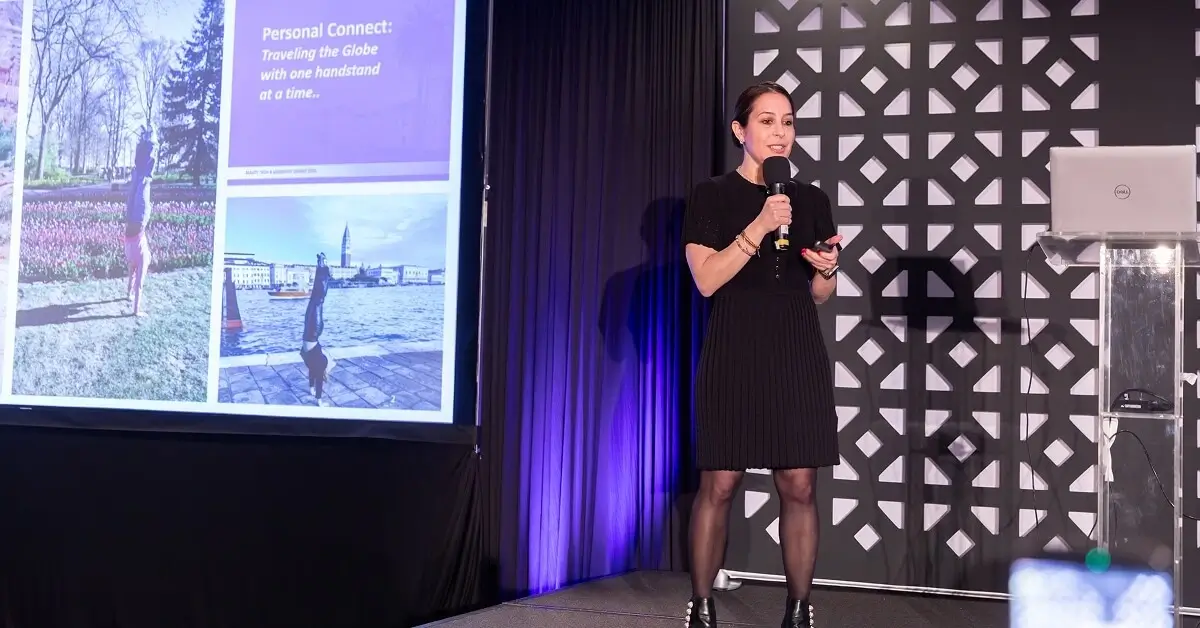
Alisar on what real skincare proof looks like
Notice what’s missing. There’s no reference to aesthetics, packaging, or storytelling. The core trigger is observable change. Consumers start a product, watch what happens over weeks, and make continuation decisions based on progress. That behavior mirrors how people approach fitness or nutrition programs: test, evaluate, adjust.
A defined time horizon turns a product into a program. It shifts the purchase from impulse to commitment. That is how longevity thinking enters mass beauty, through structured expectations and repeat evaluation.
The real shift, therefore, is not that consumers suddenly want to live to 120. It’s that they now approach beauty and wellness purchases with a performance mindset. They expect feedback loops. They expect progression. And they expect justification for staying.
That mindset scales. And when it scales, longevity stops being premium positioning and becomes standard decision logic.
From Anti-Aging to Bio-Optimization: The New Value Proposition
One of the strongest thematic connections across the Silicon Valley talks was how outdated the term “anti-aging” now feels. Speakers weren’t discussing wrinkle reduction as the end goal. They were discussing cellular energy, mitochondrial function, intercellular communication, and systemic resilience.
On the main stage, this was framed as an optimization problem, not a wrinkle problem:
“Longevity is a kind of a misnomer… It’s about aging intelligence… fundamentally about how do we optimize for structural vitality.” – Suveen Sahib Co-Founder & CEO, K18hair
That sentence quietly resets the value proposition. “Structural vitality” points to function and resilience first, appearance second. It also forces brands to talk in mechanisms rather than metaphors. Suveen went one layer deeper on what this demands from companies:
“The next… future is in companies that actually have a better understanding of biology than of branding.”
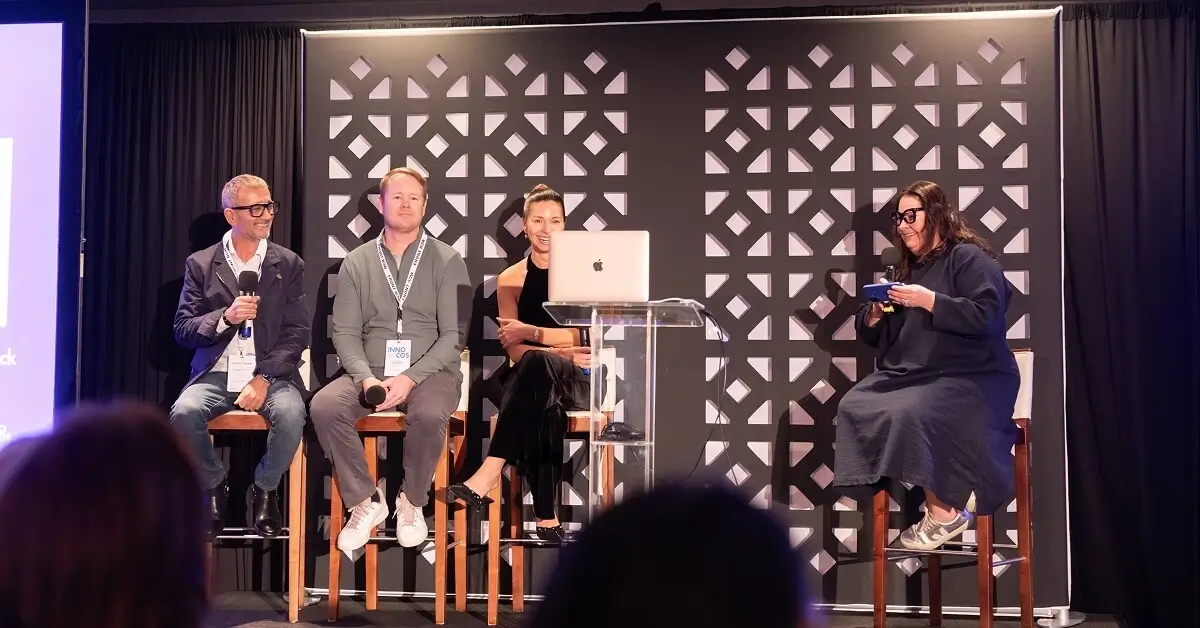
Suveen Sahib, Co-Founder & CEO, K18hair / Adam R. Jones, VP, Business Development, L’Oréal / Marina Kirschner, SVP, Global Head of Marketing, Moroccanoil / Kelly Kovack, Co-Founder & CEO, BeautyMatter
What “bio-optimization” actually looks like in practice
1) Fix the root cause, not one symptom
Victoria Vertesi (DeepSense Biotechnologies Inc.) argued that focusing on downstream symptoms (lines, dryness, dullness) misses the driver that makes “multiple systems fall apart at once.
“Circadian rhythms are your master regulator… the upstream regulator of all of the hallmarks of aging, including autophagy, mitochondrial cellular energy… inflammation.”
In other words, bio-optimization means fixing the root system, not chasing symptoms. That’s why the conversation is shifting toward basics that control everything else (sleep timing, recovery, metabolism, regulation) instead of jumping from one trending ingredient to the next.
2) Multi-pathway thinking becomes the default expectation
The Silicon Valley framing is moving away from “one hero ingredient solves one problem.” The more credible brands are building longevity claims around interconnected mechanisms and multiple biological levers working together.
That word – interconnected – is the point. It changes what “good” looks like in product strategy. A single-claim product can still sell, but it doesn’t meet the emerging standard for a longevity-positioned brand: consumers (and clinicians) are being trained to ask what pathway, what proof, what translation into function.
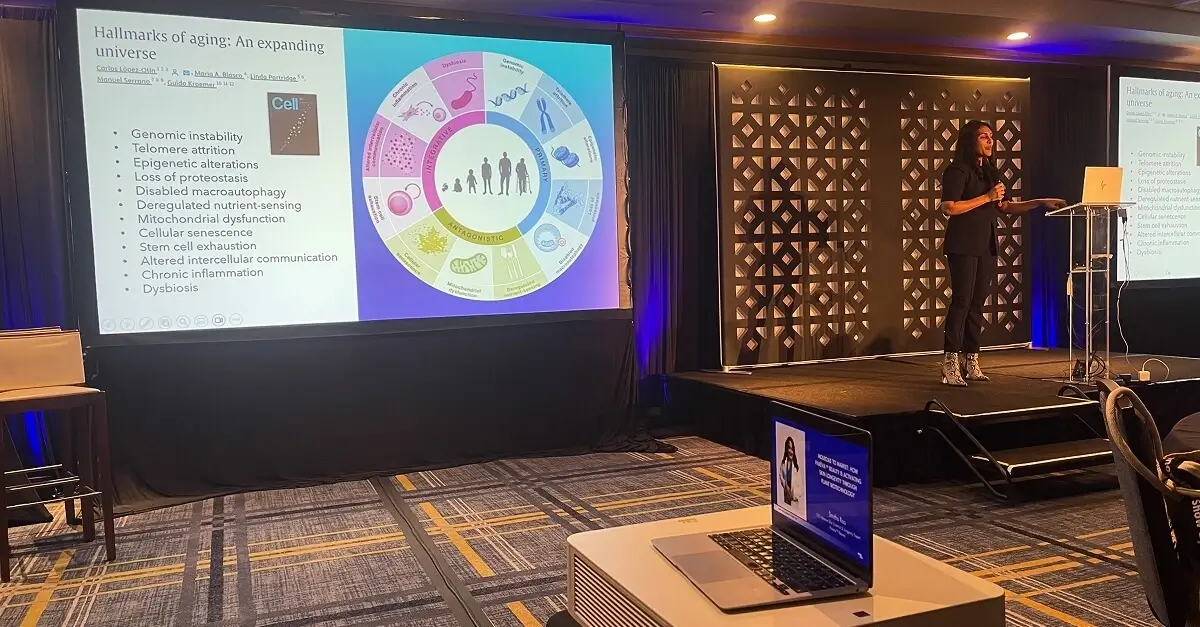
Saranya on cellular reset and skin longevity
You hear the same multi-layer logic in regenerative dermatology. Saranya Wyles (Mayo Clinic) describes how the hallmarks discussion quickly becomes a question of functional change, and why different hallmarks behave differently depending on where you intervene:
“Many of you are focusing on one hallmark, others are focusing on multiple hallmarks… the bigger question… is how is this driving functional change at the level of the skin.”
The Hallmarks of Aging
What this means for brands: your longevity story can’t hang on one fashionable mechanism anymore, because the framework itself has broadened. The hallmarks of aging have expanded from 12 to 14, with extracellular matrix changes and psychosocial isolation now recognized as part of the aging picture.
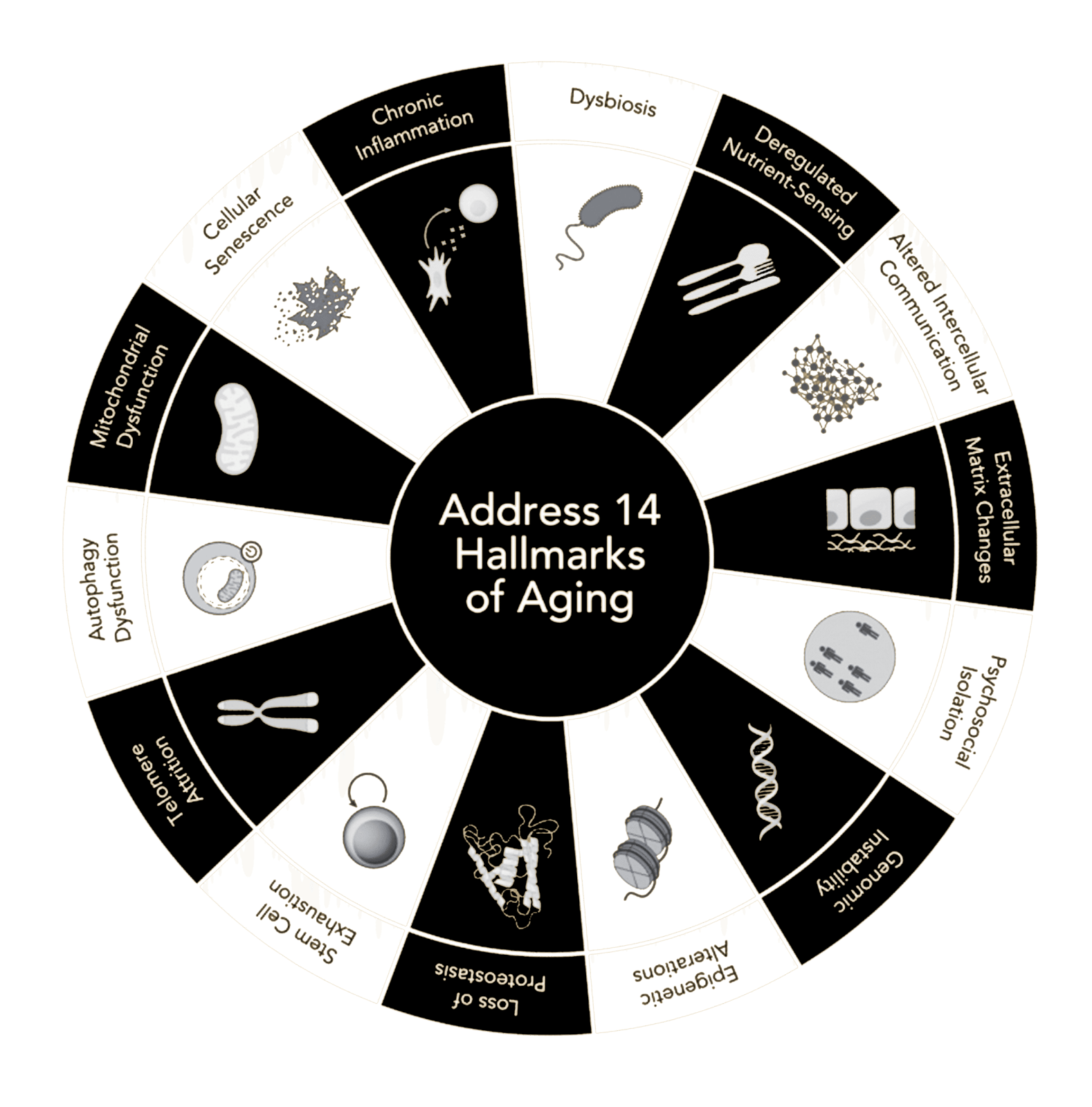
That matters commercially. It means aging is no longer framed only as a cell-level or molecule-level problem; it is increasingly understood as a structural, systemic, and even behavioral one. For brands, that raises the bar: a credible longevity position now has to connect the dots between biology, tissue function, environment, and daily life.
3) The proof standard starts drifting from “claims” to “measurement”
The Silicon Valley version of longevity has a higher entry price: you don’t get to “say longevity.” You have to show what you’re measuring, what changed, and why that change matters.
“Longevity… it’s not about who says longevity, it’s who can prove it.” – Carolina Reis Oliveira, OneSkin
She also described the new bar in practical terms: mechanisms + biomarkers + translation into clinical benefit, backed by statistically significant data and controlled studies. That’s a very different standard than “derm-tested” or “clinically inspired.
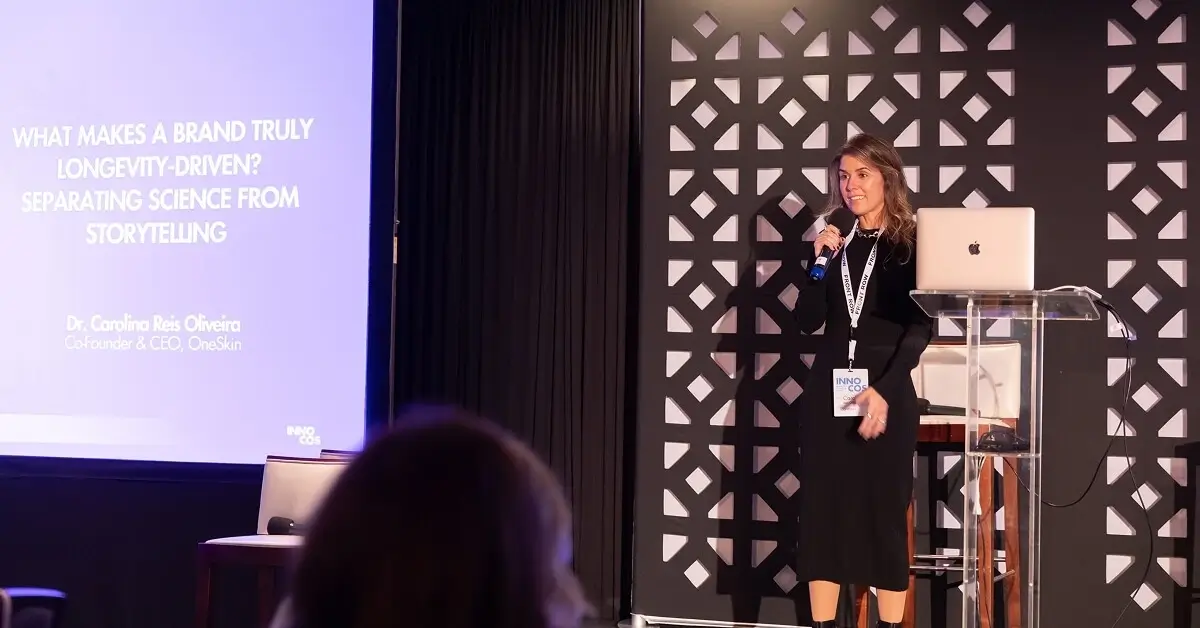
Carolina on senescence and the future of skincare
The Rise of Measurable Beauty: Biomarkers Enter the Chat
“I think it’s a trust signal when we tell consumers, we’re so confident in our product, we want you to use this test.” — Chris Maraboli, Founder & CEO, NOVOS
That sentence captures the shift. The category is moving from storytelling to verification. From claims to checkpoints.
The standard being described is specific: identify a biological mechanism, measure its impact at the biomarker level, and then demonstrate how that translates into a visible, functional improvement. That structure forces clarity. You can’t hide behind trend language if you have to define what changed.
When consumers understand modalities and mechanisms, superficial “clinically inspired” messaging stops working. The conversation becomes: what did you measure, and what moved?
Measurement also changes how success is framed. It’s no longer just smoother skin or better glow. It’s cellular senescence markers, inflammatory signals, mitochondrial function, vascular response. The visible result still matters, but it now needs a measurable backstory.
“We can actually measure the biological age of the skin… and we can see that this peptide can reduce the biological age of the skin.” — Carolina Reis Oliveira
How Evolut Uses UGC + Biomarkers
Measurement is powerful. But measurement alone doesn’t build belief. Translation does. That’s why we started integrating biomarker testing directly into UGC production.
Here’s how it works:
- We send the product together with a biomarker test kit to selected UGC creators.
- They run a baseline test before starting.
- They repeat testing at 30, 60, and 90 days.
- Only after that do they record their journey – covering lifestyle and what actually changed in the data.
The result is different from a traditional testimonial.
Personalization Becomes Infrastructure, Not a Premium Add-On
For years, personalization in beauty meant quizzes and shade matchers. Optional. Surface-level. Often cosmetic. That version of personalization is over.
What became clear across multiple panels is that personalization is shifting from a marketing feature to an operating system.
“Retailers really are on the front lines… They are closest to what people are actually doing, what they’re buying, what they’re searching, what they’re returning, what they’re repurchasing.” – John Caffarelli, Co-founder of BeautyMatter
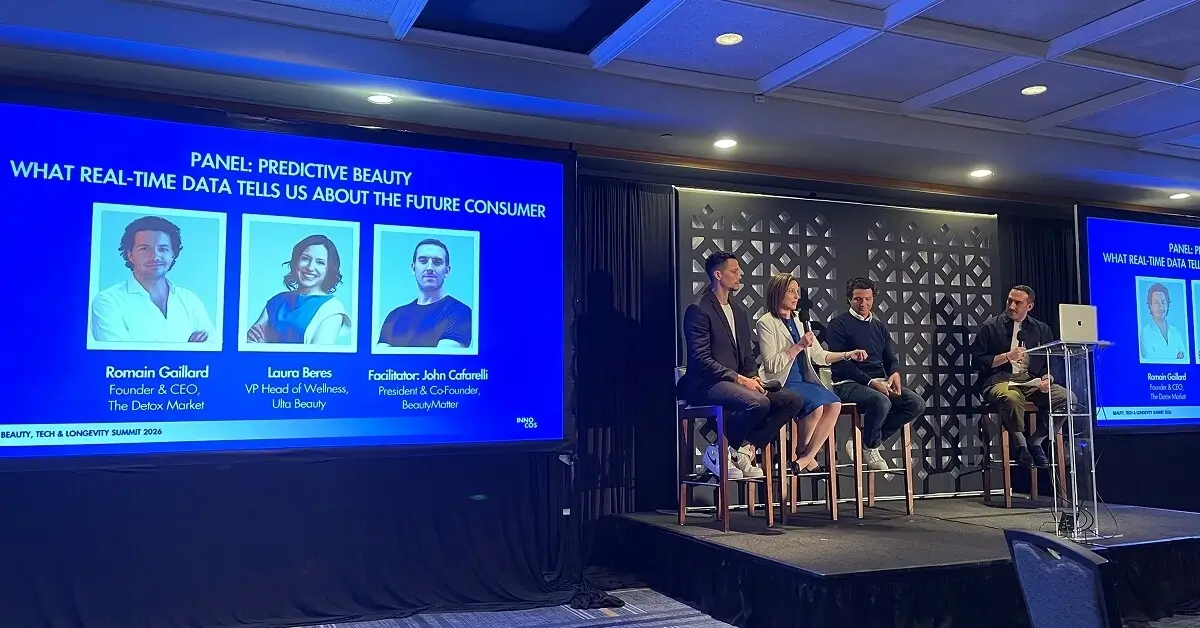
Chaz Giles, Co-founder of Alidalabs/ Laura Beres, VP, Head of Wellness, Ulta Beauty/ Romain Gaillard, Founder & CEO, The Detox Market / John Cafarelli, Co-Founder & President, BeautyMatter
When 46 million loyalty members at Ulta Beauty represent 97% of sales, personalization is not a nice-to-have. It’s a data architecture.
This same infrastructure logic appeared in longevity brands.
“We also have a mobile app called Novos Life… AI-powered and gives you personalized guidance through the lens of longevity, and we have biological age testing.” – Chris Maraboli, NOVOS
That’s not personalization as content. That’s personalization as a product layer. Then the AI discussion took it further.
AI as the Invisible Layer of Longevity
AI wasn’t presented as hype. It’s already part of how longevity brands build and test their products. In most cases, customers don’t even see it, but it’s helping brands develop products, analyze data, and make decisions faster.
Chaz Giles from Alidalabs described the gap clearly:
“It is not perfect… It is not going to replace the people that you have in your product teams. It’s going to augment them… it is 100% better than the processes that you are running today.”
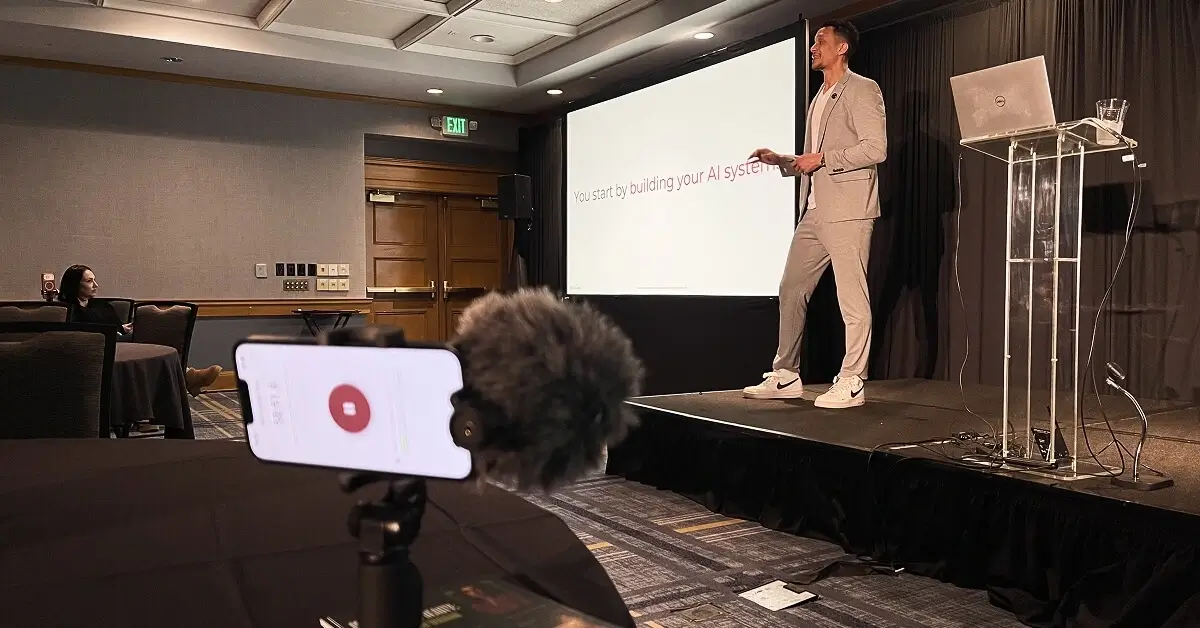
Chaz talks about the AI disruption in beauty product development
He walked through how AI is now able you to formulate products based on social signals:








This changes the speed of product development. Months become minutes. It’s here to make scientists or product teams faster and sharper.
The End of Single-Ingredient Thinking
The “hero ingredient” era is over. For years, beauty cycled through actives: ceramides, peptides, retinol, exosomes. Each year, a new molecule. Each year, a new promise.
But multiple speakers pushed back on this pattern.
“We are going to see a lot of story-driven claims that are just swapping the anti-aging word for longevity… They continue to chase the ingredient trends.” — Carolina Reis Oliveira, OneSkin
Her point was structural: longevity cannot be reduced to one molecule. Aging is driven by interconnected biological mechanisms, now recognized as 14 hallmarks, not 12.
If aging is multi-pathway, solutions must be multi-pathway too.
From Ingredient to Mechanism Stack
Carolina outlined three requirements for a true longevity brand:
- Target a biological mechanism of aging
- Show measurable impact on biomarkers
- Translate that into clinical outcomes
That already moves beyond “we added X% of trending ingredient.”
But the more interesting shift came from formulation logic.
In her presentation, Carolina showed that one version of their formula actually performed worse than doing nothing. Even though it contained their hero peptide. Only after testing different combinations did they find the version that improved skin health markers.
That’s the quiet risk of single-ingredient thinking. You optimize the headline molecule, but ignore system interaction.
Biology Is a System, Not a Slot Machine
Elsa Jungman, CEO of HelloBiome framed it even more directly:
“Stop thinking only about an active… try to think first about a system.”
Elsa used the microbiome as an example of how beauty longevity marketing often moves in waves. First it was “probiotics.” Then “prebiotics.” Then “postbiotics.” Each new term replaced the last as the headline ingredient, even though the underlying biology didn’t change.
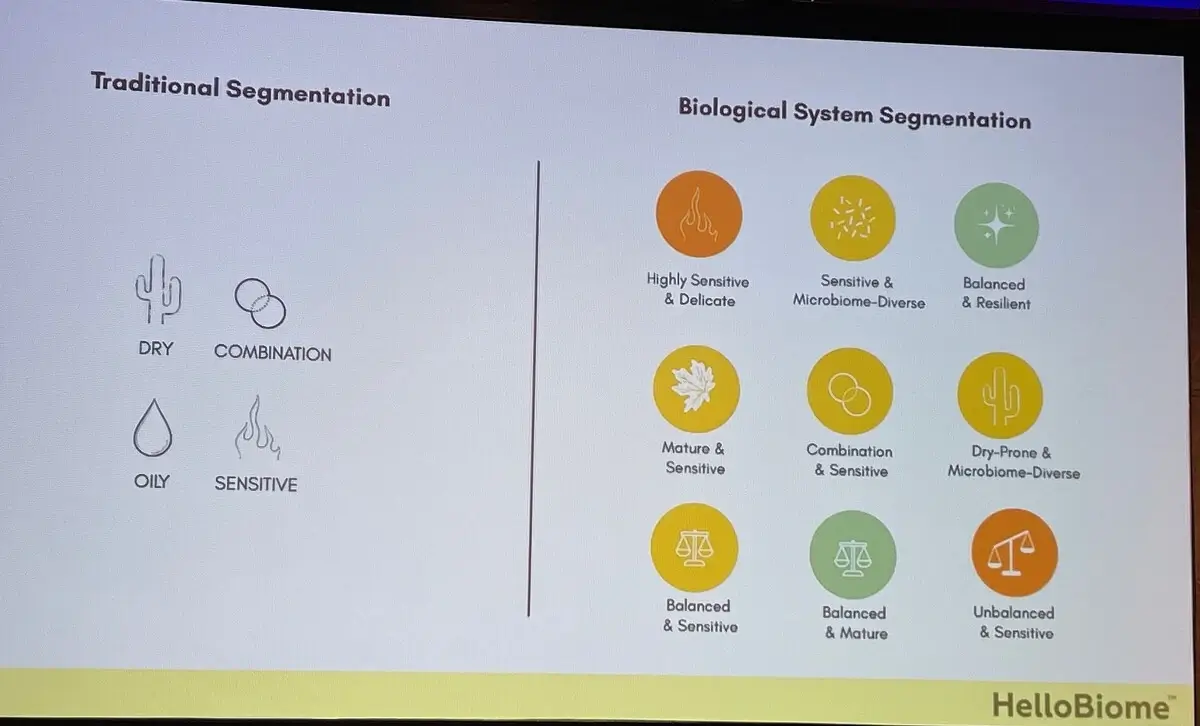
Elsa’s slide about segmentation differences now vs. previously
But the microbiome isn’t one ingredient. It’s an ecosystem.
The shift now is toward treating skin like a system, not a shelf of ingredients.
That means asking:
- Is the skin barrier strong?
- Is the microbiome balanced?
- Is inflammation under control?
- Are skin cells communicating properly?
Because if your barrier is damaged, your microbiome shifts. If your microbiome shifts, inflammation rises. If inflammation rises, collagen production drops.
Science vs. Storytelling
The center of gravity has shifted.
For years, beauty brands competed on narrative: founder story, emotional positioning, aesthetic codes, community energy. Clinical claims were supporting assets.
That order has changed.
Science is no longer the backup slide in the pitch deck. It is the product.
“Clinical is not a claim… Marketing comes after… but we need to make sure there is something very unique differentiated through the scientific data.” — Stéphane Colleu, CEO, Dr. Brandt
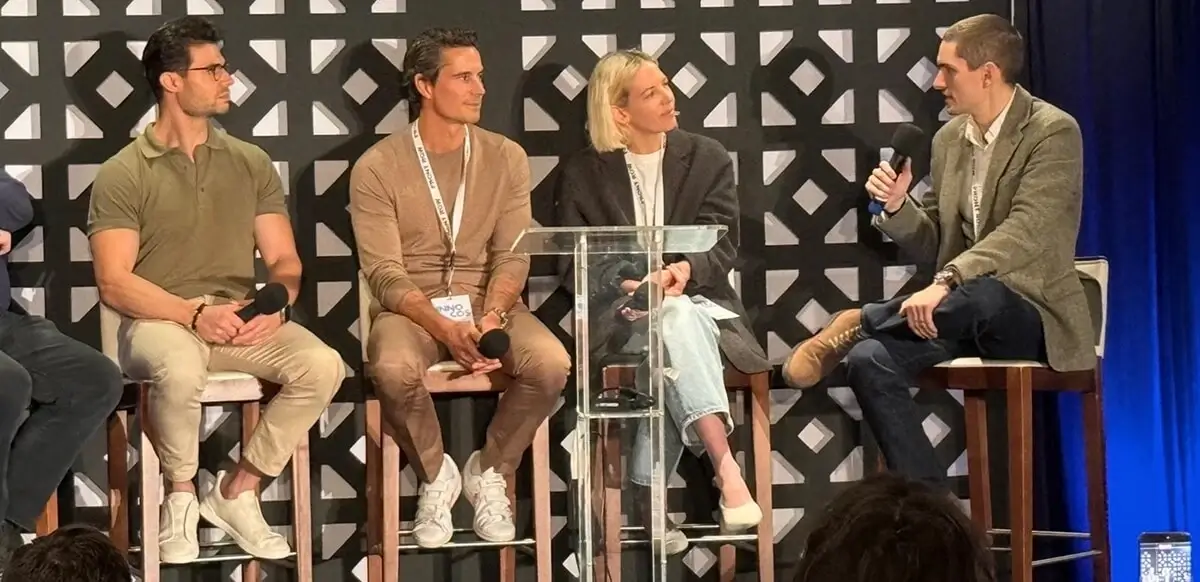
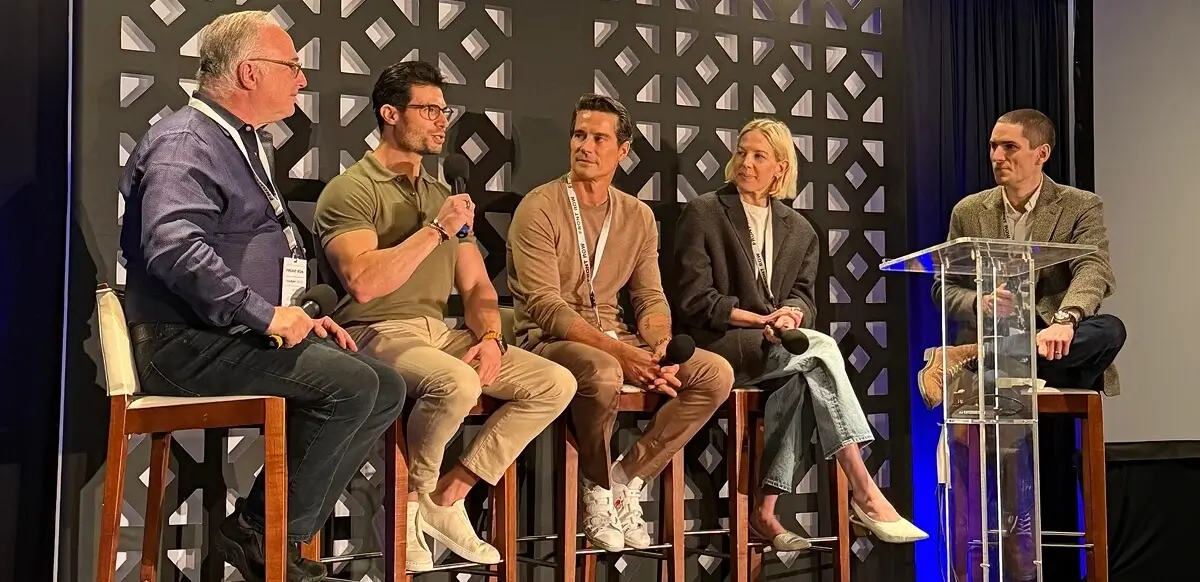
Dr. Kevin Slawin, Founder & CEO, Ponce Aurora – YUUTH skincare / Chris Mirabile, CEO, Novos Labs / Stéphane Colleu, President & CEO, Dr. Brandt Skincare / Dr. Eve Lofthus, Founder, EVENMOUTH / Zsolt Farkas (me), CEO, Evolut
That sentence captures the hierarchy change. Marketing doesn’t create differentiation. It amplifies what is already differentiated in the data.
At the same time, the bar is rising.
“Longevity… it’s not about who says longevity, it’s who can prove it.” — Carolina Reis Oliveira
This is the new trust equation:
- Story gets attention.
- Data earns credibility.
- Measurable results sustain loyalty.
The market is becoming fluent. Consumers understand biomarkers. They scan ingredients. They ask about mechanisms. They expect to see instrumental data, not just before-and-after photos.
The danger for brands is not a weak narrative. It is “narrative inflation”. If you say more than you can prove, trust disappears fast. And in a longevity category built on long-term commitment, trust erosion is fatal.
What becomes powerful now is alignment:
- Target a real biological mechanism.
- Show measurable impact.
- Translate that impact into outcomes people can feel and track.
Then tell the story. Not the other way around.
What This Means for Beauty & Supplement Brands
The longevity shift is not cosmetic. It changes how you build, validate, price, and scale products. Here’s what actually matters now.
1. Stop Selling Ingredients, Start Selling Mechanisms
If your hero message is:
- “Now with exosomes.”
- “Powered by NMN.”
- “Contains peptides.”
You are competing in a trend cycle.
Instead, articulate:
- What biological mechanism are you targeting?
- Why does it matter in the aging cascade?
- What measurable change should happen?
Carolina made the structure explicit: target a hallmark, measure the biomarker, and translate that into a clinical benefit. That logic should become the template for every product brief.
In practice, that means rewriting your PDP so it clearly communicates four things: (1) the mechanism behind the product, (2) the measurable change it is designed to drive, (3) the expected time horizon, and (4) the visible outcome the consumer can look for.
If you cannot fill those four fields cleanly, your positioning is weak.
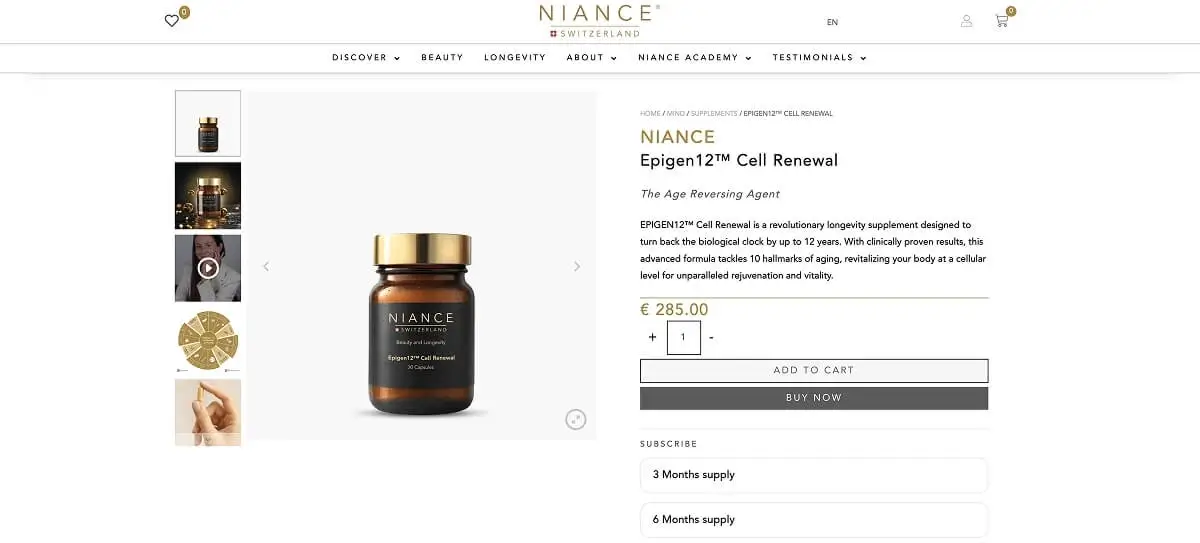
Niance Switzerland PDP as an example of how longevity science can be translated into commerce
2. Validate the Finished Formula, Not Just the Star Ingredient
One of the most overlooked insights from the stage: ingredient interactions matter.
For example, Alisar Zahr (Revision Skincare) emphasized that targeting multiple hallmarks of aging requires precise formulation logic, not just stacking actives. Her team validated mitochondrial support, microbiome balance, and intercellular communication through controlled testing before moving forward with clinical claims.
That’s a brutal reality check.
You cannot assume: Good ingredient A + Good ingredient B = Better result.
Your validation checklist:
- Test the full formulation.
- Test stability.
- Test penetration.
- Test interaction effects.
Especially in supplements, stacking without synergy validation is a retention risk.
3. Embed Measurement Into the Experience
Consumers are increasingly tracking their health through biomarkers, wearables, sleep data, and metrics like VO2 max. If your brand doesn’t offer baseline guidance, clear checkpoints, and a way to frame improvement over time, it risks feeling disconnected from how the longevity consumer already thinks and behaves.
You are leaving retention on the table.
What to implement next:
- 30/60/90-day expectation framing
- Optional biomarker integrations
- Guided protocols instead of one-off SKUs
This shifts you from product brand to performance partner. Chris Maraboli (NOVOS) described how they approach this:
“We offer a biological age test… A small minority of customers actually use this, but I think it’s a trust signal when we tell consumers we’re so confident in our product, we want you to use this test.”
4. Marketing Must Follow the Data
Stéphane’s point was simple: marketing should amplify evidence, not replace it. In longevity, that order matters more than ever. When distribution scales faster than proof, the brand may grow quickly, but trust becomes fragile.
Before you scale paid acquisition, validate this:
- Pressure-test your claims
- Review your clinical language
- Remove vague superiority messaging
Because once you amplify a weak claim, you don’t just waste ad spend. You accelerate skepticism. And in longevity, skepticism compounds faster than trust.
If your growth engine is stronger than your validation engine, your brand becomes fragile. If your validation engine is stronger than your growth engine, your brand compounds.
That’s the difference between short-term sales spikes and long-term category leadership.
5. Expect Retail to Raise the Bar
Retail buyers are evaluating hundreds of brands annually. Clear differentiation and strong fundamentals matter.
How to Get Into a Major Retailer Like Ulta Beauty
Laura Beres (VP, Head of Wellness, Ulta Beauty) made it clear for me during our interview that Ulta rewards brands that arrive with a clear story, operational readiness, and real market fit. With over 2,500 brands reviewed each year, buyers look for a (1) founder with a compelling and authentic story, (2) a sharply defined target consumer, and a (3) clear point of difference that can be explained in one sentence.
Just as important are the business fundamentals: operational readiness, the ability to scale, and the infrastructure to support growth once the brand lands on shelf across many stores at once. In that environment, clear differentiation, commercial viability, and confident execution are what get a brand in and keep it there.
She emphasized that there’s no fixed revenue or funding threshold to enter Ulta. What matters more is whether the brand is ready for that stage of growth.
Longevity positioning alone will not open doors.
You need:
- Clear story
- Clear target consumer
- Clear proof stack
- Operational readiness to scale
- And a freaking solid science and business deck
Recently, I helped one of our clients get in touch with a GCC distributor. The distributor’s first question was whether there was a solid pitch deck with all the supporting data – otherwise, I shouldn’t even make the introduction. Fortunately, this client had a rock-solid one.
What your retail pitch must include:
- Mechanism targeted
- Validation method (in vitro, clinical, instrumental, peer-reviewed, etc.)
- Clinical or measurable outcomes
- Repurchase logic (protocol structure, time horizon, subscription model)
If they cannot understand your differentiation in one slide, you don’t have differentiation. So make it impossible for a buyer to ask: “But why will this sell?” Instead, answer it before they do.
Summary
Longevity is moving fast, but the winners won’t be the loudest brands. They’ll be the ones that build real proof, translate it into simple customer checkpoints, and package it into routines people can actually stick to.
If there’s one takeaway from INNOCOS Silicon Valley, it’s this: in beauty and supplements, trust is becoming measurable and brands that treat measurement, personalization, and integration as infrastructure will compound while everyone else keeps chasing the next ingredient trend.