


INNOCOS Paris. April 17. A room full of founders, investors, R&D directors, and clinicians who collectively run or advise some of the most important brands and funds in this space.
Across twelve hours of programming – from Euromonitor’s market data to Alida Labs’ AI workshop to a fireside with Joël Palix on capital – the same arguments kept showing up.
The beauty and longevity industries are not converging. They have already converged. The question now is who has the structural depth to survive the collision.
Here’s what the industry needs to hear.

Pullman Paris Montparnasse Hotel
#1 Trend: Longevity Washing Is the New Greenwashing
The word “longevity” appeared in almost every session. Some used it to describe real epigenetic science. Others used it because “anti-aging” had started to sound dated.
That gap is dangerous, and several people on stage said so directly. “We are past the longevity washing,” said Renée Fitton, VP at L-Nutra, who comes from a company with 140 patents and 45 clinical trials behind their protocols.
“People are already sick of this term, and so we do have to be very, very cautious about how we’re leveraging it.”

Renee Fitton, MS RD – Vice President of B2B Sales & Growth, L-Nutra / Dr. Peiwen Sun, Chief R&D and Innovation Officer, Proya Cosmetics / Dr Christine Pfeiffer, Medical Director, Longevity Center Switzerland / Facilitator: Kelly Kovack, Founder & CEO, BeautyMatter
Susie Willis, founder of The Biology of Beauty by Romilly Wilde, was more pointed.
“It’s not a marketing descriptor. It’s a biological claim, and we must treat it as that. If we’re not measuring longevity, then we don’t really have it as a claim. It will be disbanded.”
The Global Wellness Institute already named longevity fatigue one of their key trends for 2026, which was referenced in the morning’s “Luxury Has Shifted” panel. Gérôme Guiot of LVMH put it plainly:
“Is this a fad or something which is gonna be in the long term? That’s our job as well, to make sure this is a long-term thing.”
What the data shows is that the brands doing the right work – clinical-grade testing at the finished product level, not just ingredient data or perception trials – are the ones holding retention. Skin Diligent‘s Tule Park noted that their repurchase rate across 26 products averages 60%, with their bestseller at 80%. That is not driven by packaging. That is driven by trust built through a decade of epigenetic research and disciplined claims.

Tule Park, Co-Founder & CEO, SkinDiligent / Catherine Rochat – CEO, CRB Cosmetics / Gregory Gazagne, Director, Telostim, CEO IDEC Therapeutic / Kishan Babuji, CTO, IRI-Sys / Facilitator: Anna Vovchok, Chief Strategy and Brand Officer, Ponce Aurora
What this means for you: If you are a DTC founder positioning around longevity without molecular-level efficacy data to back it up, you are building on sand. The consumer is testing your formula in ChatGPT. Your competitors are filing patents. The regulatory environment will follow. Get your claims audit done now, not after you scale.
#2 Trend: The Shift from Perception Trials to Biological Proof Is Not Optional
Susie Willis opened her session with a provocation that landed hard: most skincare brands validate perception. Almost none validate biology.
“A lot of skincare brands are talking about the fact they have clinical evidence, and a lot of that often is just user trials and perception trials. But that’s just perception. How are you testing biology?”
Willis’s brand uses Oxiproteomics, a Paris-based lab that measures oxidative protein damage at the molecular level – testing both isolated ingredients and finished formulations to confirm that active compounds survive the manufacturing process at sufficient potency.
Catherine Rochat, CEO of CRB Cosmetics, made the same point from the formulation side.
“We need to design the formula with intention. We need to build the architecture of the formula so that we are sure that the final ingredient is delivered at the right place, at the right time, and to the right people.”

The mechanism matters. The delivery system matters. An ingredient at one or two percent of the formula tells you almost nothing about what the other ninety-eight percent is doing to your cells.
Think about it this way: if a brand puts a hero ingredient on the front of the bottle at 2%, what’s in the rest? Fillers? Preservatives? Synthetic fragrances? The “active” ingredient might do exactly what the marketing says, but if the rest of the formula is working against your skin biology, you’re cancelling out the benefit. Possibly making things worse.
As Tule Park argued:
“If you are going to add one epigenetic ingredient at 1% or even 2%, what is the 98%, 99% of the product doing to your skin cells? That does not answer the epigenetic cellular terrain.”
This is the bar that clinical-grade brands like OneSkin – referenced by Arnaud Auger in his opening talk – are setting. OneSkin spent seven million dollars on peptide research before they launched a single product. Joël Palix, veteran investor and former CEO of Feelunique, confirmed the shift from the capital side at the investor session:
“Right now, patents, technology, IP is gaining importance in the eyes of investors, definitely.”
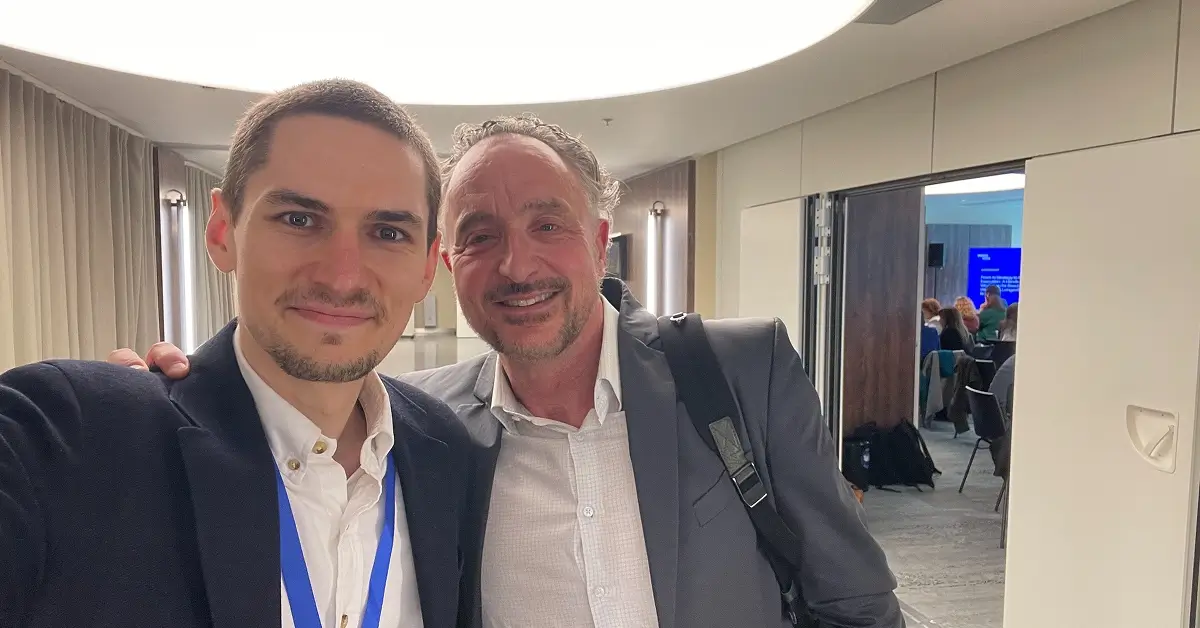
After our investment panel with Joel
What this means for you: Your testing hierarchy needs to evolve. Ingredient-level data, finished product testing, and mechanism-of-action validation are the new minimum. Perception panels are a cherry on top, not the foundation. If you cannot answer the question “what is the biological change in the tissue?” – your longevity claim will not survive the next two years.
#3 Trend: Agentic AI Is Replacing Human Workflows
The afternoon AI workshop delivered by Chaz Giles of Alida Labs was one of the most practically dense sessions of the day, and the numbers he used to frame the opportunity were not soft projections.
Global investment in AI hit $300 billion in 2025. Over 80% of Fortune 500 companies piloted AI that year. More than 60% of them were struggling to get results, not because the technology doesn’t work, but because they started with the technology instead of the problem.
Chaz’s framing was clean:
“Everything you see in AI right now, today, is the worst that it will ever be going forward.”
The specific shift he identified as the one brands need to understand immediately is the move from generative AI as a content tool to agentic AI as a workflow replacement. An agent is not ChatGPT. It is an LLM given a set of tools, access to your inbox, your CRM, your Shopify backend and a set of instructions. It executes tasks autonomously.
The sales prospecting demo Alida ran live in the room used Claude Cowork to read a sales deck, access a co-founder’s LinkedIn profile, scan a second-degree network of over 100,000 connections, identify the highest-fit leads by persona and pain point, and draft personalized outreach emails that referenced each prospect’s recent activity. What that typically takes a sales team thirty minutes per lead to do manually now runs in the time it takes to make a coffee.
The business intelligence case study was more immediately relevant for DTC brands. A direct-to-consumer company was running all of their sales data through Excel with a junior analyst producing basic SKU-level reports. When an AI data analyst agent was deployed, it revealed that their gifting discount was producing LTV that was 40% lower than baseline with no promotion. Their auto-discounts were destroying margin. Their subscription customers, who on the surface appeared to have lower average order values, were actually their highest-lifetime-value segment because of purchase frequency. None of that was visible in a spreadsheet.

Chaz Giles, Co-Founder & CEO, Alida Labs
“The question is not whether you are going to be using AI. The question is whether your team and your data are keeping pace,” Chaz said.
What this means for you: The entry point for agentic AI is not an enterprise software purchase. Claude Cowork, which Alida demoed running locally on a laptop against a personal LinkedIn and a sales PDF, is already available. The constraint is not the technology. The constraint is building the right use case hierarchy – starting with the workflow that, if automated, would generate the most measurable business value – rather than experimenting randomly with thirty different tools. Map your workflows first. Then select the AI.
#4 Trend: Authority in Longevity Is Fragmented
One of the sharpest panels of the day was the afternoon session on luxury across generations, facilitated by Chloé de Ruffray with Esther Moisy-Kirschbaum from Magma and Yasmine Zemrani from LVMH Perfumes & Cosmetics.
The core argument: authority in longevity used to belong to institutions – doctors, universities, labs. It no longer does. It now sits across three fragmented territories: founders who self-experiment publicly (Brian Johnson, Huberman), platforms that accumulate and personalize data (Oura, Whoop), and increasingly, the consumers themselves.
“Who do we actually trust in this space? There’s no single owner,” said Esther. “It used to be pretty clear-cut. And today, everyone has access to their own legible metrics and their scoreability.”

Facilitator: Chloé de Ruffray, Foresight Consultant and Co-Founder, Longevity Culture Club / Yasmine Zemrani, Consumer Insights & Strategy, LVMH Perfumes & Cosmetics / Esther Moisy-Kirschbaum, Head of Content, Magma & Oblique Forecasting
The market signals are unambiguous.
- Kering has partnered with L’Oréal to focus on wellness and longevity.
- LVMH has moved into sports.
- Dior just opened its first permanent spa in the United States, embedded inside a flagship store, with a science-driven treatment menu.
Euromonitor‘s Fflur Roberts confirmed that luxury beauty reached $64 billion in 2025, growing at 4%, and is the second-fastest category in personal luxury behind wearables – with 19% projected growth over the next five years.
But the risk is real. Yasmine Zemrani observed that in France specifically:
“The medical system is in crisis and it’s quite disconnected from the longevity philosophy. In this strong disconnection, luxury brands have a role to play by building R&D to be trusted sources.”
The brands that will own this authority are not the ones that add longevity to their tagline. They are the ones building educational platforms – the kind of intimate masterclass format described by Andrea DiNunzio of Coty, where 18 people gathered with pen and paper to learn about regenerative beauty from a dermatologist and an aesthetician. That room does not need mass reach. It needs depth.
“The magic of the brand is in the in-between, where you’re delivering access to information experiences that otherwise they wouldn’t have the ability to attend or be introduced to,” Andrea said.

Andrea DiNunzio, General Manager, Ultra-Luxury Skincare and Fragrance, Coty / Virginie Couturaud, Scientific Communication Director, Parfums Christian Dior / Arnaud Autret, Investment Director Europe, L’Oreal BOLD
What this means for you: If you are a founder without the Dior budget, the architecture of trust-building is still available to you. Curated, science-led experiences – even at 20 people – build the kind of authority that no paid media budget can shortcut. Your KOL strategy should be shifting toward credentialed experts who can sit in a room and answer hard questions, not just post before-and-after content.
#5 Trend: The DTC Retention Crisis Is a Structural Problem, Not a Campaign Problem
The afternoon panel on zero-party data and the retention flywheel, led by Emma Powell and Heidi Henneman of Groa with Aoife Teague of Octane AI and Polly Barnfield, surfaced a number that reframes the entire DTC growth model.
In 2025, e-commerce generated $6 trillion in revenue. In that same year, $4.8 trillion was lost to churn. 70% of customers who make a first purchase never come back. Most brands are running at full speed while their growth is entirely replacement – acquiring new customers at rising cost to replace the ones bleeding out the back of the funnel.
Emma’s intervention is to treat this as an economics problem, not a campaign problem.
“Your existing customers are worth 7-9 times more to you than a new customer.”
The mechanism Groa has built uses Octane AI’s quiz infrastructure to collect zero-party data – age, skin concerns, purchase goals, lifestyle signals – and routes that data bidirectionally into a live email and SMS ecosystem. Not batch-and-blast. Actual personalization at segment level: a customer who identifies pigmentation as their primary concern receives a completely different post-purchase journey than one who flagged texture.
The results are measurable. Brands that implement this model – with fewer than five well-integrated apps in their Shopify stack rather than the average twenty-plus siloed tools – move into the top 10% of profitability on DTC economics.

Emma Powell, Founder & CEO groa° / Heidi Henneman, Co-Founder & CMO, groa° / Aoife Teague, Director of Partnerships, OctaneAI / Polly Barnfield OBE – Founder and CEO Maybe*
Polly Barnfield from Meyer, who has advised the UK government on how agentic systems should behave in practice, noted that fewer than 8% of brands have actually embedded AI into their workflows rather than just using it to ask questions. The companies that Groa has built agentic retention systems for are now running 300-variable physics calculations to identify funnel leaks automatically, rather than spending 80 hours per month manually pulling reports from disconnected platforms.
“Think about a flywheel,” Emma said.
“If you start thinking about a flywheel – Apple, Amazon, Disney – you think about how successful those businesses are. Why shouldn’t that model work for connected commerce?”
What this means for you: Stop measuring retention as a monthly aggregate number and start mapping the specific lifecycle moments where your customers exit. The quiz is not a marketing gimmick – it is the first data collection moment that enables everything downstream. If your quiz data is not flowing bidirectionally into your email platform, you are collecting intelligence you are not using.
#6 Trend: Beauty Becomes the Front Door to Longevity
The most important shift in beauty isn’t happening inside beauty. It’s happening at the edge, where skincare meets supplements, wearables, diagnostics, fragrance, textiles, and devices.
Arnaud Auger, Director at Cathay Innovation, made the case directly. Skin longevity has already moved beyond cosmetics. The category now spans every product that touches the body. The biology underneath is the same. What changes is the storytelling.
“Luxury brands integrate them to enhance mystique. Premium brands integrate them to enhance performance credibility. Different storytelling. Same biology.”
His personal story made the point land. Seven years ago, Auger was obese, pre-diabetic, insulin-resistant and at 29, had a biological age of 36. He was eating well, working out, doing everything right, and still aging faster than his peers.
He applied what he called the Silicon Valley principle: you can’t improve what you don’t measure. Blood tests. Whole genome sequencing. Gut microbiome. VO2max. Continuous glucose tracking. The result: 25 kilograms lost, pre-diabetes reversed, biological age now 14 years younger than chronological. Marathons on four continents. Qualified for the Spartan World Championship.

Arnaud Auger – Director & Deputy Head, C.Lab, Cathay Innovation
What this means for you: Skin is the first visible signal of aging. That’s why vanity is the most powerful entry door into the broader longevity journey. Reduce wrinkles, and the consumer eventually has to sleep better, eat better, manage stress, balance hormones. The skincare consumer becomes a longevity consumer whether they planned to or not.
That’s exactly why L’Oréal repositioned from cosmetic manufacturer to longevity company. According to UBS data Auger cited, the global longevity industry is projected to reach $8 trillion by the end of the decade, currently the only sector growing faster than tech.
#7 Trend: The Investor Logic Has Shifted
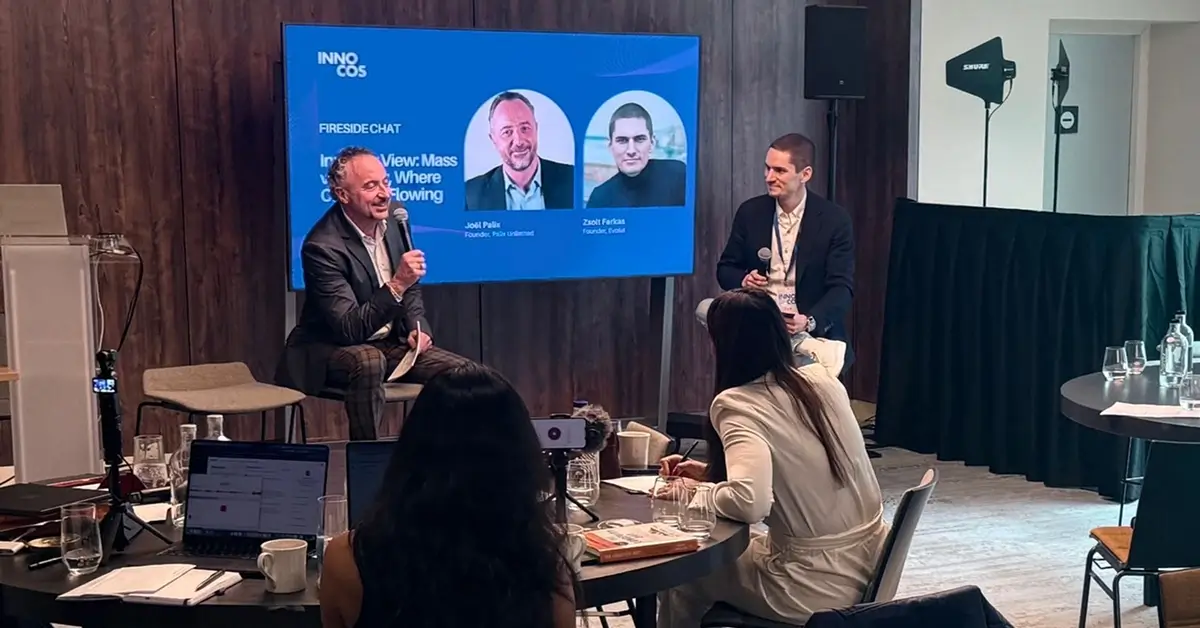
Joël Palix spent thirty years running major beauty businesses before founding Palix Unlimited and taking board seats at brands including Secret de Lully and BDK Parfum. His conversation with me at the investor session was the most direct account of where capital is flowing right now.
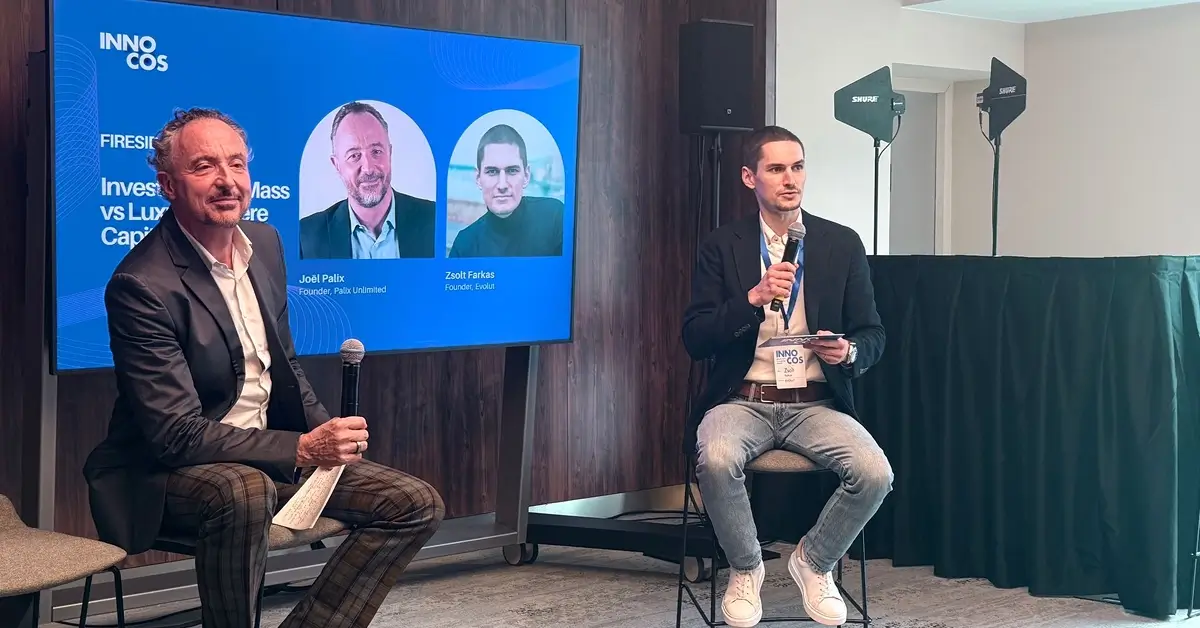
Beauty investment panel with Joel and Me
The DTC playbook of five years ago – good product, nice packaging, strong community, seed funding – is gone. “Today it’s much more selective, way more complicated.”
For beauty brands, the primary signal investors are looking for is proven retention. Not traction. Retention.
“I think someone was mentioning a 60% retention rate. If you have a business that is small but with 60% retention rate, it’s extremely attractive.”
For longevity brands specifically, Joël is looking for evidence of habit formation – subscription models that demonstrate a customer has been hooked into a behavioral pattern with lifetime value that exceeds acquisition cost. The strategic acquirers come in around $20 million in revenue. The funds want to see you already at meaningful scale with a clear international story.
On pre-market R&D investment: science is now an asset, not just a cost.
“Right now, patents, technology, IP is gaining importance in the eyes of investors, definitely.”
But the trap Palix warned against is overspending on science before proving consumer acceptance – He referenced a beauty tech company that spent four years building technology and running clinical tests with zero revenue. When he tried to raise from consumer funds, they walked away – to them, the business looked old without the sales to justify it.
The advice on AI investment was pragmatic and somewhat contrarian:
“AI, pure tech is of great interest to investors. But it’s a bit at the border of what they can do in terms of due diligence. Beauty tech is hard to finance because it falls in the cracks between consumer funds, tech funds, and health funds.”
What this means for you: Build your data room around retention cohorts, not top-line revenue. If you are raising, your single most powerful slide is one that shows that the customers who stay are staying longer and spending more across repeat purchases. Patents and clinical studies are multipliers, not replacements, for that proof. And if you are building in AI, make sure you can explain to a generalist consumer fund what problem it solves for the customer, not just how technically sophisticated it is.
The Pattern
Every session at INNOCOS Paris 2026 was, ultimately, a version of the same argument.
The beauty consumer has arrived at the intersection of biology, technology, and self-agency faster than the brands selling to her. She is scanning formulas, tracking biomarkers, mapping her immune code, asking AI systems which discount tier actually improves her lifetime skin health. She is not impressed by longevity language. She is looking for longevity proof.
The brands that will matter in five years are not the ones with the most categories or the loudest launch campaigns. They are the ones that decided to be honest about what they can measure, rigorous about what they claim, and serious about building systems – AI-powered retention systems, clinical validation systems, immune profiling partnerships, epigenetic testing protocols, that actually compound over time.
The bar is moving. The question is whether you are building toward where it is going, or defending where it was.


