Brand positioning is the foundational system. Performance amplifies brand positioning. It does not replace it.
The Performance Marketing Trap
Many founders think they have a media buying problem when they actually have a brand positioning problem. Beauty, supplement, and longevity brands eventually hit a scaling wall: (1) CAC climbs, (2) retention softens, and (3) creative half-lives shrink – the ad set that worked for six months last year now needs a refresh every three weeks. The team starts producing more ads, more creator content, more testing, and more channel activity just to maintain the same growth curve.
The reflexive response is to push harder on the levers that are already underdelivering. But scale rarely outworks diminishing returns.
“Performance marketing is amplification infrastructure.“
It can move money and attention, but it cannot manufacture the relevance and meaning that turn impressions into preference and preference into loyalty.
When brand positioning is weak or outdated, marketing channels have to work harder.
- Creative gets tired faster because there is no strong idea behind it.
- CAC goes up because people ignore brands that sound like everyone else.
- Retention drops because customers have no real reason to come back, except for the next discount.
This article is about what sits beneath all of that. The strategic layer that determines whether your channels compound or burn cash.
Brand Positioning Is the Foundational System
The word “brand” has been narrowed in much of founder vocabulary. In classic marketing strategy, brand is not just what a company looks like – it is the meaning, associations, and position a company occupies in a category and in the consumer’s mind.
Today, it is often reduced to creative output: (1) visual identity, (2) campaign assets, (3) packaging, or the (4) tone of an Instagram caption. Those expressions matter, but they are downstream. They treat brand as an aesthetic layer applied at the end of the marketing process, rather than the strategic architecture that should be guiding it.
The real work of brand sits much earlier and much deeper. Brand positioning is the strategic architecture that determines what the entire marketing system is allowed to say, who it is designed to say it to, and what the audience is meant to feel and believe as a result.
It is not a layer applied after the channels are built. It is the foundation the channels are built on.
This distinction matters because it is the difference between performance marketing that compounds over time and performance marketing that erodes over time. Strong positioning makes the brand easier to recognize, remember, and choose. It is what gives creative more conceptual range to work with – room to extend a coherent idea rather than starting from scratch every time. And it is what makes retention something other than a discount strategy.
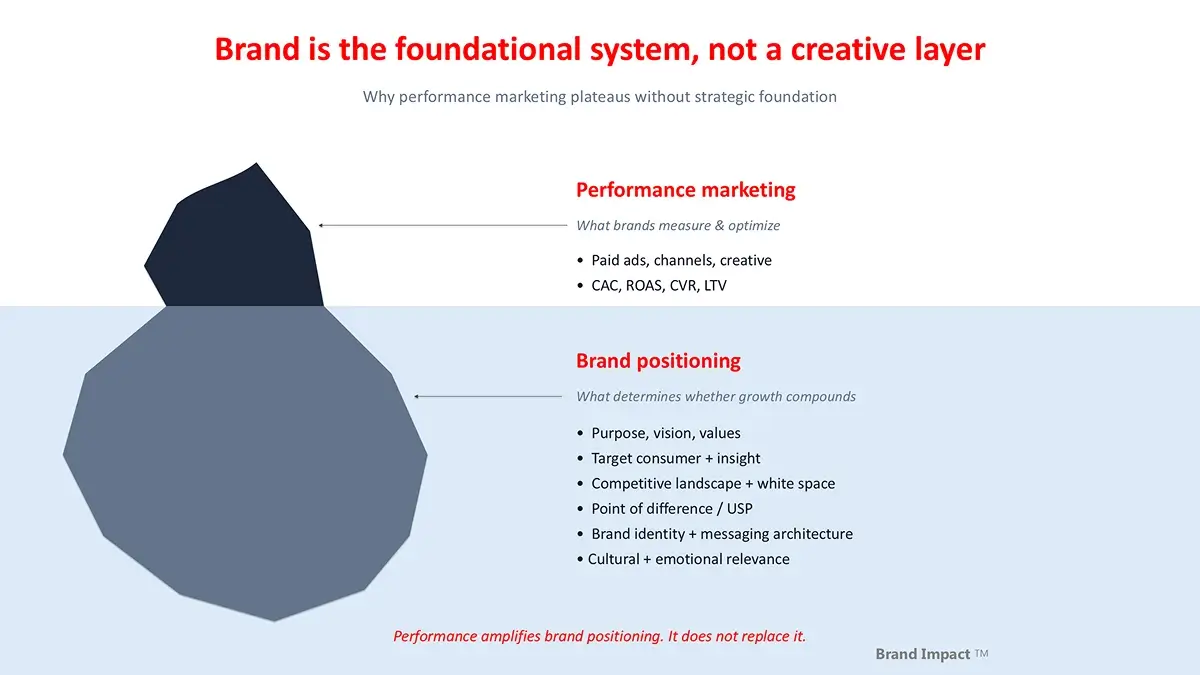
Performance amplifies brand positioning. It does not replace it.
The visible tip – paid ads, creative refresh, channel mix, CAC, ROAS – is what most teams measure and optimize daily. The submerged foundation – (1) purpose, (2) target consumer, (3) point of difference, (4) brand pillars, (5) content brief – is what determines whether that surface activity compounds into enterprise value or dissipates into spend.
When founders ask why their performance is plateauing, the answer is usually that they are trying to optimize the visible layer while the strategic core is undefined.
The Warning Signs Your Brand Positioning Is Stale or Weak
The signals are visible months before the plateau hits revenue. Most founders feel them and misdiagnose them as channel issues, creative issues, or team issues. They are rarely those things in isolation. They are symptoms of a foundation that needs work.
Six signals worth taking seriously:
Creative refresh cycles are shrinking.
The ad sets that used to last 90 days now last 21. The team is producing faster but the lifts are smaller. This is what creative fatigue looks like when there is no underlying brand idea to refresh against – every new creative is a brand-new attempt rather than a variation on a coherent theme.
Message dilution across channels
The website says one thing, the ads say another, the email says a third, the influencer brief says a fourth. Each function is optimizing locally without a shared brief. Internally, team members articulate the brand in different ways.
Brand search volume is flat or declining
Even as paid spend climbs. People are seeing the brand and not remembering it well enough to come back to it directly.
Retention is soft despite strong acquisition
New customers come in but do not return at the rate the LTV models assumed. There is nothing to pull them back beyond promotion.
Performance is increasingly dependent on discounting
Margin is compressing because the brand cannot earn full price. It has to bid for transactions instead.
The brand sounds interchangeable
When you cover the logo, you cannot tell which brand the ad belongs to. The category has converged on similar language, similar visual codes, and similar claims, and your brand is inside that convergence rather than outside it.
If you recognize two or more of these in your own brand right now, the plateau is not a channel problem.
What Brand Positioning Actually Means
The framework I work from, which I learned at Procter & Gamble and have since adapted across heritage and emerging brands, defines brand positioning as the strategic output of eight inputs. The five most public-facing here:
- Purpose, vision, values. The why beneath the what. Why does this brand exist beyond producing the product?
- Target consumer and consumer insight. Not just demographics. The goal is to understand the rituals, switching triggers, behaviors, and emotional tensions that reveal a deeper unmet need – the one your brand can address more meaningfully than the category is today.
- Competitive landscape and white space. Where are the other brands clustered, what claims are they all making, and where is the unoccupied territory the brand can credibly own?
- Point of difference and unique selling proposition. The single thing this brand does, says, or stands for that competitors cannot credibly claim, that the target consumer actually values, that the brand has a credible right to win, and that the brand can deliver consistently.
- Brand pillars and content brief. The three to five themes the brand stands for and delivers value around – what it publishes, partners with, sponsors, and stands alongside – and the rules that translate positioning into the content and messaging system performance marketing operates inside of.
Positioning is the integrated output of these inputs and a few additional strategic elements. It is not a tagline. It is not a moodboard. It is a strategic filter that every downstream activation translates from.
When the filter is sharp, the channels compound. When it is soft, the channels burn cash trying to compensate.
Brand Positioning Is Also the Innovation Filter
Performance marketing is the most visible place positioning shows up, but it is not the only one.
The same strategic foundation determines whether product innovation strengthens the brand or fragments it. Without clear positioning to anchor decisions, founders can end up launching what is technically possible rather than what is strategically additive. Roadmaps start to cannibalize existing SKUs, hero franchises lose definition, and every new launch competes for the same consumer attention. The team is busy. The brand is diluted.
Commercial innovation – campaigns, partnerships, retail strategy, community programs, and channel expansion – faces the same test. Without brand positioning as the brief, opportunities can become disconnected from the larger growth system.
Strong positioning also defines extendability – the rule for which adjacent categories, formats, or segments the brand can credibly enter without diluting core equity. Without that rule, line extensions multiply faster than the brand’s permission to inhabit them.
Brand positioning is the filter that helps leadership say no to the wrong opportunities and yes to the right ones – across product, marketing, distribution, and partnerships. That is what makes it foundational rather than tactical.
Heritage Revival: The Freeman Beauty Restage
A real example of what this looks like in practice.
When I joined Freeman Beauty in 2016, the company had a 40-year heritage as the #1 facial mask brand in U.S. masstige retail. The business was healthy, but key brand strategy metrics were slowly weakening as the category became more competitive.
New indie brands were entering the market, major skincare players were adding innovation, K-Beauty was reshaping consumer expectations, and younger shoppers were gravitating toward brands that felt more relevant to their identity and values. Freeman still had heritage and scale, but the category was increasingly rewarding brands that felt more current, differentiated, and culturally relevant.
Product innovation was beginning to cannibalize existing SKUs, with only modest expansion of total category market share. As speed-to-market became a key objective, the unified brand positioning anchoring the portfolio had weakened over time.
The work was a brand restage that started with brand positioning, not packaging. We commissioned brand equity and extendability research, redefined the target consumer (an 18-24 social, energetic, DIY-oriented beauty user), tightened the point of difference around efficacious, fun natural botanicals at an accessible price, and reframed heritage as authority, not nostalgia, and rebuilt the brand identity, product architecture, and messaging system to match. The visual restage came late in the process – after the strategic decisions had been made about what the brand stood for and who it was for.


The outcomes followed. Portfolio brands delivered 20-50% YoY growth and 10-50x category outperformance.
Distribution expanded across mass and specialty retailers including Walmart, Ulta, and Walgreens and into new channels (Target, Kohl’s, and Dollar). In 2017, Yellow Wood Partners acquired Freeman Beauty, publicly describing it as a company with a “strong differentiated brand identity.” When a private equity firm uses that kind of language in a deal announcement, it signals that brand equity is not decoration – it is part of the asset value.
Modern Challenger: Orpheus and the Cultural Pivot
A different shape of the same principle.
Orpheus is a clean biotech skincare brand built around the Resurrection Flower – a rare plant from the founder’s homeland in Bulgaria with documented stress-recovery properties. Founder Sara Kyurkchieva built the brand from her own life: sensitive skin, chronic inflammation, insomnia, a creative life that ran across time zones and late nights. The original positioning was credible and defensible, but still largely rooted in the category’s existing language: clean biotech skincare and science-led.
Within the broader beauty market, “clean biotech” had become a crowded category claim. The science angle created credibility, but it was not enough on its own to build a distinct emotional world around the brand. Press features validated efficacy, while performance creative continued to rotate through ingredient stories and expert validation – starting to look similar to other premium clean skincare brands in the category.

Before rebrand

After rebrand
The shift was not a creative refresh. It was a strategic repositioning. The brand’s foundation was reauthored to anchor in cultural and emotional territory – resilience, recovery, nocturnal creative identity, and the music and nightlife communities the founder herself moved through.
The Resurrection Flower stayed as the proof point, but the brand promise expanded from “clean biotech” to something far more specific: skincare built for people who refuse to choose between living fully and looking rested.
“Discovered by DJs. Adopted by nocturnal creatives. Look like you’ve slept, even if you didn’t.”

The community the strategy identified, made literal.
The language became culturally located, not category-located. The visual system, founder narrative, and content brief all rebuilt around the new positioning.

Early indicators pointed to stronger engagement, clearer community resonance, and improving commercial signals – including higher AOV and encouraging repeat-purchase behavior in later cohorts. Most importantly, the brand now had a clear strategic foundation for every channel to translate and compound from.
How to Approach Brand Positioning Today
For founders and marketing leaders reading this and recognizing themselves in the warning signs, the work does not start with a creative refresh or a channel optimization. It starts with five strategic questions:
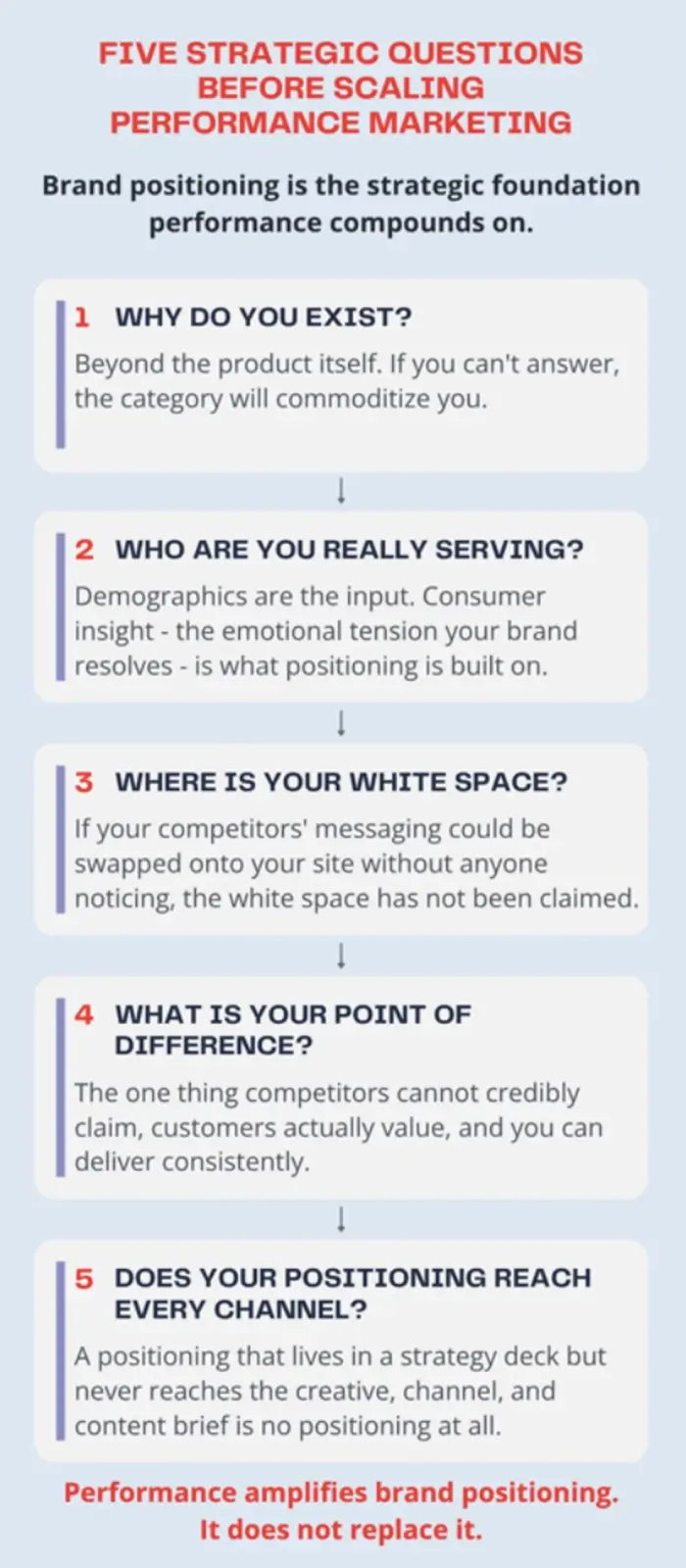
Each of these questions opens deeper strategic work. Answering them rigorously – with proper research, competitive analysis, and the discipline to narrow rather than expand – is the difference between brand positioning that compounds and brand positioning that erodes.
The work is harder than channel optimization, which is partly why so many teams avoid it. Channel optimization is measurable in days. Brand positioning work pays back over quarters. But it is an investment that sets the basis for sustainable growth.
Heritage brands that need to evolve face one shape of this question. Younger brands trying to scale beyond founder voice face another. Both face the same underlying truth: the cost of getting positioning right is paid once. The cost of getting it wrong is paid every month, in rising CAC and softening retention, until the brand can no longer afford to ignore it.
The Foundation Beneath the Funnel
Performance marketing is one of the most powerful tools in the modern brand operator’s stack. When the brand architecture underneath it is sharp, performance dollars compound into enterprise value – the kind of value investors and strategic acquirers recognize as differentiated brand equity, or that an emerging skincare brand earns by becoming culturally indispensable to a community that did not have a brand before.
When the strategic core is soft, performance dollars end up doing the work positioning was supposed to do. Paid media buys more attention. Creative refreshes more often. Discounts carry more of the conversion burden. The system keeps working harder until it can no longer work efficiently.
“Brand positioning is the foundational system. Performance amplifies it. It does not replace it.”
For founders and marketing leaders recognizing the plateau in their own business, the next step is not simply to optimize the channels. It is to revisit the strategic foundation underneath them.
About the Author
Irena Kojouharova is a strategic brand leader and fractional CMO advising beauty, longevity, and wellness companies looking to scale through stronger brand positioning and integrated growth strategy. She has led brand work across heritage names including Procter & Gamble, Estée Lauder, Moroccanoil, Wella, KEVIN MURPHY, and Freeman Beauty, and applies these proven frameworks to emerging brands. Irena serves as Board Advisor to INNOCOS, a global Beauty, Longevity & Wellness community. She holds an MBA in Marketing from Pepperdine University. Connect with her on LinkedIn.