What 500 Ads Told Us This Year
Last year, we analyzed 500 of the best-performing supplement ads on Meta. The average top performer ran for 215 days.
We did it again. This year the number is 393.
In 12 months, the benchmark for a winning supplement ad moved by 81%. The best supplement marketing ads aren’t just surviving longer, the brands behind them have learned to build creative that doesn’t burn out. Median survival now sits at 394 days, meaning half of these elite ads are still live well past the one-year mark.
That shift is what this report is about. Not which ad looks good. Which ad lasts – and why.
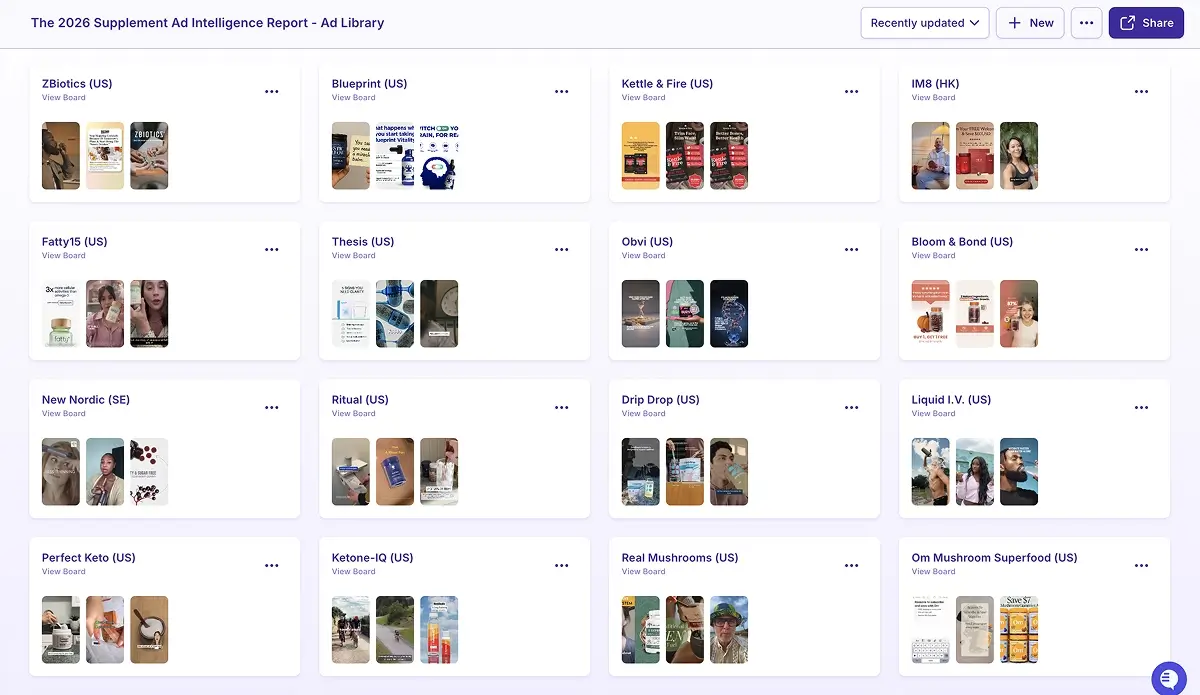
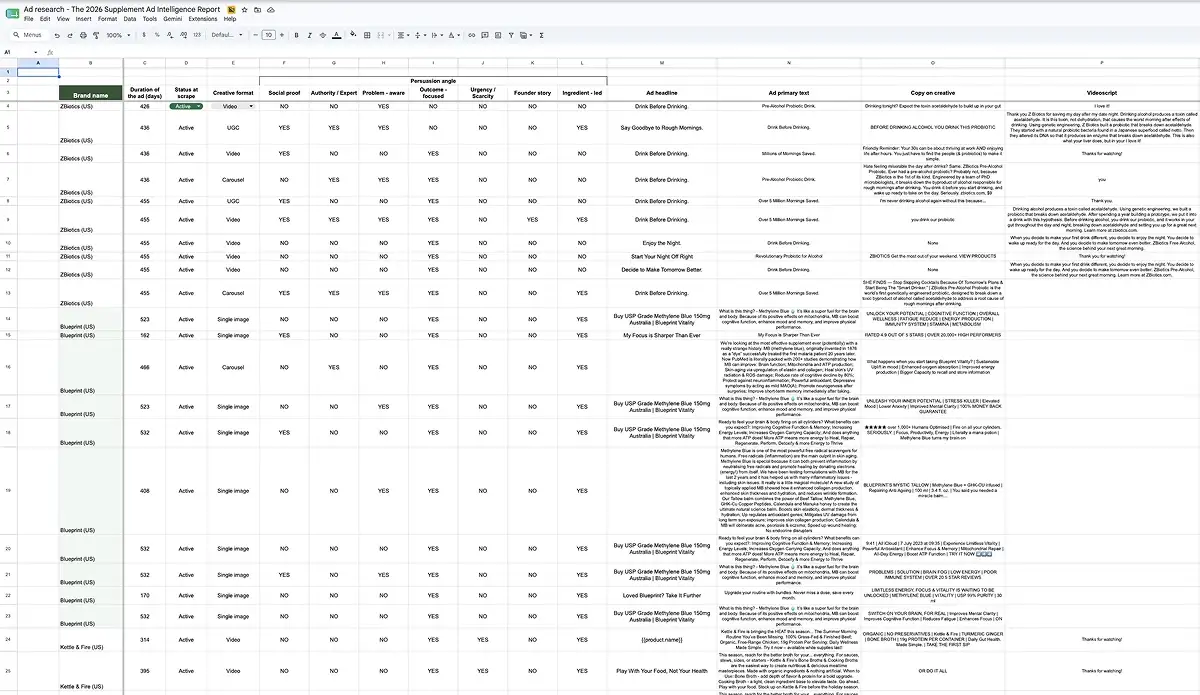
Behind then scenes.
To find out, we used MagicBrief to pull the 500 strongest Meta ads from 50 supplement and wellness brands. The names you already know from your own feed: AG1, Happy Mammoth, Ritual, Seed, Onnit, Symprove, Vital Proteins, and dozens more across the US, UK, Australia, and Europe. Then we broke every single ad down – by format, hook, persuasion angle, landing page, offer type, and the actual words on the creative.
Last year answered what works. This year we went deeper.
We added four new dimensions we couldn’t measure before:
- the persuasion angle behind each ad
- the hook that opens it
- the landing page and offer combination it sends traffic to, and
- a full semantic read of the copy itself – length, readability, sentiment, word for word
The questions we set out to answer:
- What separates an ad that runs for a year from one that dies in three weeks?
- Which creative choices actually extend an ad’s life?
- Can you predict whether an ad will last before you spend a dollar on it?
Let’s get into it.
/ You can read more about the Methodology at the end of this article/
The Brands Behind the Data
The 50 brands in this study weren’t picked at random. Every one of them runs ads consistently on Meta, tests creative at volume, and has been at it long enough to give us something real to measure. These are the brands setting the pace — the ones you keep seeing in your own feed.
They cover the full map of modern supplements: greens powders (AG1, Live It Up, Huel), gut health (Seed, Symprove, Supergut), collagen (Vital Proteins, Absolute Collagen, Bubs Naturals), nootropics and energy (Onnit, Ketone-IQ, Thesis), hormone and women’s health (Happy Mammoth, Ritual, Lemme), functional mushrooms (Real Mushrooms, Four Sigmatic), and the fast-growing longevity category (Fatty15, Blueprint).
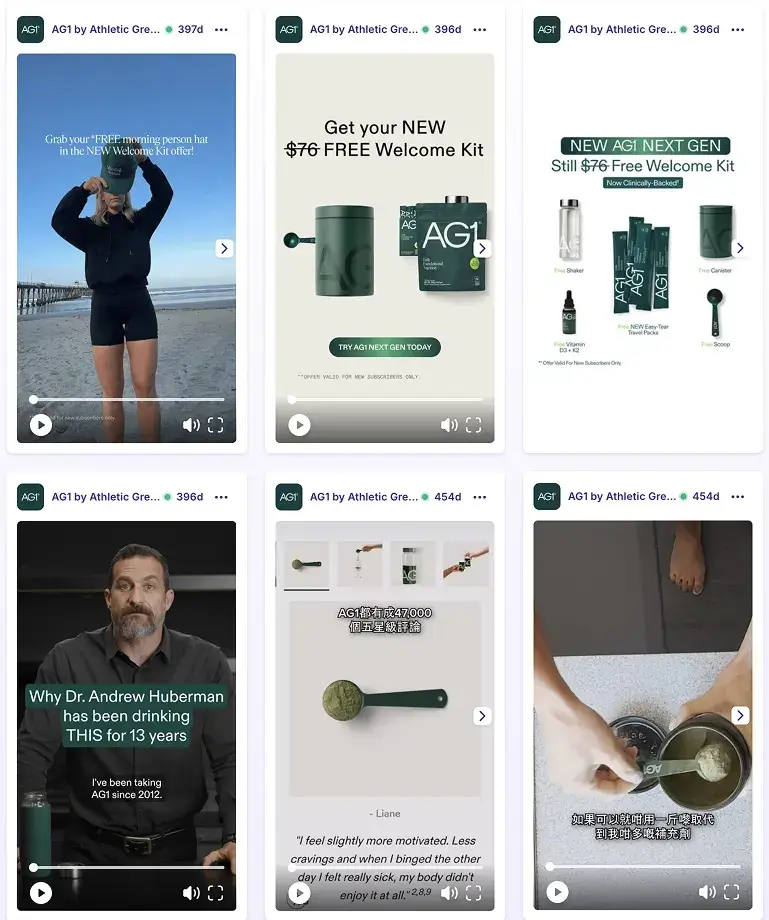
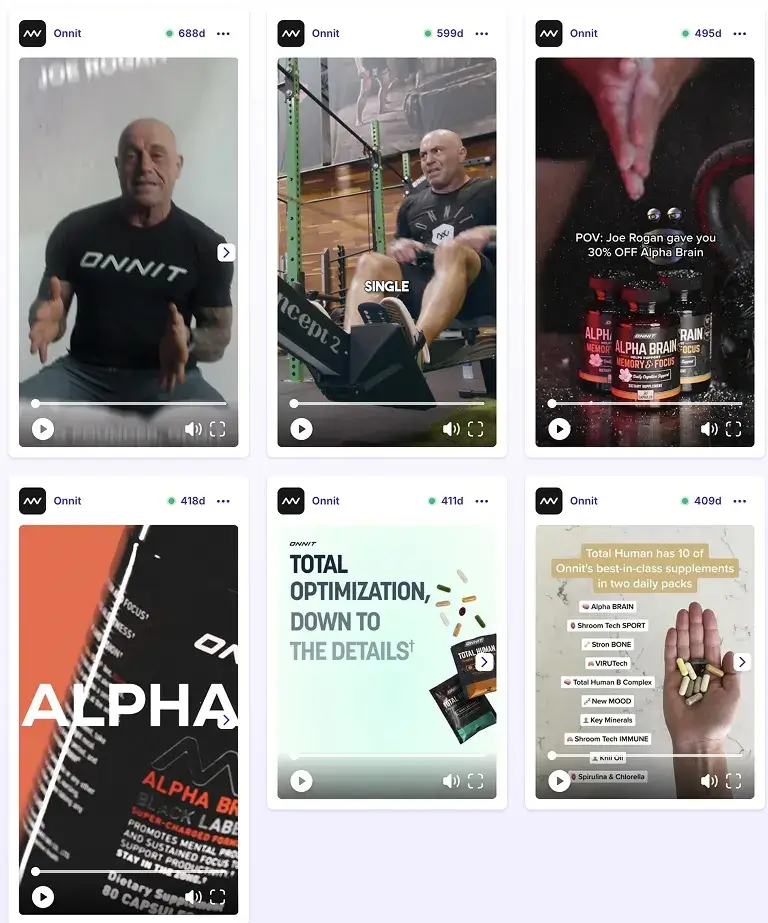
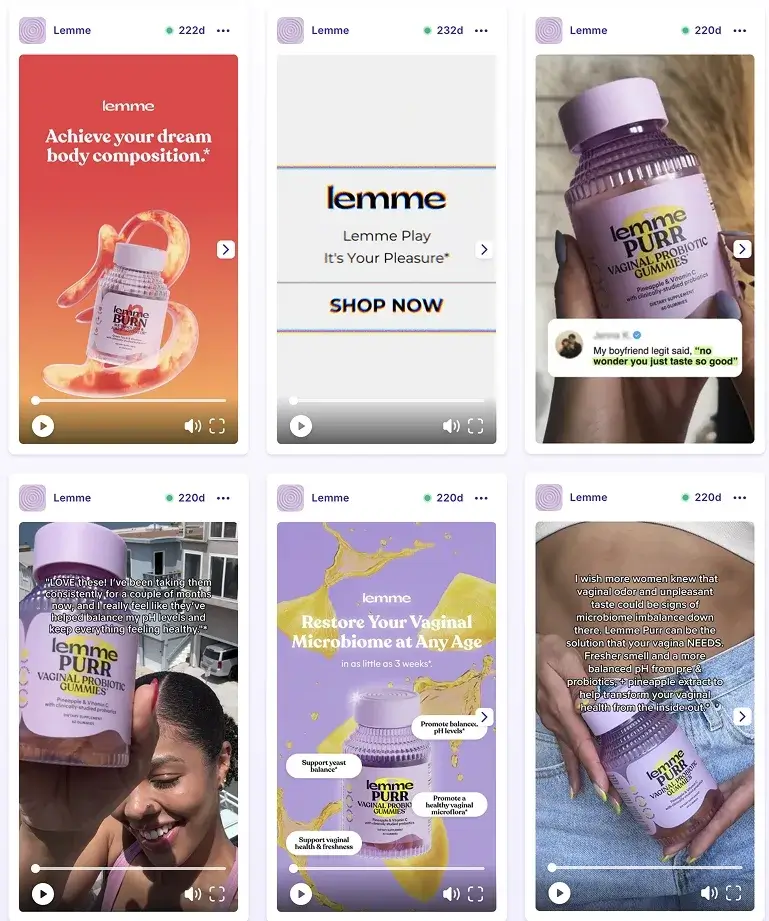
Top performer ads of AG1, Onnit and Lemme from the analyzed ad library
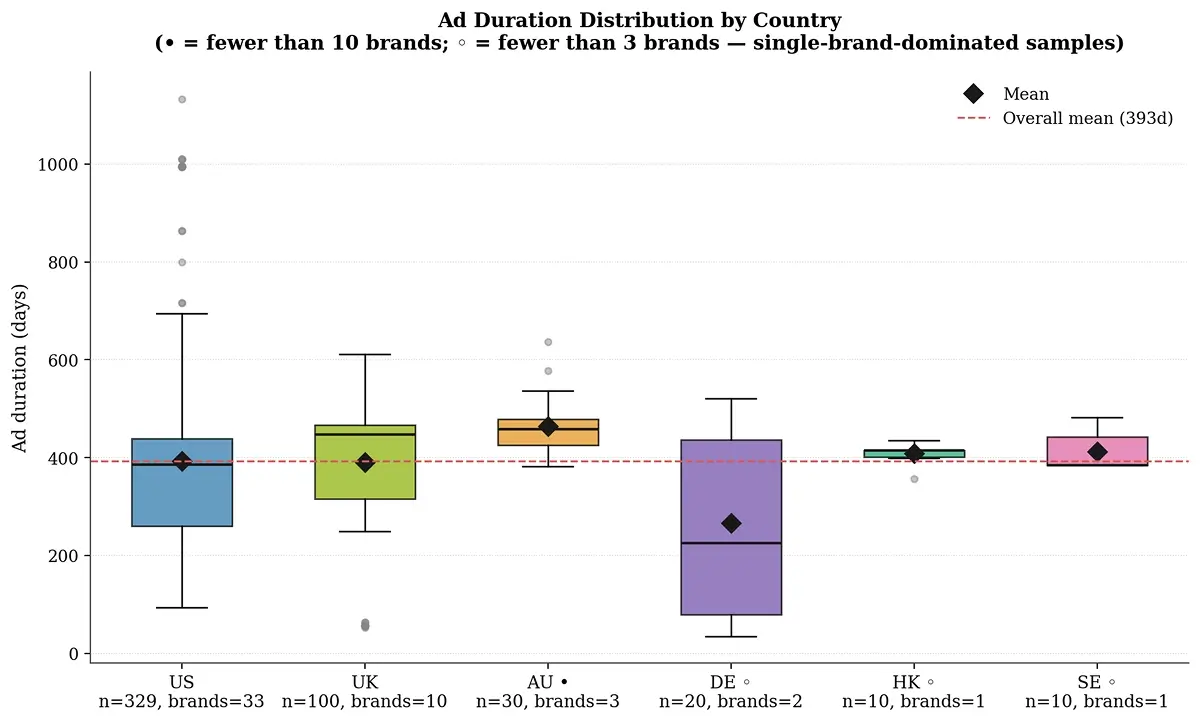
Geographically, the dataset leans where the spend and the maturity are:
- United States — 329 ads across 33 brands
- United Kingdom — 100 ads across 10 brands
- Australia — 30 ads across 3 brands
- Germany — 20 ads across 2 brands
- Hong Kong — 10 ads, 1 brand
- Sweden — 10 ads, 1 brand
The US and UK make up the overwhelming majority, and they’re the only two markets with enough volume to compare head-to-head with real statistical confidence.
That weighting isn’t an accident. The US and UK are the epicenter of DTC wellness advertising, where functional health, performance, beauty-from-within, and biohacking have fully merged into everyday consumer spending. When a creative strategy works here, it tends to travel.
The 2025 → 2026 Shift
A quick word on the landscape before the numbers. The supplement market didn’t just grow this year, it consolidated around a way of advertising. The lines between categories have blurred: gut health sells itself on skin, collagen sells itself on energy, greens powders sell themselves on longevity. The brands in this study are selling outcomes, identity, and routine, not pills anymore. That maturity shows up in the data in one unmistakable way.
Ads are lasting nearly twice as long.
In our 2025 top supplement ads study, the average top-performing supplement ad ran for 215 days. In 2026, that figure is 393 days – and the median sits at 394, meaning half of these elite ads are still live past the one-year mark.
This is the single most important number in the report. An 81% jump in one year tells us the best brands have stopped treating ads as disposable and started building creative engineered not to fatigue.
Longer-running ads also signal that Meta’s algorithm is finding and rewarding stable, proven creative — the brands feeding it consistency are being rewarded with reach.
And it’s not just the average. Last year, most top ads still burned out fast, with only a few going the distance. This year, going the distance is the norm, not the exception.
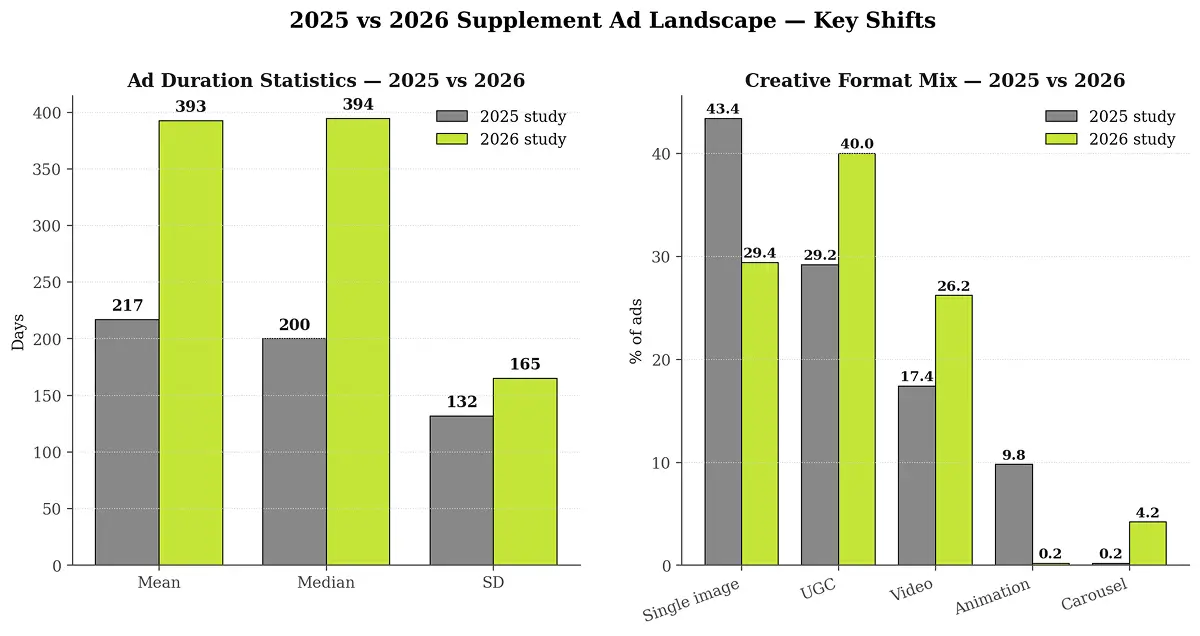
Now here’s the part that surprised us. The format mix barely moved.
Single image is still the most-used format, but it slipped slightly, from 43.4% of ads in 2025 to 40.0% in 2026. UGC held its ground at roughly a quarter to a third of all ads. Video stayed in a similar band. Animation faded further toward the margins, and carousel remains all but extinct.
So if the formats are nearly the same as last year, what’s driving ads to live twice as long?
That’s the whole question this report answers. The gain isn’t coming from which format brands use, it’s coming from how they build inside it: (1) the hook that opens the ad, (2) the persuasion angle underneath it, (3) the words on the creative, and (4) the page they send the click to. Those are the four new dimensions we measured this year, and they’re where the next 217 days are hiding.
Pillar 1 - A Snapshot of All 500 Ads
Before we model what makes an ad last, here’s what the 500 ads actually look like. Think of this as the surface layer of supplement marketing in 2026 – the raw distribution of every choice these brands made, before we ask which ones paid off.
Duration. The average ad ran 393 days; the median, 394. The average and the median land in almost the same place. That tells you long runs are the norm across the whole field — the typical ad here really does stay live for more than a year.

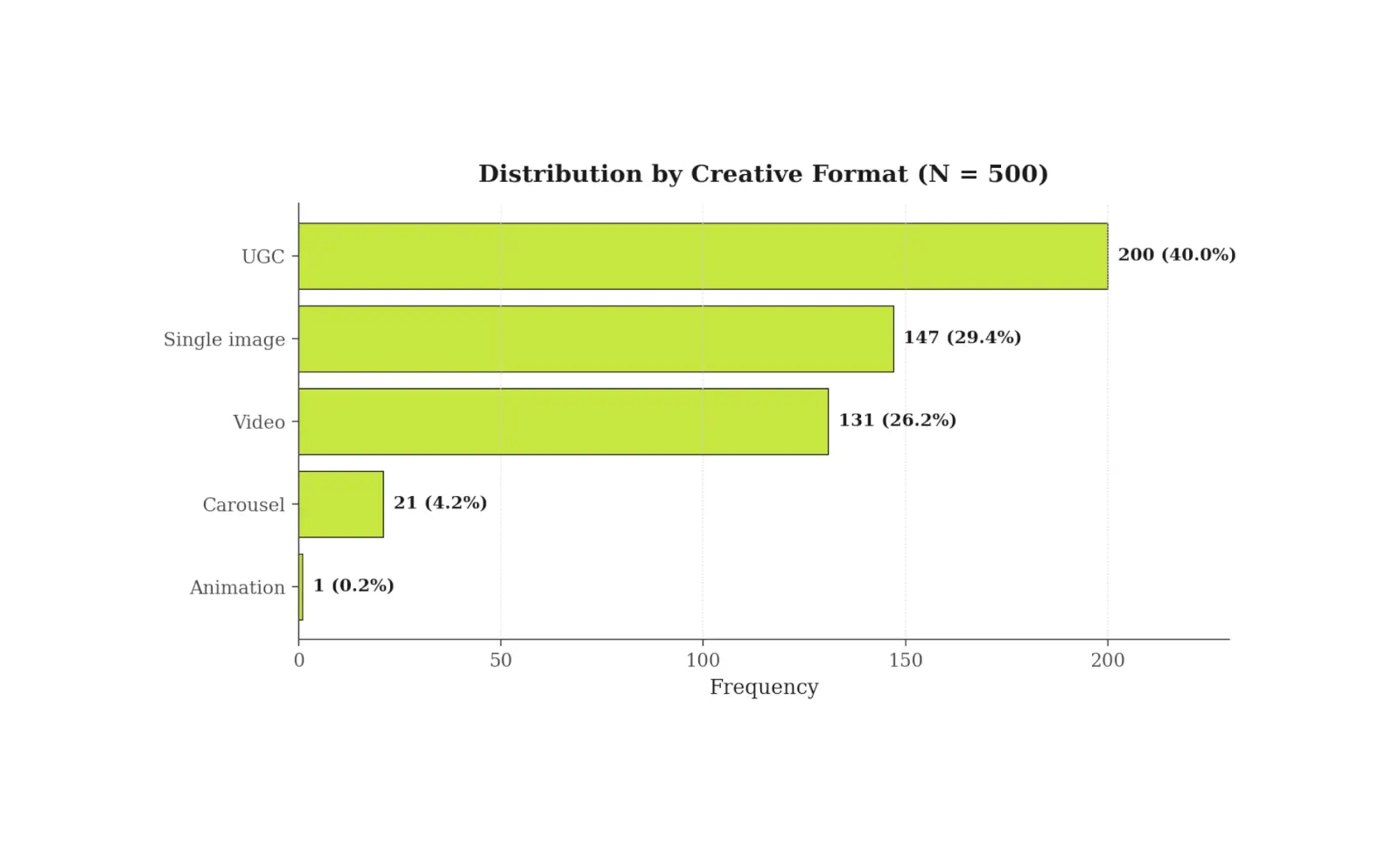
Creative format. Single image is still the workhorse at 40.0%, followed by UGC, then video, with animation now a rounding error and carousel effectively gone. The mix barely moved from last year – which, again, is the puzzle the rest of the report solves.
Hook type (new this year). This is where the data gets honest about itself. The single biggest “hook” category is Unspecified at 33.2%, ads that open with no verbal hook at all. Add Visual hook (no copy) at 17.8%, and more than half of these ads lead with an image, not a line. Among ads that do open with words, Customer POV leads at 18.8%, then Bold claim (8.4%), Founder POV (4.8%), and Pattern interrupt (4.4%). Problem callout, the hook that turns out to matter most later is used in only 4.2% of ads. Hold that number.
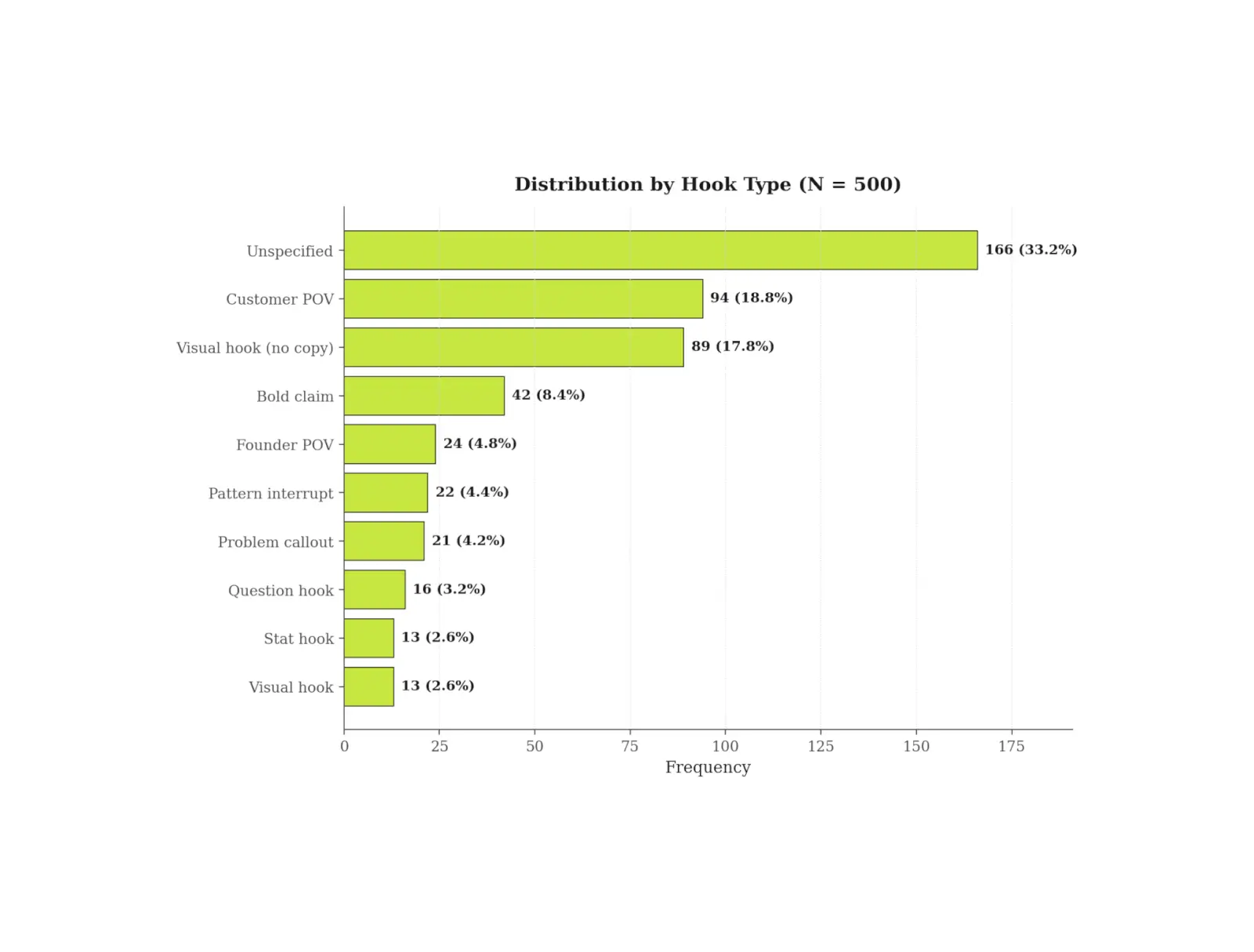
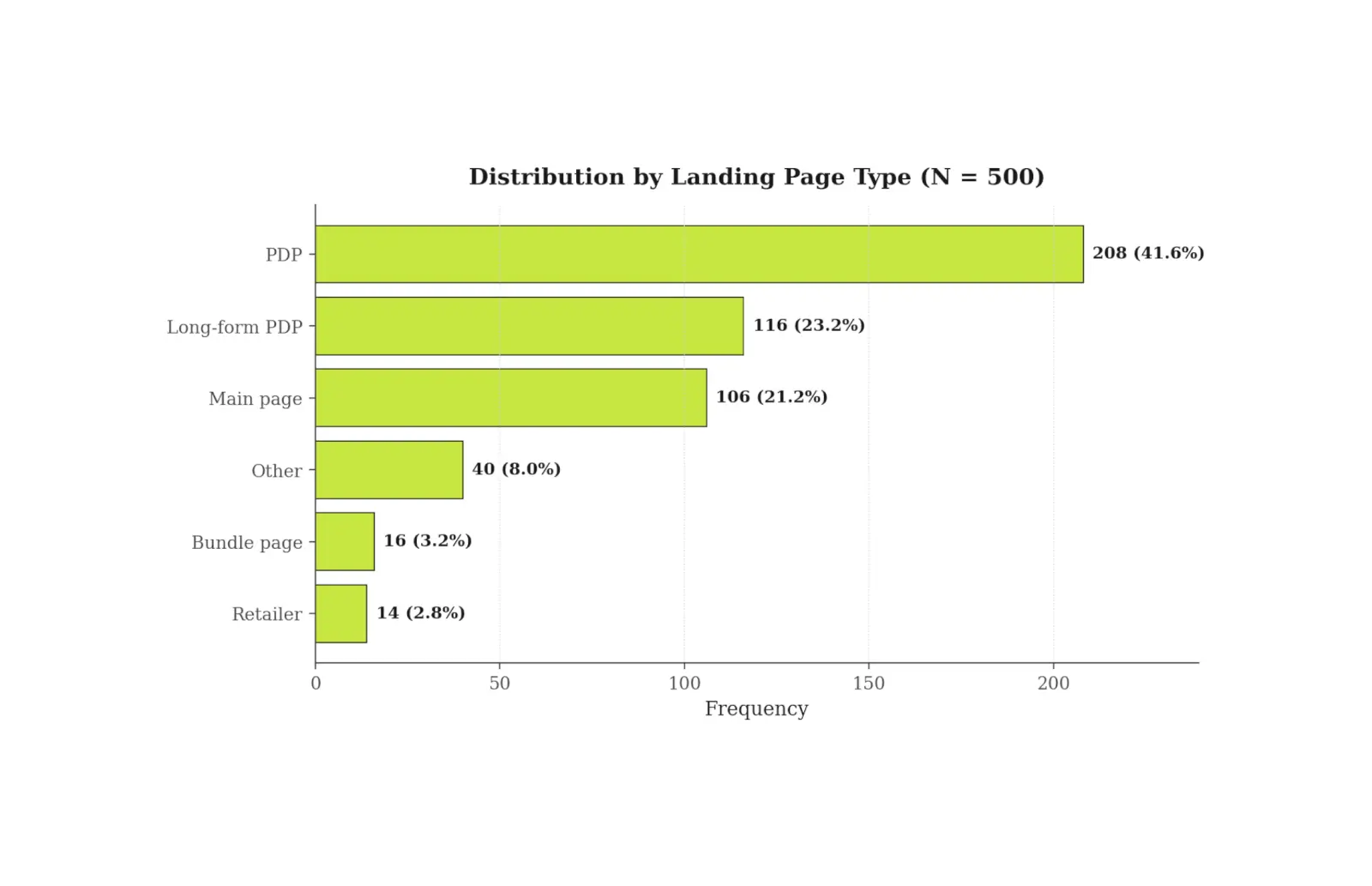
Landing page. Product pages dominate. Standard PDPs and long-form PDPs together take roughly two-thirds of all traffic, with main pages, retailer links, bundle pages, and a catch-all “other” splitting the rest. Supplement marketing still mostly runs ad → product page, full stop.
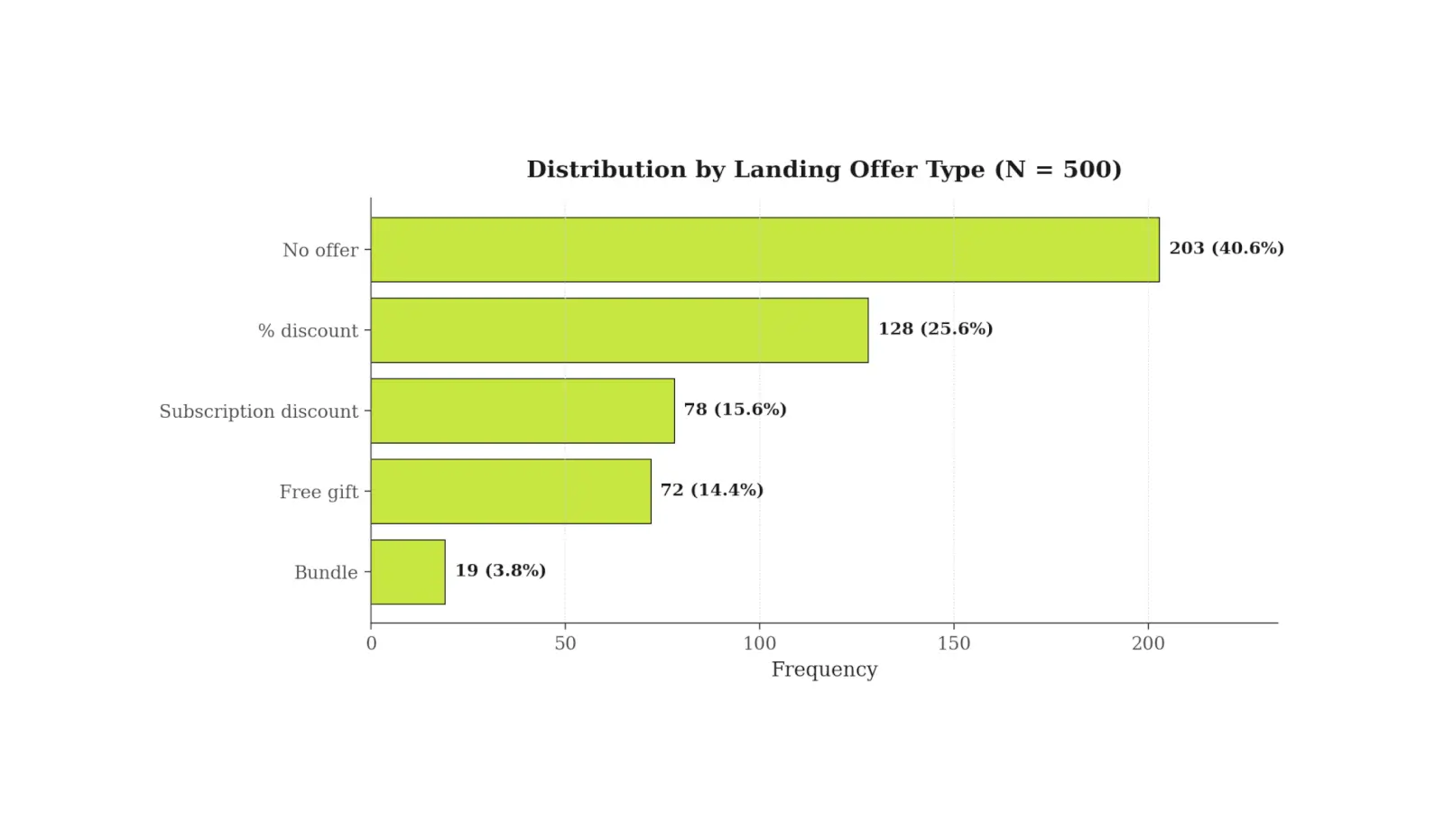
Offer type (new this year). A large share of ads carry no offer at all. Pure awareness or brand plays with percentage discounts, subscription discounts, free gifts, and bundles making up the rest. Which offer works, and on which page, is its own pillar later (and the answer is not what most brands assume).
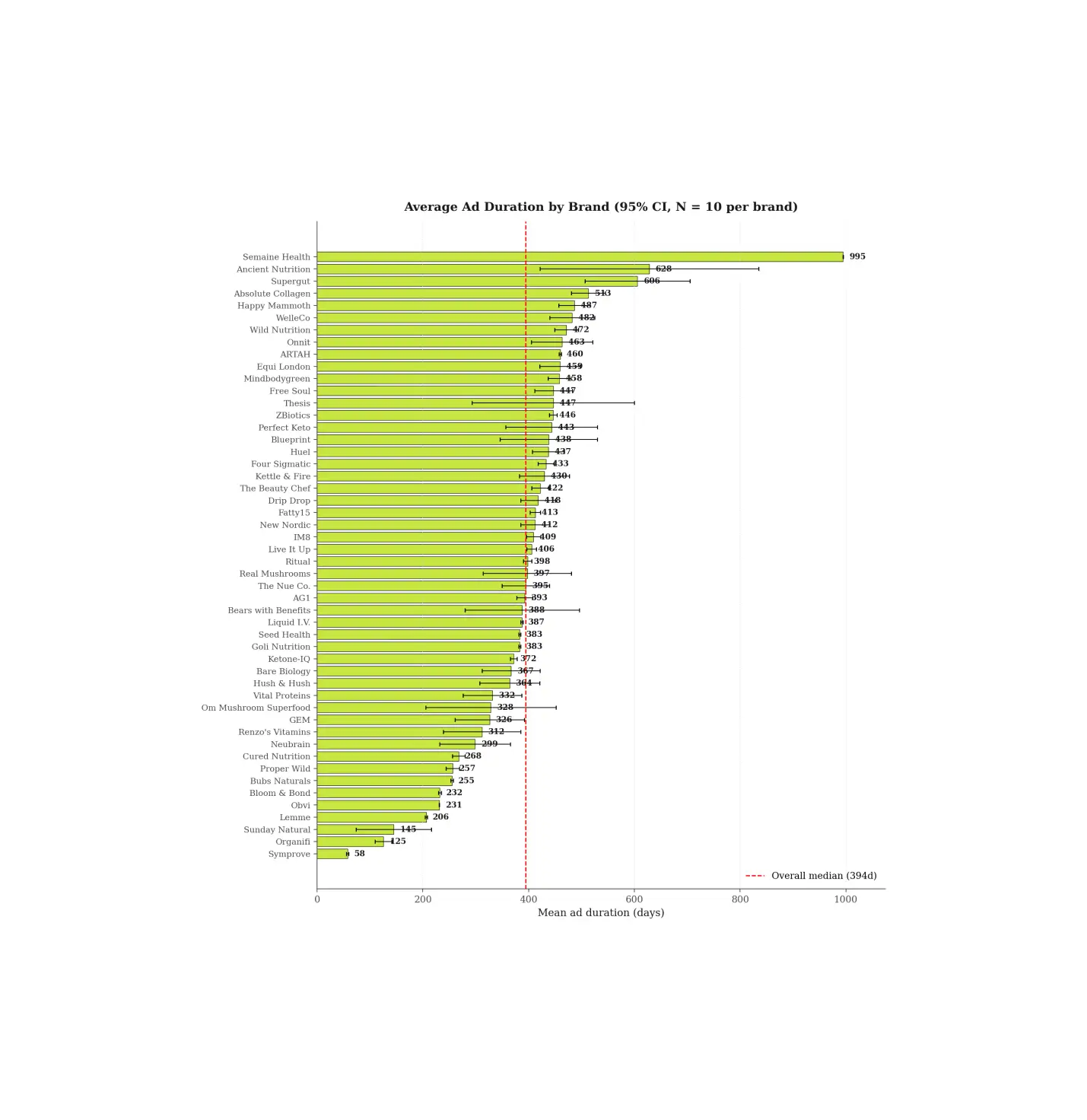
Brand by brand. Look at each brand on its own and the spread is huge. Some keep their best ads running well past a year. Others burn through them fast. The error bars on the chart show how much to trust each one — a wide bar means that brand had too few ads to read much into.
None of this, on its own, tells you what works. It tells you what brands are doing. The gap between those two things — between the common move and the move that actually extends an ad’s life — is the entire point of the next six pillars.
Pillar 2 — What Makes an Ad Survive
Up to now we’ve looked at what brands do. This pillar is where we start asking what works, using the same kind of math doctors use to study how long patients live, pointed instead at how long ads live. It’s called survival analysis.
In plain terms: we track every ad day by day and ask, “how many are still running?” Plot that over time and you get a survival curve — a simple picture of how fast the ads in a group drop off.
Across all 500 ads, the median survival time is 394 days. Line up every ad from shortest to longest, and the one in the middle ran for more than a year. That’s the bar in supplement marketing right now.
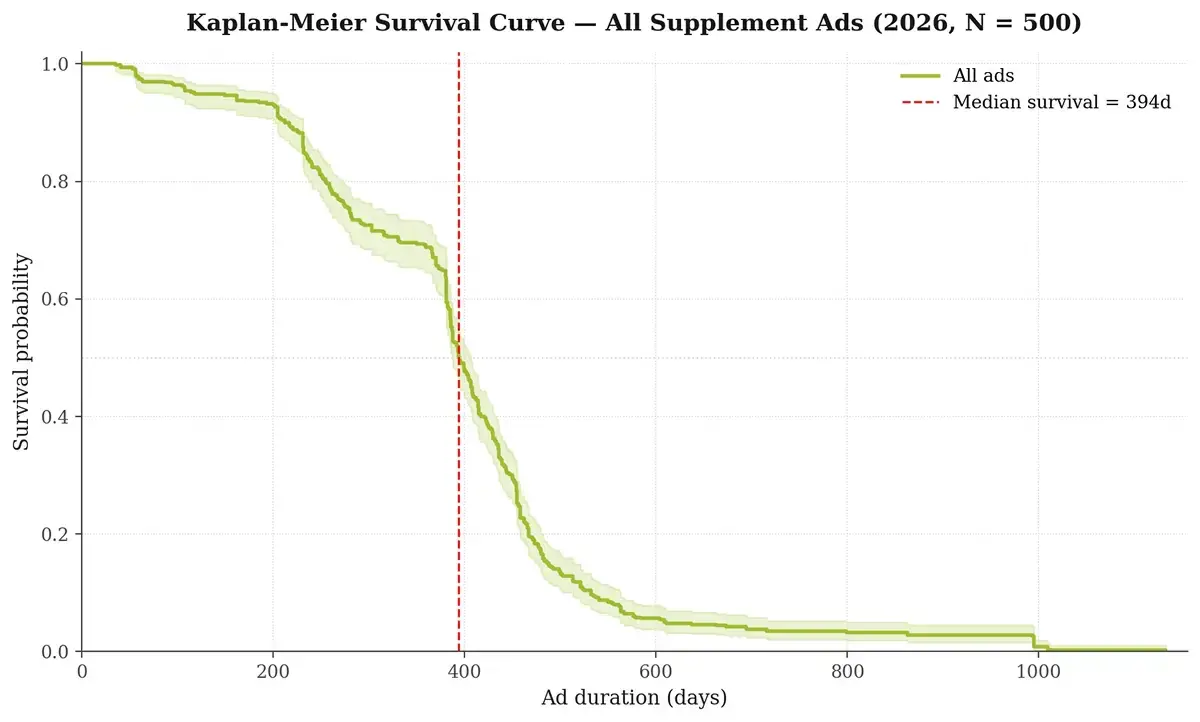
Then we put the three structural choices every brand obsesses over to the test — creative format, landing page type, and offer type — to see which one changes how long an ad lives.
Only one did.
✅Creative format moves survival. The gaps between formats are real, not chance (log-rank p = 0.029). The format you pick has a measurable effect on how long your ad stays alive.
❌Landing page type does not. Product page, main page, long-form page — on its own, the destination showed no real effect on survival (p = 0.750).
❌Offer type does not either. Discount, free gift, subscription deal, or no offer at all — by itself, the offer made no real difference to how long the ad ran (p = 0.281).
This one’s worth sitting with, because it flips part of last year’s story. In our 2025 report, landing page type looked decisive. With a cleaner survival model — and the offer dimension added for the first time — the page you send traffic to, on its own, doesn’t decide how long your ad lives.
In plain terms: swapping to a fancier landing page or a different offer won’t, by itself, keep your ad running longer. The format you build in will. The real magic shows up when page and offer work together — and that gets its own pillar later.
Note: Everything here measures each lever on its own. “Not significant” means a lever doesn’t move survival by itself — it does not mean it’s useless. Landing page and offer come roaring back when we look at them together in Pillar 7.
So the levers brands fight over hardest — which page, which discount — barely move the needle alone. Which raises the obvious question: if format is the only structural choice that clearly matters, what’s carrying the other 200-plus days of survival? The answer sits in the parts of supplement marketing brands rarely measure — the hook, the angle, and the words themselves. That’s where we go next.
Pillar 3 — Your Ad's Odds Before You Launch
Pillar 2 told us which levers move survival. This pillar turns that into something you can use the moment you’re briefing a creative: a probability.
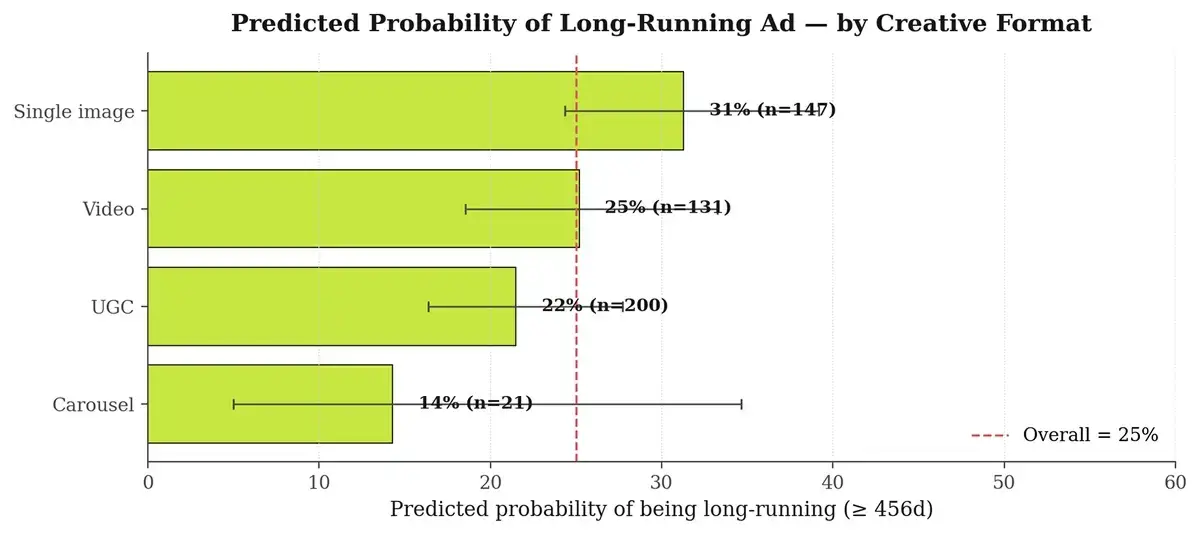
First we drew a line. We took the top 25% of ads — the ones that survive 456 days or longer — and labelled them “long-running.” Everything else sits below the line. Then we built a model that reads an ad’s choices and predicts its odds of clearing that bar.
Here’s how the odds shift across each choice. Read these as: does this lift me above the 25% line, or drag me below it?
By creative format. The pattern is similar to last year – UGC and single image lift the odds, while video and animation pull them down. Format is the one structural lever that clearly moves the number.
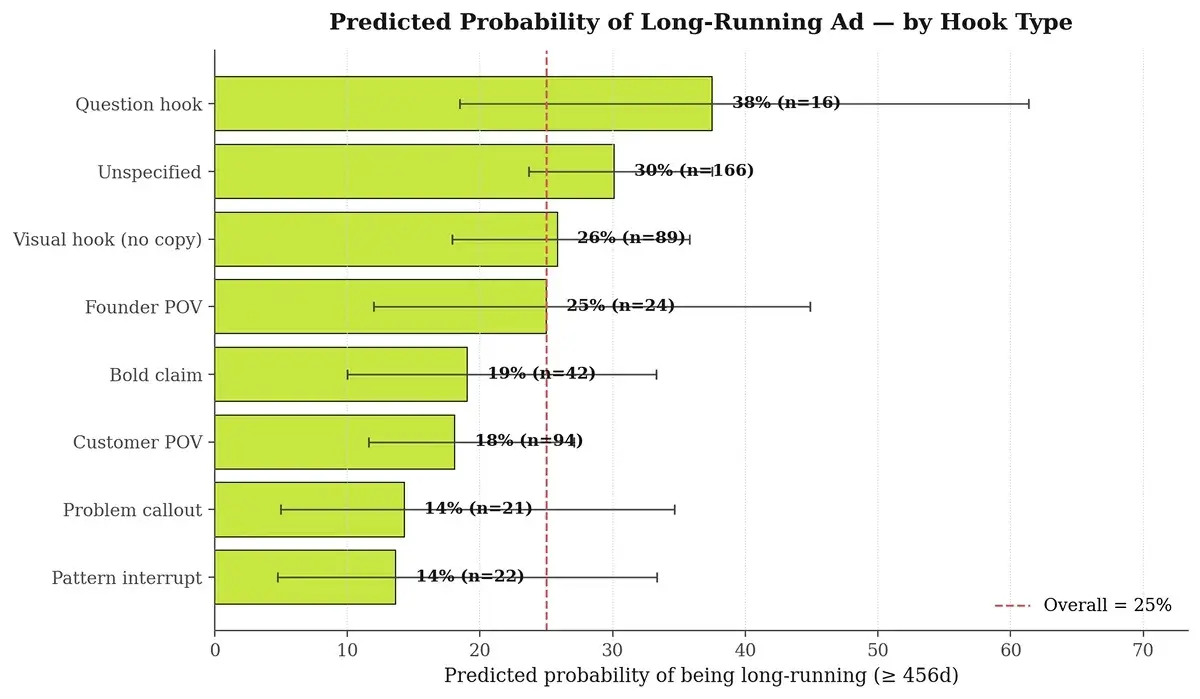
By hook type. This is where it gets interesting, and it’s the headline of Pillar 5: one hook stands well above the rest. We unpack it in full shortly.
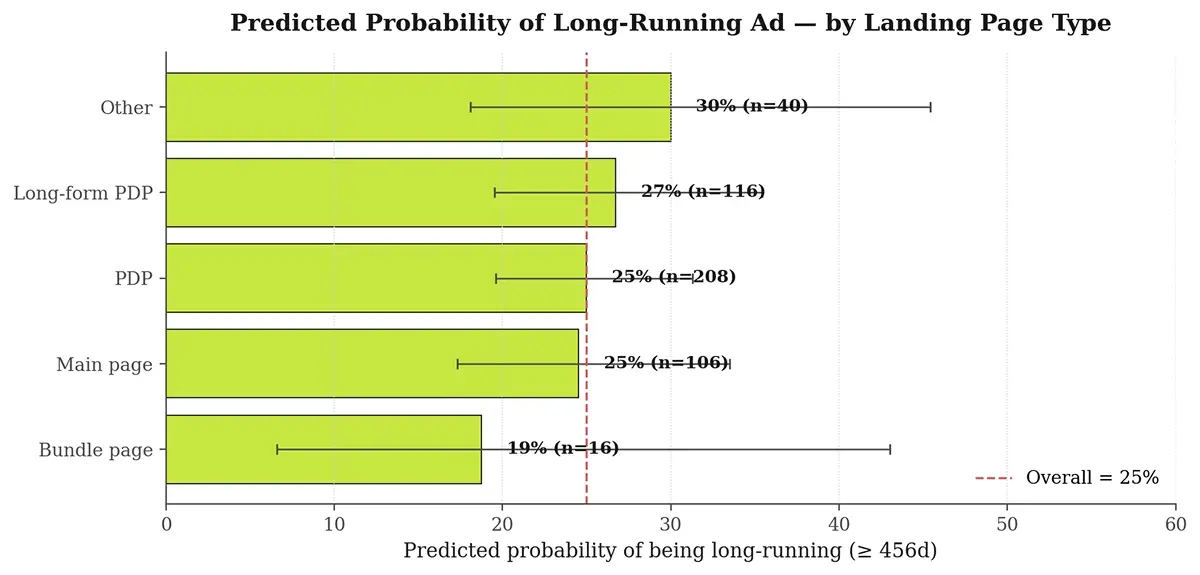
By landing page and by offer. On their own, both stay close to the 25% line – exactly what Pillar 2’s survival test predicted. Neither, by itself, is the lever brands think it is.
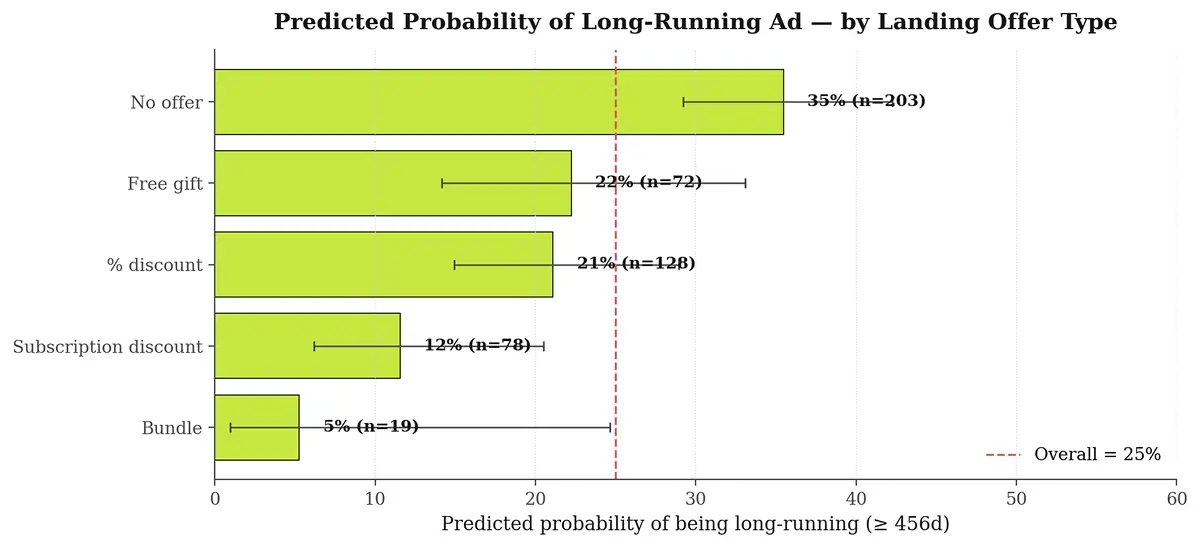
By country and by persuasion angle. Small standalone shifts here too – the bigger differences show up when you combine them, not in isolation.
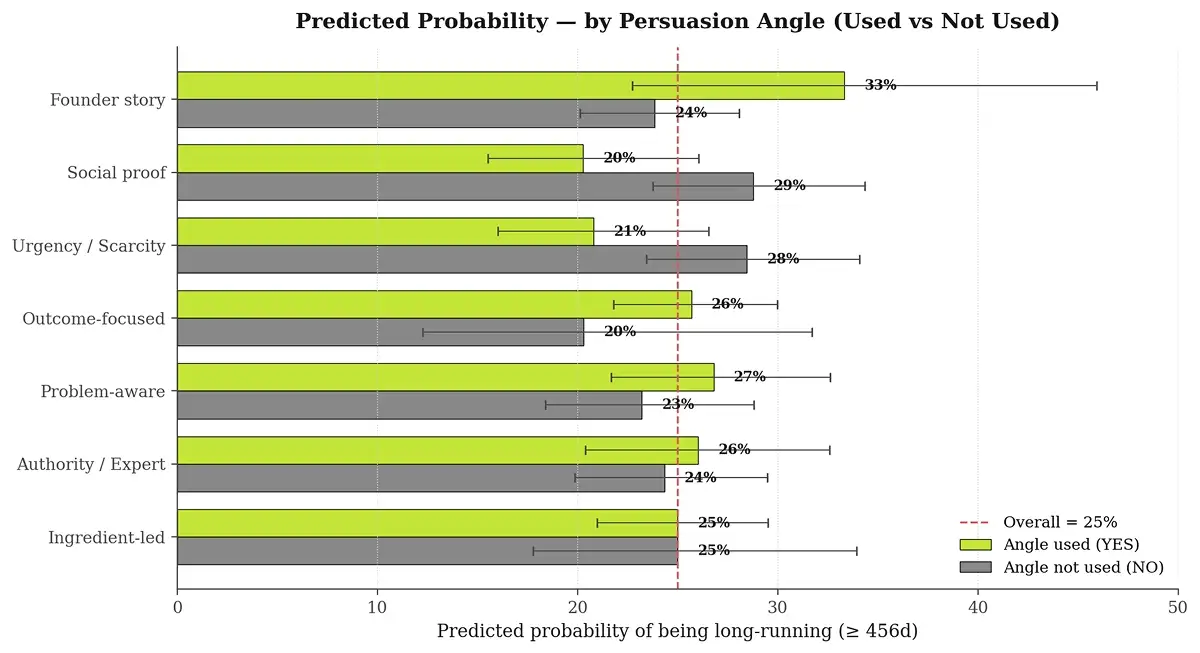
The most useful charts are the last four — the interaction panels: format × offer, format × landing page, offer × country, and number of persuasion angles × format. This is where the flat, boring standalone numbers suddenly come alive. A choice that looks average on its own can become a strong bet once it’s paired with the right partner. That’s the whole argument of Pillar 7, previewed here.
Note: The 25% baseline is relative to this elite group of top ads — not to the average ad in your account. A choice that lifts you to 40% here means 40% odds of beating the best of the best, which is a high bar by design.
This is the dashboard for supplement marketing: pick your format, hook, page, and offer, and read your odds before launch. But the single most powerful lever isn’t a format or a page, it’s the reason the ad gives someone to care. That’s the persuasion angle, and it’s where we go next.
Pillar 4 — The Five Persuasion Archetypes
Every ad makes an argument for why you should care. This year, for the first time, we coded that argument. Each of the 500 ads was tagged for the persuasion angles it used – 7 in total:
- Social proof — reviews, testimonials, customer counts
- Authority / Expert — doctors, scientists, clinical backing
- Problem-aware — naming the pain before the fix
- Outcome-focused — the result you’ll get
- Urgency / Scarcity — limited time, selling out
- Founder story — the person and the why behind the brand
- Ingredient-led — the formula and the science of what’s inside
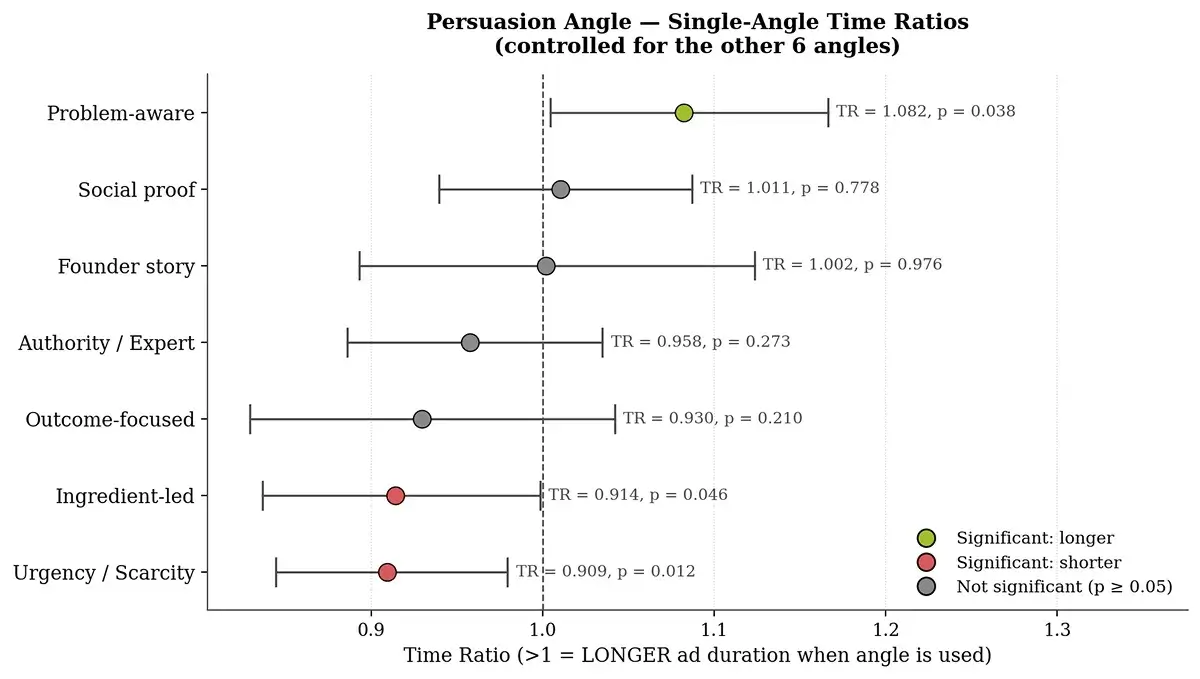
First question: does any single one of these, on its own, make an ad last longer?
No. Not one.
We measured each angle’s effect on duration while holding the other six constant. Every angle landed right on top of a Time Ratio of 1.0 — no measurable lift — with p-values nowhere near significant (Founder story TR 1.011, p = 0.77; Authority/Expert TR 1.002, p = 0.98).
In plain terms: a Time Ratio of 1.0 means “no effect on how long the ad runs.” Bolting “add social proof” or “mention a doctor” onto an ad doesn’t, by itself, buy you a single extra day. There’s no magic angle.
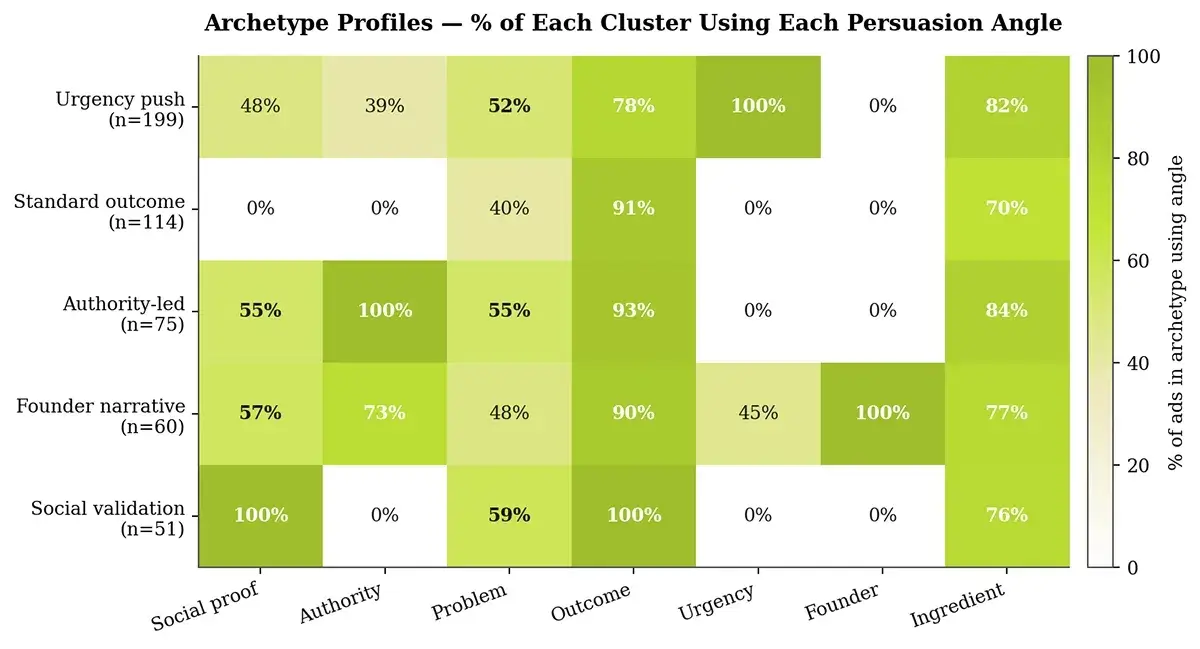
So we asked a better question. Ads don’t lean on one angle, they combine them into recognizable styles. We let the data group the 500 ads by how they mix angles, and five clear archetypes emerged:
- Standard outcome — just the result, little else. The plainest pitch, and the most common of all (n = 114).
- Social validation — built on proof: reviews, ratings, “join 100,000 customers.”
- Authority-led — doctors, clinical studies, certifications, the lab coat.
- Founder narrative — the founder’s face and story carrying the ad.
- Urgency push — discounts, countdowns, “before it sells out.”
Then we looked at how long each archetype’s ads survive. The means land in a fairly tight band – roughly 367 to 420 days – but the pattern is telling.
The substance-led archetypes appear to run longest: Authority-led and Social validation sit near the top of the range (~420 and ~412 days). The thinner pitches run shortest and Standard outcome, the single most common archetype, lands at the bottom (~367 days).
Let that sink in. The most common move in supplement marketing — just name the result and stop there — is also the one that dies the fastest. The archetypes that give the viewer something to believe — proof, expertise — earn the longer runs.
So the lesson isn’t “pick the Authority archetype.” In supplement marketing, coherence beats accumulation – one clear, believable reason to care outlasts a pile of stacked angles or a bare outcome claim. Next, we zoom in on the very first thing a viewer meets: the hook.
Pillar 5 — The Hook: How the Ad Opens
The persuasion angle is why the ad exists. The hook is the first thing a human actually sees — the opening line, the first frame, the half-second that decides whether someone keeps watching or keeps scrolling. This year we coded it as its own dimension, and it surfaced one of the most useful findings in the report.
Start with what brands are doing. From Pillar 1: a third of all ads (33%) open with no verbal hook at all, and another 18% are pure visual hooks with no copy. So more than half of supplement marketing ads lead with an image and let the picture do the talking — no surprise, given how many are static single-image ads.
Among the ads that do open with words, the field is lopsided:
- Customer POV — 18.8% (by far the most common verbal opener)
- Bold claim — 8.4%
- Founder POV — 4.8%
- Pattern interrupt — 4.4%
- Problem callout — 4.2%
- Question hook — 3.2%
- Stat hook — 2.6%
Customer POV from IM8
Bold claim from Thesis
Pattern interrupt from Perfect Keto
Notice Problem callout sitting near the bottom — it’s one of the rarest openers in the feed.
Now switch the question. Stop asking how often is each hook used? and start asking how well does each hook perform? — meaning, of the ads that use it, what share go on to become long-runners (surviving 456+ days).
Among UGC and Video ads, one hook pulls clear of the pack.
Problem-callout ads run long 44% of the time — nearly double the 23% baseline.
Bold claim comes next at around 26%, just over baseline. The rest sit at or below it, with the weakest openers dropping to roughly 15%.
In plain terms: open by naming the viewer’s problem — “Bloated by 3pm?”, “Hair thinning in your 40s?” — and your ad is roughly twice as likely to still be running a year later as the average. Lead with a bold claim and you’re slightly ahead. Lead with most other openers and you’re average or behind.
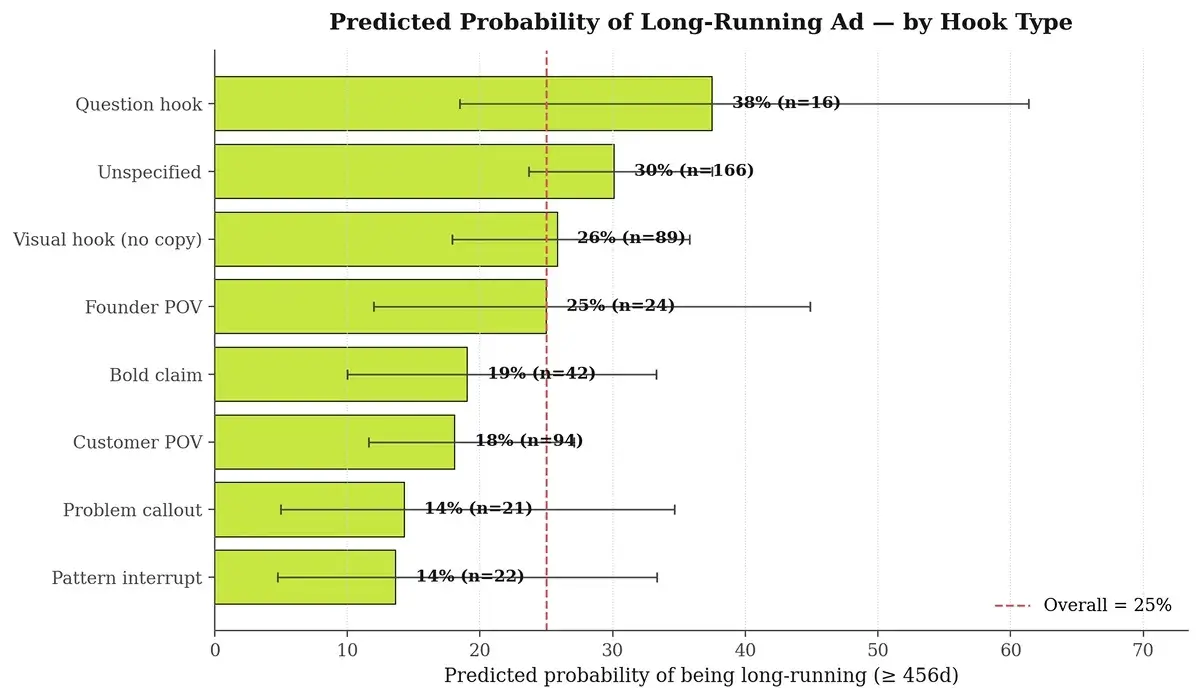
Here’s the gap that should make you sit up: Problem callout is the best-performing hook and almost the rarest — used in just 4.2% of ads. The most common verbal opener, Customer POV, is everywhere. The one with the strongest longevity signal is barely touched. That’s an open lane in supplement marketing.
Now the honest part, because we’d rather you trust this report than be sold by it.
Note: Treat this one as a high-upside, low-cost bet rather than a guarantee. A problem-first hook is cheap to test, and the directional evidence — plus the fact that almost nobody uses it — makes it one of the easiest experiments to justify in your next creative batch.
One more layer: the same hook behaves differently depending on the format you wrap it in. Take Bold claim — on UGC it averages around 339 days, but on Video it stretches to around 385. Hook and format tune each other; they aren’t separate decisions.
And hooks don’t float free of the angle either — each opener tends to set up a particular archetype. A Founder POV hook leads into the Founder narrative; a Customer POV hook into Social validation. The chart below maps which hooks feed which archetypes.
The takeaway is simple, and a little uncomfortable, because it means breaking a habit: stop opening with the outcome or the testimonial by default, and start opening with the problem. It’s the rarest hook in the feed and the one with the strongest signal for longevity. Next, we drop below the visuals entirely — into the actual words on the page.
Pillar 6 — The Words Themselves
We’ve covered the format, the opener, and the angle. This pillar goes underneath all of it, into the literal language of supplement marketing — every headline, caption, on-screen line, and video script in the dataset, read by a machine.
We split the copy into four channels, because the words in each do a different job:
- Headline — the ad’s main line
- Copy on creative — the text burned onto the image or video
- Primary text — the caption sitting above the ad
- Videoscript — the words spoken aloud in a video or UGC
For each channel we measured three things — the tone (how positive or negative the language is), the length (word count), and the readability (how easy it is to read) — and asked whether any of them move ad duration.
Here’s what carried, after we corrected for the fact that testing this many features will throw up false hits by chance.
Positive tone wins — and it wins most on the creative itself. Upbeat, positive copy is tied to longer-running ads. The effect is strongest in the words on the creative and in the headline (around +6% per notch), and smaller but still present in the primary text (~+2.8%). Warm, optimistic language outlasts flat or negative language.
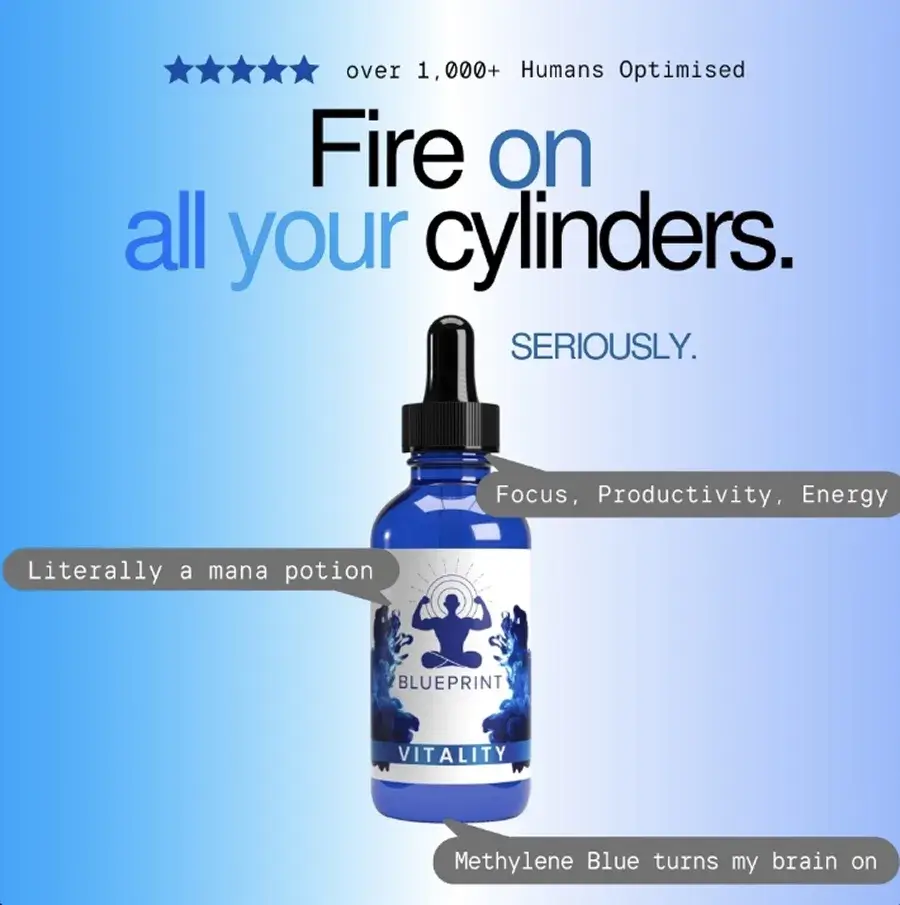
Blueprint positive tone ad from Bryan Johnson
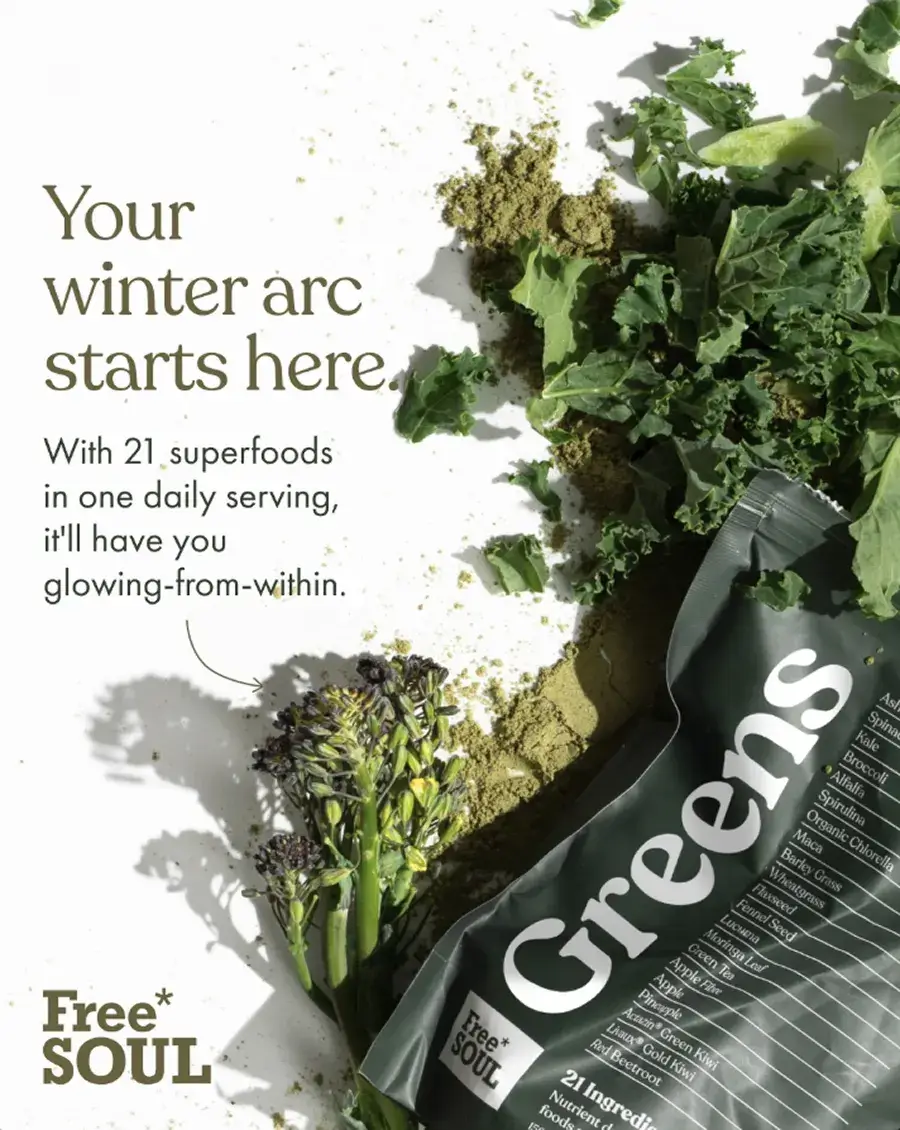
Free Soul positive tone ad
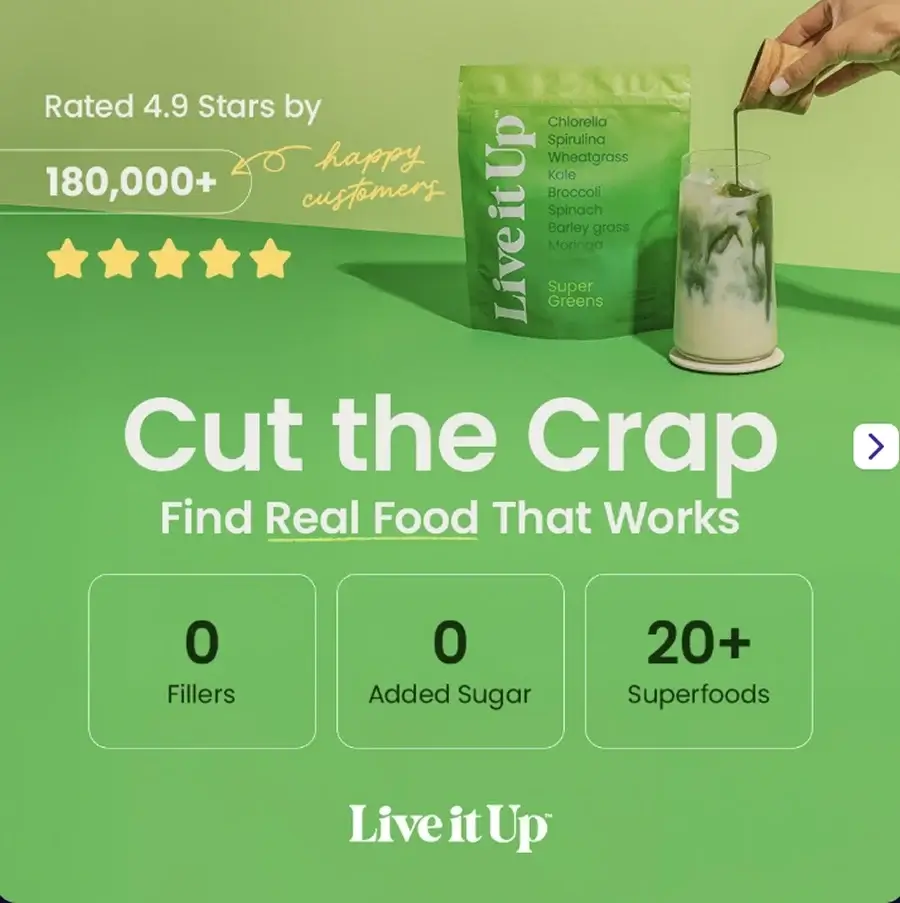
Live it up positive tone ad
Length has no clear winner. Word count doesn’t push one direction across the board. In some channels a little more copy helps slightly; in others it hurts slightly. No “write longer” or “write shorter” rule holds everywhere.
Readability had the weakest effect. Of the three features, how easy the copy is to read mattered least. The only thing worth noting: in headlines, simpler, easier-to-read lines tended to run a little shorter. That hints a more detailed, specific headline may last slightly longer than a light one. The effect is tiny, so don’t build a rule around it.
Note: These are correlations inside an elite set of ads, and the effects are modest — single digits per notch. Think of copy as the tuning layer, not the engine. It won’t rescue a weak format or a vague hook. On a strong ad, though, a warmer, more positive line is a cheap, real edge.
The summary: in supplement marketing, the words matter least of everything we measured and they still matter. Tone is the lever worth pulling. Lead with positive, human language, especially on the creative and in the headline. Next comes the finding that flips conventional wisdom hardest: the landing page and the offer, working together.
Pillar 7 — The Page and the Offer Are One Decision
Remember the strange result from Pillar 2? Landing page type, on its own, didn’t move survival. Offer type, on its own, didn’t either. Both came back flat.
This pillar is why and it reframes one of the most common decisions in supplement marketing.
They don’t work alone. They work in pairs. A landing page and an offer are really one combined decision. Look at them together, and the data finally makes sense.
So we built a matrix: every landing page type crossed with every offer type, with the average ad duration in each cell (we dropped any cell with fewer than 10 ads). Then we read the grid.
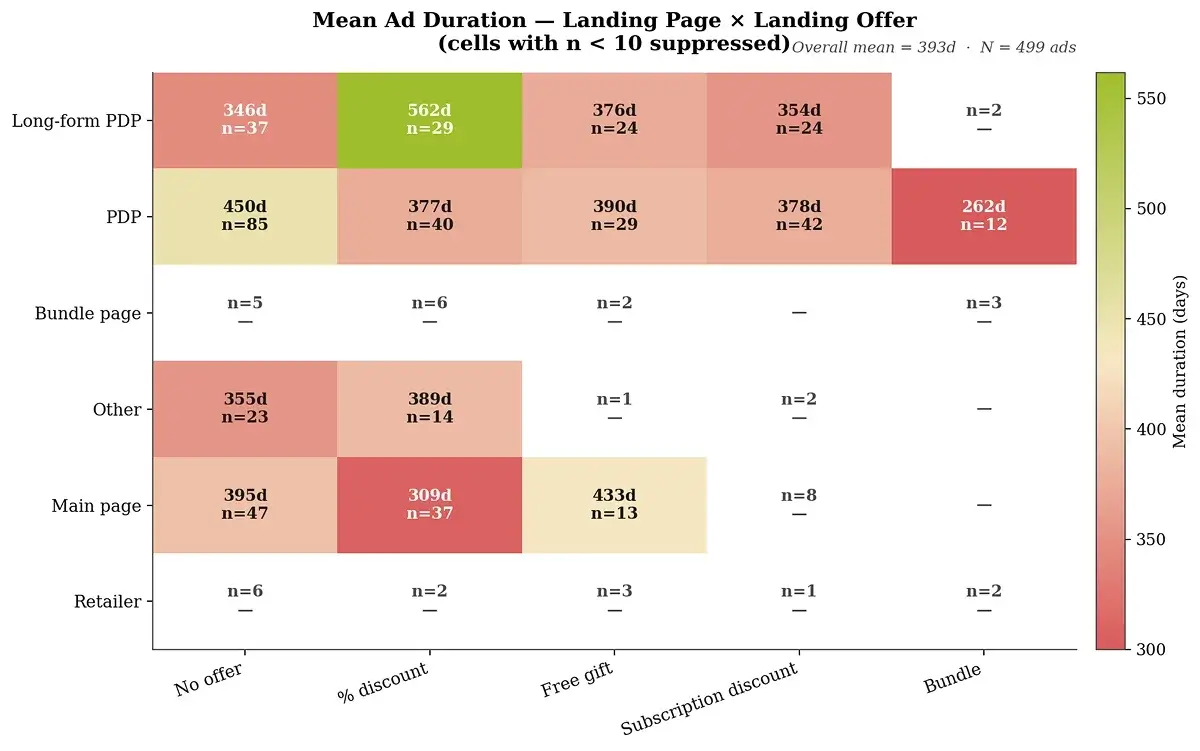
The spread is enormous. The best pairing runs 562 days; the weakest sink to the low 300s — a swing of more than 200 days, purely from how you match the destination to the deal.
The winning recipes:
- Long-form PDP × % discount — 562 days (the single best cell in the matrix)
- Long-form PDP × Free gift — top tier
- PDP × No offer — 450 days (also the most common cell, n = 85 — a dependable workhorse)
- Main page × No offer — 395 days
- PDP × Free gift — 390 days
Now the finding that should change how you brief your next campaign.
A percentage discount is the most powerful offer in the whole study and the most dangerous. It depends entirely on the page it lands on.
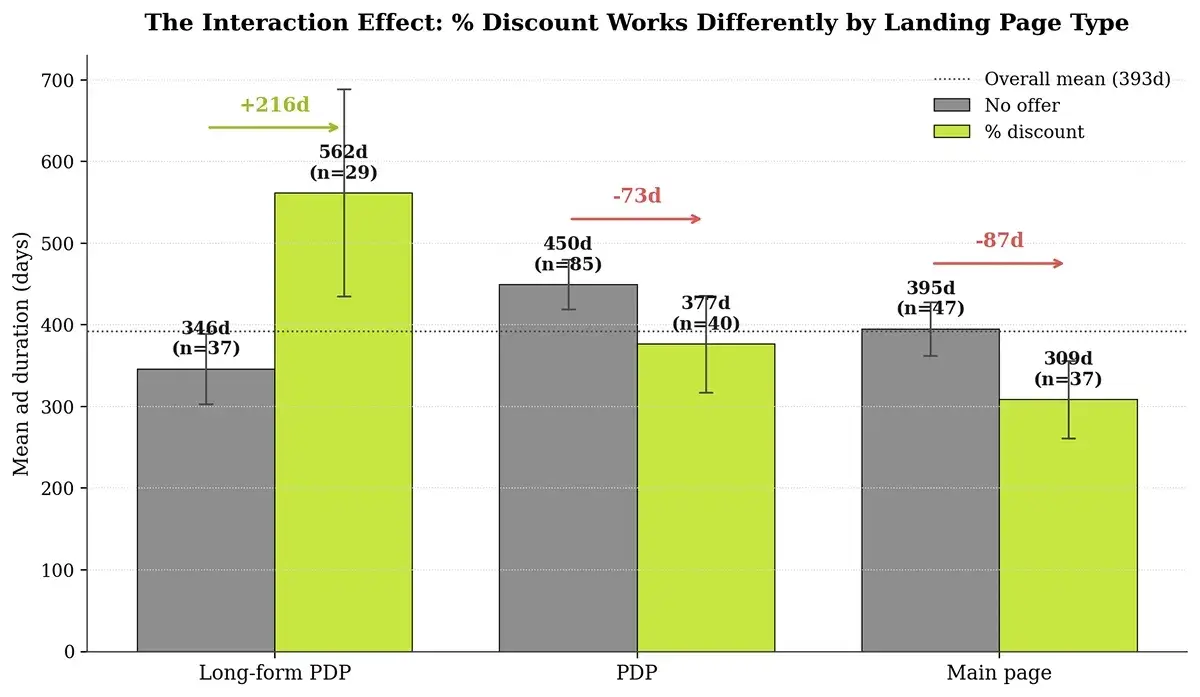
Watch what the same discount does across three pages:
- On a long-form PDP, a % discount adds +216 days, lifting the ad to that chart-topping 562.
- On a standard PDP, the same % discount costs you 73 days.
- On a main page, it costs you 87 days.
Same offer. Opposite outcome. The page decides whether your discount is a weapon or a leak.
In plain terms: a long-form PDP gives a discount room to do its job — the page is already explaining, proving, and convincing, so price becomes the final nudge. Drop that same discount onto a thin product page or a homepage and it just teaches people to wait for a deal, and the ad burns out faster.
And don’t miss the quiet winner. PDP × No offer runs 450 days, and it’s the most common pairing in the whole dataset. Plenty of brands keep a clean product page with no discount alive for well over a year. Bolt a discount onto it and you lose 73 of those days.
Note: These are the standout pairings, not a promise that every long-form-PDP-plus-discount ad hits 562 days. The takeaway is directional and strong: match the offer to the page, and never assume a discount helps by default.
So the real question in supplement marketing was never “should I run a discount?” It’s “a discount to where?” The page and the offer are a single move — brief them together, or you’ll keep paying for the mismatch. Next, we leave creative behind and look at the two markets big enough to compare head-to-head: the US and the UK.
How We Did This - Methodology
Every ad was still running when we captured it. We didn’t wait for these ads to die. That means the durations you’ll see aren’t final, they’re how long each ad had already survived at the moment we pulled it. The real numbers are higher than what we report. In survival terms, the data is right-censored, and our models are built to handle that.
We grouped the ads by brand. Ten ads from AG1 aren’t ten separate results, they come from the same team, the same budget, the same playbook. Our models recognize that, so a few busy brands can’t tilt the findings.
These are the best ads, not average ads. We pulled roughly the top ten longest-running ads per brand. So when we call something “underperforming” later, we mean underperforming relative to this elite group — not relative to the average ad in your account. Everything here is a comparison between winners.
The statistical modeling and analysis behind this report were led by our data analyst, Flóra Pőcze, who built every model you saw.