BeautyMatter Next50 is the biggest event on its calendar: two days in Los Angeles, 450 beauty executives and the 50 brands BeautyMatter expects to shape the next decade. I went for one simple reason, to:
Look for signals of what the beauty buyer of 2027 will look like, and how she will discover, trust, and buy beauty products.
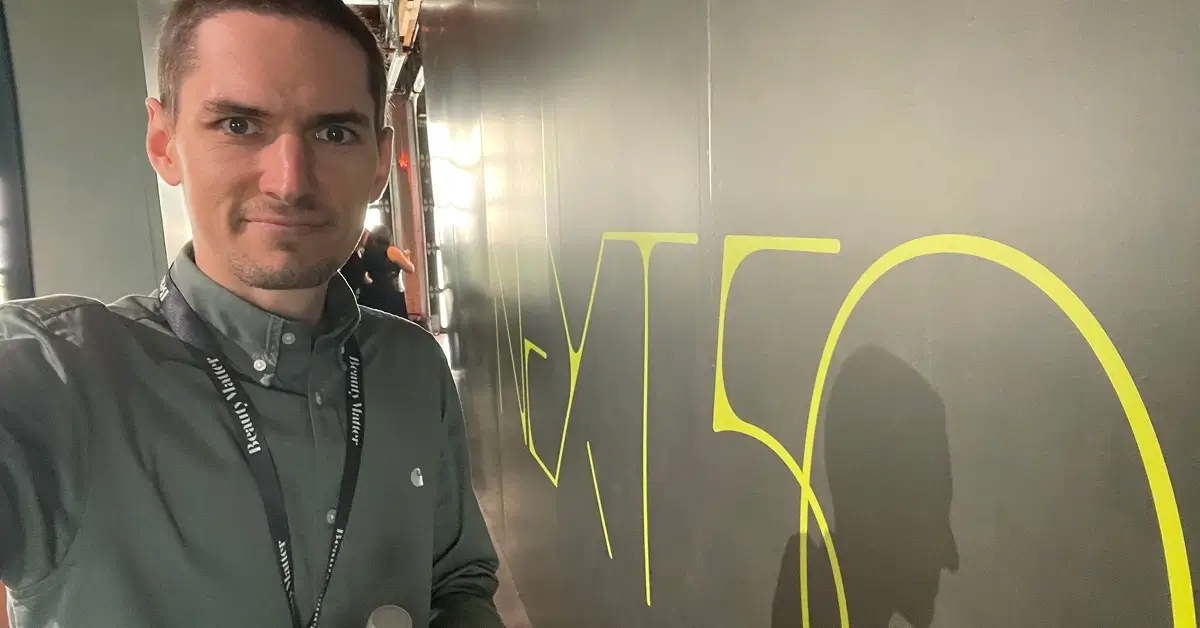
Me at the BeautyMatter Next50 event in LA
To answer it, I talked with numerous industry insiders, sat down to do a deeper interview with six beauty founders and listened to the panels with Ulta Beauty, Sephora, Laneige, ClearStem and the creator-economy operators.
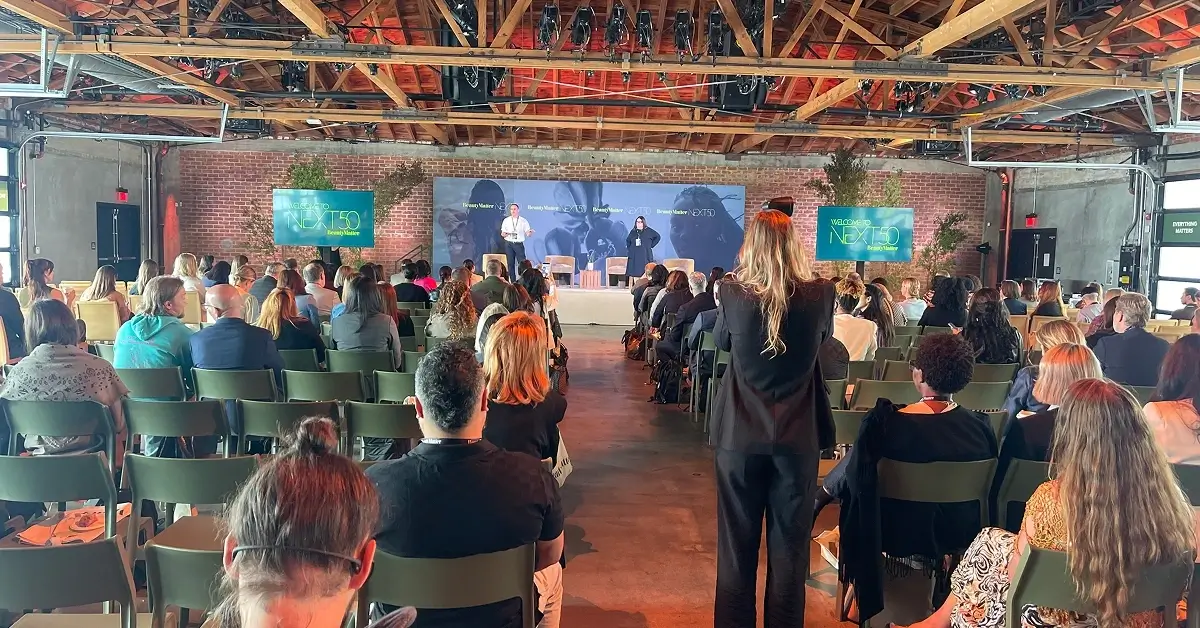
John and Kelly are on stage
Seven patterns came out of the event, and together they describe one customer and one purchase. These are the patterns I saw, with the numbers the founders and retailers gave on record.
#1 She is found by an AI agent before she sees an ad
Every founder I interviewed sees orders coming from AI search.
Nisha Phatak (Lion Pose), whose dark-spot serum sells 60%+ through D2C and about 30% on Amazon, put it plainly when asked whether she sees orders coming from AI search:
“My gut says yes. The direct data is really hard to tell.”
Kim van Haaster, who built the first tulip-based skincare brand (Bloomeffects), sees the same orders and traces them to one place. When an LLM answers a skincare question, it leans on sources where real people compare products in their own words, and Reddit is the largest of them. Her brand had done no AI work at all; the ranking came from the community:
“I think the reason why AI has picked up on it so well is because we’re very strong on Reddit. Just naturally, we have a really strong community.” – Kim van Haaster.
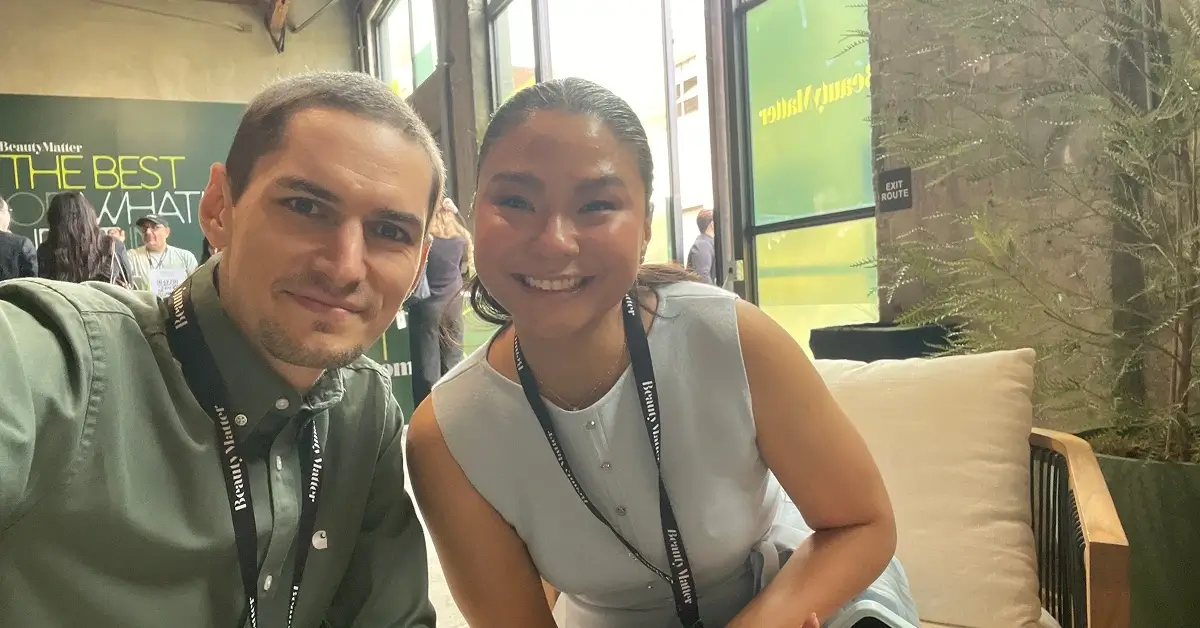
After the interview with Kim
Aamna Adel’s one-year-old hair brand (Rhute Hair) climbed the same rankings against established names on the back of blog content and education.
The retailers have gone further. Ulta Beauty’s Chief Merchandising and Digital Officer, Lauren Brindley told the room that Ulta is “currently the most visible beauty retailer on all the LLMs and the AI platforms”, that it stood up an agentic-commerce team at the beginning of last year, and that it is a founding member of Google’s Gemini shopping programme.
Kelly Mahoney, the CMO described the marketing job in three steps:
- be the best marketer to the guest,
- then to the creators who talk to the guest,
- and now “the best marketer to agents, who are now starting to inform our guests about beauty discovery.”
Sephora is working the same problem from the other direction: instead of only trying to be found by the assistant, it is putting itself inside it. Its ChatGPT plug-in reads a shopper’s Beauty Insider profile, so when she asks ChatGPT for a routine, the answer is built from her own purchase history and preferences and lands on Sephora products.
The brands that already rank did nothing exotic. Reddit, blog content, the “traditional SEO tactics”, in Nisha’s words. One founder runs software to find the Reddit threads worth joining; a person still writes the reply. On the creator panel, Statusphere’s founder added the piece most brands have not noticed yet:
“YouTube Shorts is one of Gemini’s top sources, so a creator already posting on Instagram should post the same clip to Shorts, even if she doesn’t have any followers there.” – Kristen Wiley
If nobody will watch it, no problem, the model will.
2027: the agent is a channel you optimise for like any other, and the brief for it looks like a Reddit thread, not a landing page.
Top of ChatGPT, top of the growth chart
One early example shows what this could be worth. Sebastian Kraft runs a GEO Beauty Index that measures how often ChatGPT recommends each skincare brand in the UK. The two brands it recommends most are CeraVe (in 81.94% of answers) and La Roche-Posay (74.80%).
In the same week, L’Oréal reported 13.9% growth in its dermatological beauty division, and those same two brands led that growth. Kraft is careful to call this “an intriguing observation, not evidence of causation.” Nobody knows yet whether being recommended by AI creates the sales, or whether strong sales make AI recommend the brand. But the two lists match, and that is worth noticing.
#2 She trusts a person, not a follower count
Kristen Wiley (Statusphere), who has run micro-influencer campaigns for a decade, pointed to the shift: the creator economy “used to be an attention-based economy” and is now “a trust-based one.” Her reason is practical.
“Thanks to AI, every video I see, the first thing I look at is, is this real?”
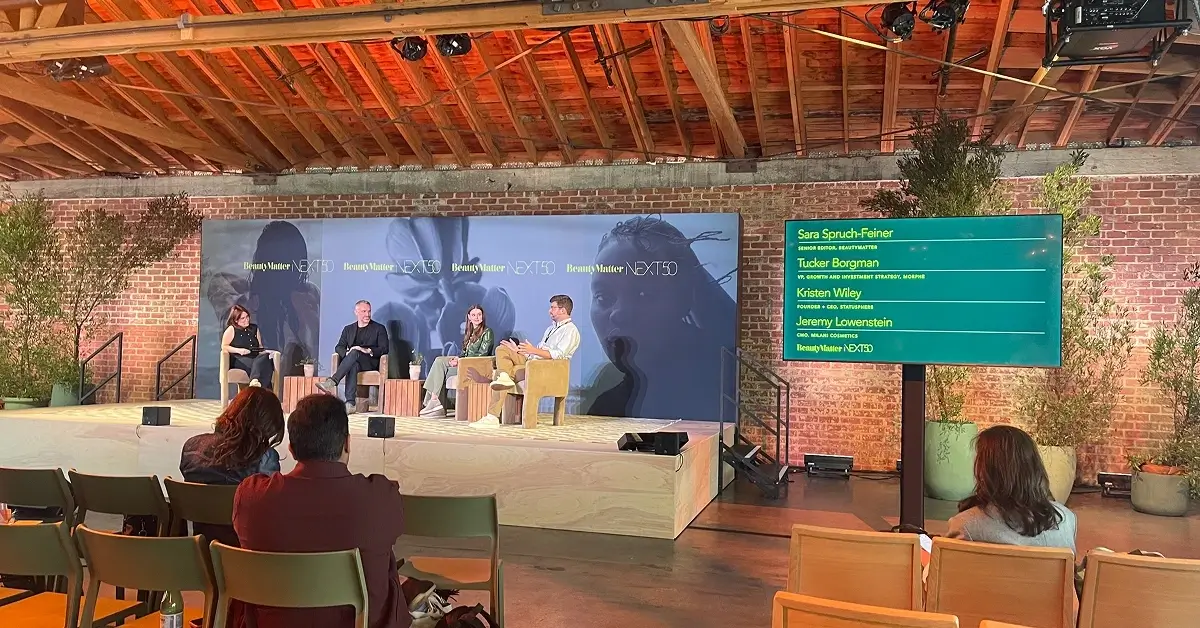
“The Post-Follower Creator Economy” panel discussion moderated by Sara Spruch-Feiner, Senior Editor, BeautyMatter
The mechanics behind that shift were visible in other panels. One mass-market makeup brand now runs campaigns with 150 to 200 nano-creators at once, very selective about which creators it picks and very relaxed about what they say, then boosts the 10–20% of posts that earn it. The team reads “saves” as an intent signal and treats comments like “heading to Ulta right now, picking this up at Target on Friday” as “straight-up purchase intent signals.”
Reach is not important. Behaviour is.
Milani showed what the long version of that looks like. Three years ago its influencer manager noticed a creator called Shelby Ann Bell talking about Milani on her own, with a small following in the affordable-beauty space. The brand sent product with no ask attached. She kept posting because the brand matched what she already stood for: quality makeup at a drugstore price. One of her multi-product videos sent Milani’s Cheek Kiss cream bronzer organically viral. Only then did paid partnerships start, and this year the two ran an event together in Atlanta, taking over a coffee shop so her community could meet her in person. By then she had millions of followers. Jeremy Lowenstein’s point was that none of this was engineered around her follower count: the fit came first, the trust came from three years of her audience watching the brand show up in her routine, and the reach arrived as a by-product.
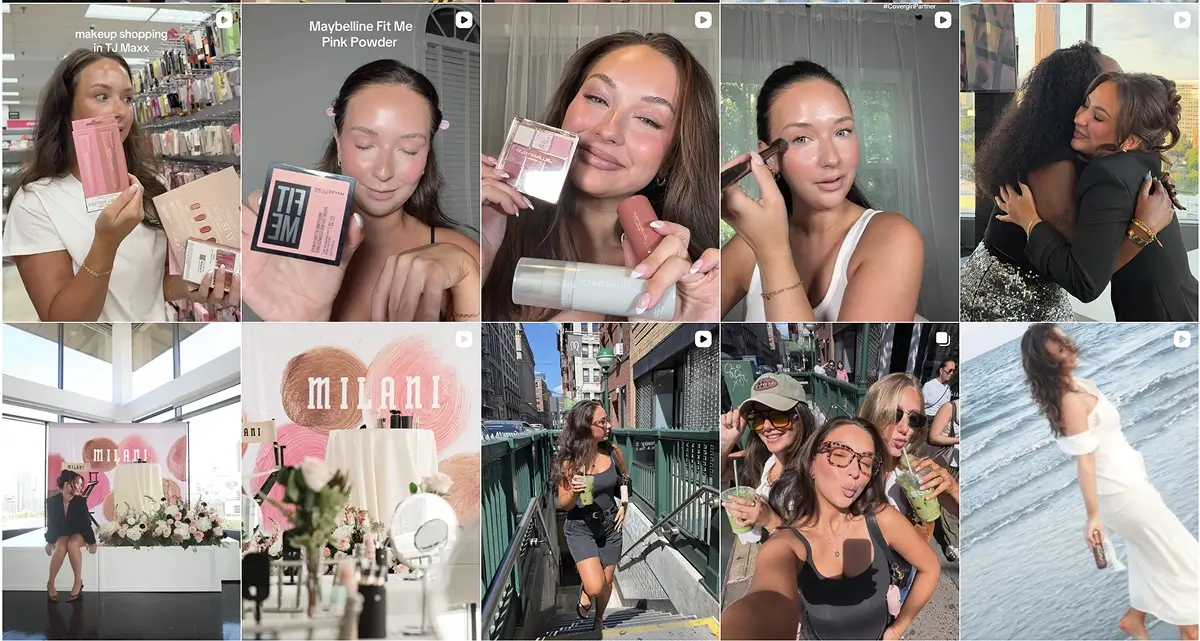
Shelby Ann Bell’s Instagram feed
Sephora’s Amber Turley also mentioned an important point. The more AI enters the journey, the more people want “connection back to people.” She described it as a barbell, heavy at both ends and empty in the middle: on one end, every tool technology can offer, from chatbots to skin scans; on the other, “what is known and true and authentic,” a person whose judgement you trust.
By the time a customer walks into a Sephora store, she has already used the chatbot, read the reviews and asked her friends. The beauty advisor’s job is the last step: a real person confirming that the choice she has already made is the right one.
#3 The founder is the ad
Four of the six founders said the same thing without being prompted during my interviews. Their own face converts better than anything else they run.
- Aamna Adel: “the founder, science expert-led videos are the best performing videos.”
- Roz Samimi, a year and a half into her acne brand (banu skin): “I post as the founder, and that has actually been the best performing ad content.”
The hard part came from Aamna. Her brand has grown fast with a small team, and the bottleneck is the number of people who can produce founder-led content, “because we haven’t really found an agency that’s able to create the type of ads that works for our brands.”
That is the honest state of the market, and it matches the ad data. In our 1,000-ad beauty study, founder-story ads carried a 32% chance of running long against a 25% baseline, and the founder/celebrity play (Haus Labs, Weleda, Kylie) was one of four patterns behind the longest-running ads of the year. The reason is the one Roz gave: the founder’s story is “the highest conviction kind of sell.”
This does not put agencies out of work, it changes what they do. The fastest-growing founders do not choose between founder content and agency content. They run both, plus creators, in one mix, as Nisha put it, and judge every video by the same CPA. Whatever misses the number gets cut, no matter who made it. The founder brings the one thing nobody else can: her own conviction on camera. The agency brings everything around it:
- the new angles to test,
- the next round of improvements,
- and the forty variations of her best video that she will never have time to shoot herself.
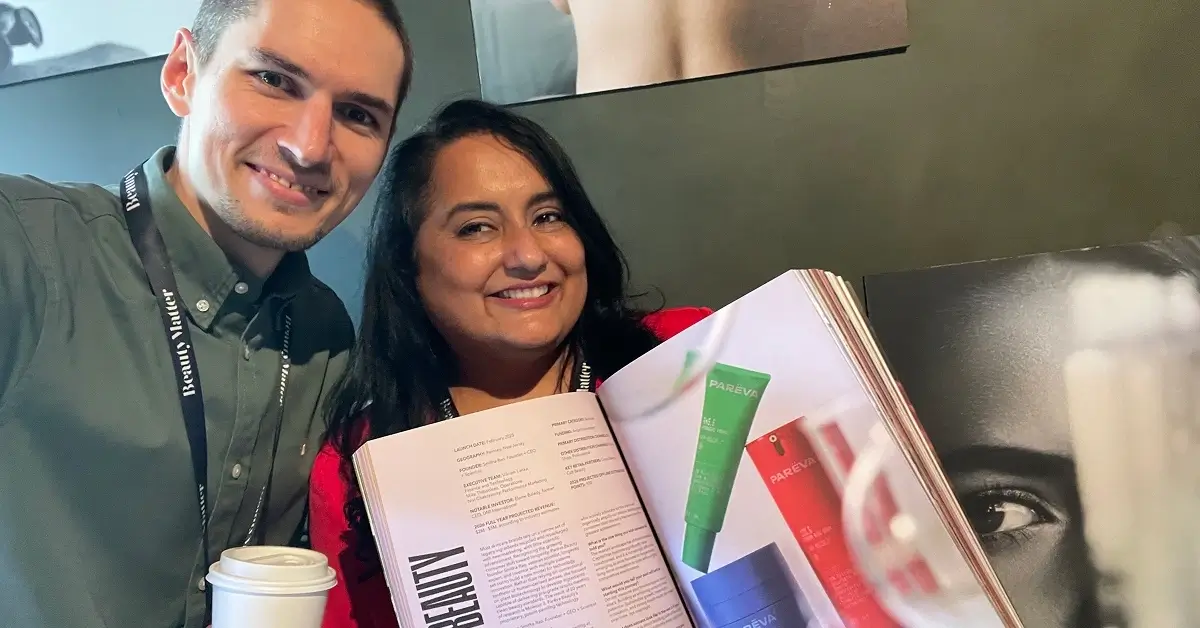
This is how we work with one of our own clients, Paréva Beauty, whose founder Smitha Rao I met again at BeautyMatter Next50 (where she was on the list). Smitha’s own videos are part of every creative batch, because nobody explains her products with more conviction than she does. Our team builds the rest around them: new angles, fresh formats, and the variations of her strongest video that keep it alive for another round of testing.
#4 She buys the clinical result, not the marketing claim
Ask a Next50 founder for her strongest claim and she gives you a figure, a timeframe and a lab.
Rhute Hair’s bond repair: 88% of broken bonds repaired after the first use, 90% within three minutes, seen under the microscope.” Adel chose to quantify because the category does not:
“usually in the bond repair industry, people won’t talk about percentages.” – Dr. Aamna Adel
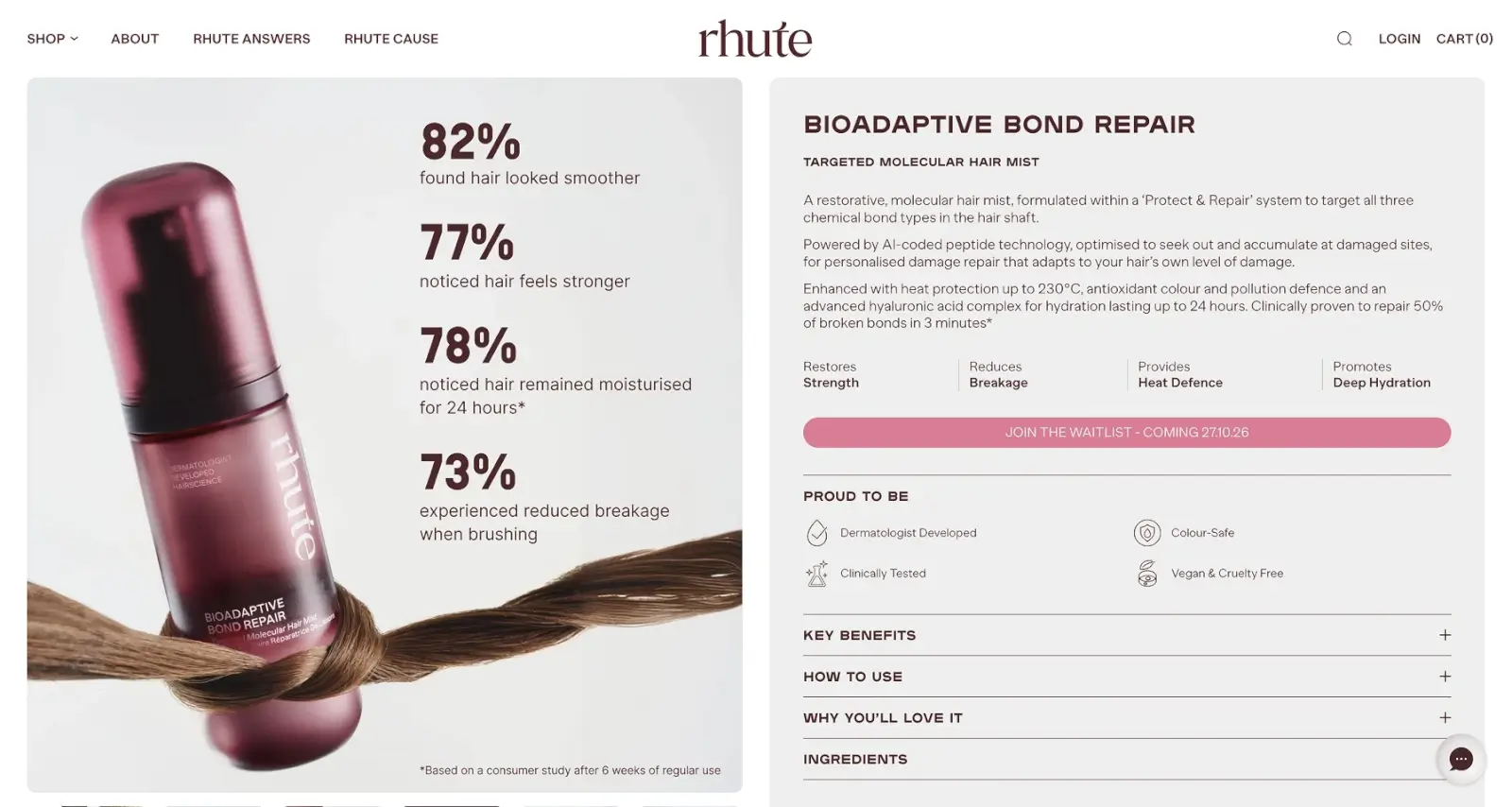
Rhute Hair’s Bond Repair PDP
Knesko’s gold mask: skin hydration up 171% in 15 minutes, with a four-week study behind it, run by a third-party lab.
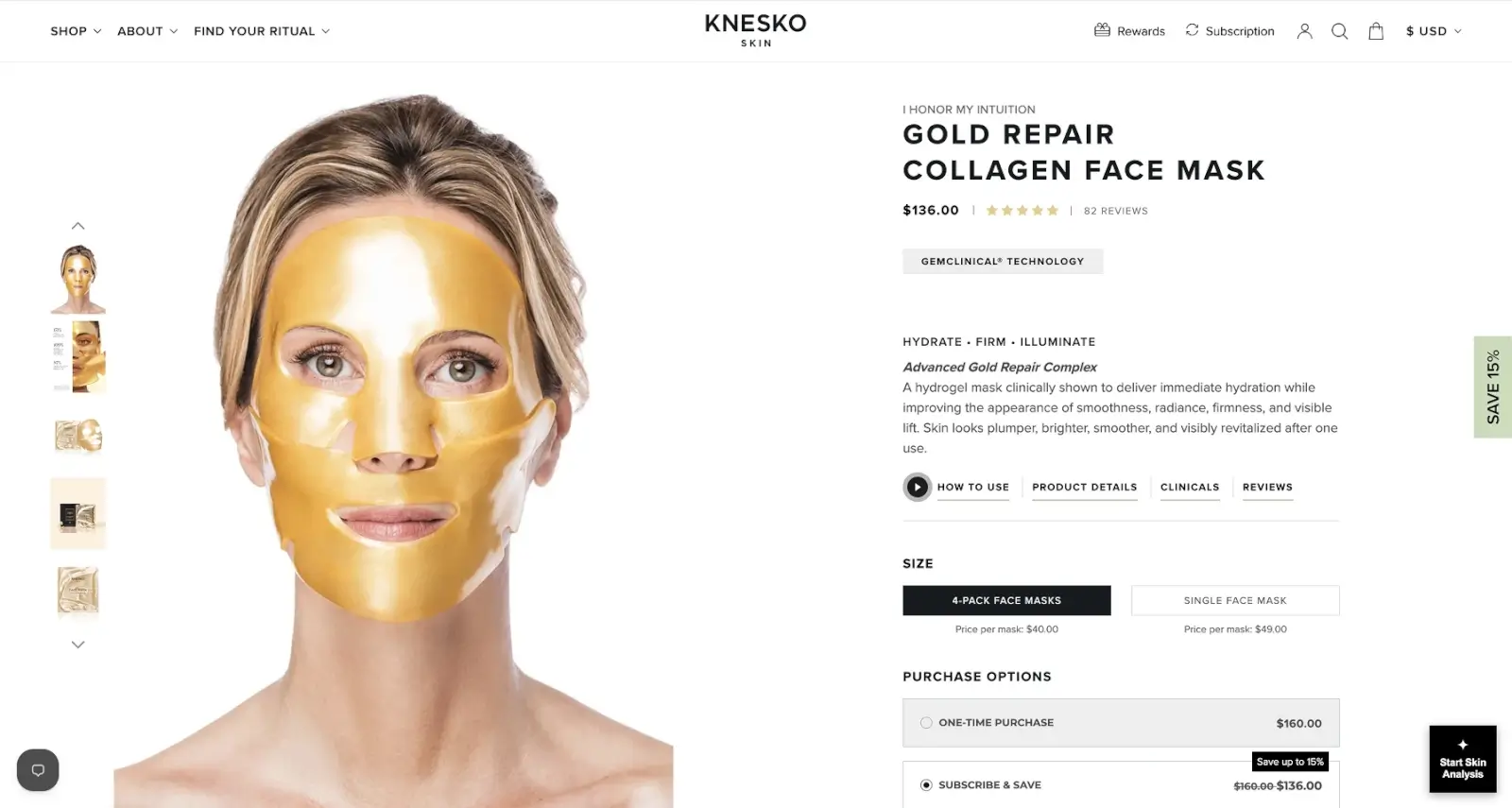
Knesko Skin’s Gold Face Mask PDP
Lion Pose’s serum: 97% of trial participants saw dark spots shrink over eight weeks, third-party lab again.
Now look at what most beauty advertising does with claims. In our 1,000-ad study, 73% of top beauty ads are outcome-focused and nearly half open with a bold claim, while only 5.8% open by naming the customer’s problem.
The problem-callout hook carried the best long-run odds of any opener (32% against the 25% baseline).
What the behavioral data tells us
Consumer-side data from our partner Lóvi, whose AI skincare assistant logs 100,000+ typed conversations and millions of product scans, shows the same gap from the buyer’s seat. More than 95% of moisturizers people scanned claimed hydration; 18% of those people had raised dryness as a concern. When a product goes wrong, 59% of complaints describe a skin reaction and 20% say it did nothing: products fail on tolerance 3 times as often as on efficacy, which is a claim almost nobody makes. And when Lóvi’s users tap through to buy, fit lifts purchase intent 2.9× against 1.2× for price and 1.1× for a discount. The first question after a scan is “does this suit me?” (21%), and price sits under 5%.
Read the sources together. The founders who are winning make a specific, measured, time-bound claim about a problem the customer named. The ads most brands run make a generic claim about an outcome nobody asked about. In 2027, with an LLM summarising the evidence before she reads the ad, an unquantified claim reads as no claim at all.
#5 The first order is a cost, the second is the business
The question “do you optimise first-order CPA or play the long game with LTV ROAS?” produced the most useful answers on the Next50 event, because the answers changed with the age of the brand.
Nisha: “two years ago when we were a much smaller business, it was all about that first order because the first order is really all we had to go off of.” Now she has a full year of data on what a customer spends after the first order, “and so now I’m optimizing CPA more on LTV.”
Kim was more direct: “Within two transactions, we’re making our money back.”
Roz, 18 months in, sees her most loyal customers back “nine or 10 times already” and launched subscriptions a week before the interview.
Polen Kocak of the biotech brand SickScience Labs, reports a 50% returning rate on D2C and has moved from building subscriptions to acquiring new customers, because “when they come and try products, they love it and continue using it.”
Roz also pointed out a catch. She is optimising the first order again, because her customer “might be shopping on our website and they might replenish at Sephora during the Sephora savings event.” Retention still happens; the brand just stops seeing it. The first order has to be profitable on its own, because the second one may be paid to Sephora, not to the brand.
Build the business backwards from loyalty
On stage, Laneige’s Pilgyeom Choi put a 30-year brand’s view on the same economics: “a viral can be similar to flirting”, and the relationship is decided by “the staying power”, which in Laneige’s case is a lip mask launched in 2014 that still sells every second.
The K-beauty economics panel went further: a new brand should “reverse-engineer the business for loyalty, because with the rise of customer acquisition costs, you can’t afford to have that as a sunk cost.”
2027: CAC targets are set from retention data, which means unit economics come before the media plan. A brand that cannot read its own repeat rate cannot set a budget, and will either underspend into a profitable product or overspend into a leaky one.
#6 Retail is the new awareness channel
Retail is one point in this report, deliberately. The founders put it here, and the data they gave is hard to argue with.
- Bloomeffects launched in 850 Ulta stores in February. Her revenue split went from 80/20 DTC to 50/50 in 8 months, and she is “curious to see what next year holds.”
- SickScience Labs launched in 757 Ulta stores.
- ClearStem’s Kayleigh Christina went into 611 Target doors after 9 years of waiting for the right partner.
- Wizard Wellness went into roughly 4,000 doors across Walmart, Target and CVS, and Walmart’s data shows 78% of his buyers are new to the category.
The line that explains why came from Lorne Lucree (Wizard): “We would be burning through cash if we were trying to build awareness online right now.” The retail shelf gave him the organic awareness that paid social could no longer buy at an acceptable price. Kim Van Haaster said the same thing from the other side: “Meta is not what it used to be.”
Kayleigh Christina (Clearstem) gave the rule for making the shelf work: “your shelf should never be an introduction. It should be a little more of a reunion.” The Target shopper with two children pulling on her cart “does not have time to homework at Target.” If she has not already met the brand in her group chat or her feed, the end cap is wasted.
Lauren Brindley (Ulta) made the retailer’s side of the offer: “we’re no longer the second stop”, there is “no standard playbook”, and a brand can start in 10 stores, online or on TikTok Shop. With 47 million loyalty members carrying 95% of sales.
“Ulta can see what a brand’s customer does after the first purchase better than most brands can.” – Lauren Brindley

From Cultural Signal to Consumer Cart panel moderated by Kelly Kovack, Founder + CEO, BeautyMatter
2027: the retail shelf runs on the DTC engine, not instead of it. A brand that cannot convert cold traffic online will be exposed on the shelf, because the shopper arrives having already decided, and she decided somewhere else.
#7 Everyone still runs 30% off
Three founders were asked about their Black Friday offer. Three gave the same answer: 30% off, site-wide. One adds a gift with purchase. One holds a ROAS floor all year and breaks it only in the run-up to Black Friday, so that they can amplify during the campaign.
Other speakers at the same event argued against discounting. On the K-beauty economics panel, pricing was called “a lagging indicator of equity”: your price tells the market how strong your brand is. The customer “will find the price that she thinks is appropriate”, so a brand has two options: prove it is worth the premium, or watch the market push its price down.
Cosnova Beauty kept its prices flat through inflation and tariffs for exactly this reason: once a brand starts moving its price around, it loses the trust of its community. And the middle of the market, masstige, is being squeezed from both ends, by cheaper brands with better formulas and by premium brands with stronger proof.
Our own data agrees with the panel, not the founders. Across 1,500 top-performing beauty and supplement ads, urgency and scarcity cut ad lifespan by roughly 40%, and 80% of the longest-running beauty ads carry no offer at all. Daniel McCarthy of Theta said the quiet part on D2C Diaries:
“If you acquire a customer on a discount, mechanically it’s going to lower their CLV.” – Daniel McCarthy
Lóvi’s data makes the same point from the buyer’s side. When a shopper scans a product and taps through to buy, a discount raises the chance of purchase by only 1.1×, the weakest of the five factors measured. A product that fits her skin raises it 2.9×. In other words, telling her the product is right for her sells almost three times better than telling her it is cheaper.
One important note on discounting
None of this means a brand should never discount. Black Friday is the one week of the year when the customer arrives looking for a deal, with her favourite products already in mind. A discount she expects does not read as weakness; a discount she sees every month does. The founders at BeautyMatter Next50 were doing the sensible thing: running the offer where it is expected, and most of them holding their price the rest of the year. The damage comes from the brand that discounts in March to hit a number, then has nothing left to offer in November, and from the brand whose Black Friday customer never comes back at full price.
2027: Black Friday stays, and stays at 30%. The brands that win keep the discount to that one week, make it an offer worth waiting for (a bundle or a gift over a flat percentage), and go into January with cold audiences and a full-price story, so the November spike does not become the year’s only growth.
The 2027 playbook
She is discovered by an agent, convinced by a person, sold by a number, kept by the second order, reminded by the shelf and tempted by the same discount as last year.
The order matters. The first five patterns are the online engine of the brand:
- Being found by AI.
- Being recommended by creators people trust.
- Putting the founder’s own face in front of the customer.
- Making a claim with a number behind it.
- And pricing the first order so the second one carries the business.
- Retail, pattern six, only pays off once that engine works, because the shopper has already made up her mind before she reaches the shelf.
- Black Friday, pattern seven, is the one habit the industry can keep, as long as it stays one week a year.
Build the first five. Earn the sixth. Keep the seventh to one week.