


It’s a tradition at Evolut: once or twice a year, we go deep down the rabbit hole and research the top-performing beauty ads in the industry. We analyze them across numerous metrics to bring you the most important conclusions, the ones that will help you create better ads.
After our first beauty ads research and our beauty intelligence report, this deep dive is meant to show you what medium-sized and large brands are using successfully: which angles, hooks and scripts work in the beauty space, and what drives conversions in this hyper-saturated market.
What 1,000 Ads Told Us This Year
The median beauty ad in our study ran for 20 days.
Top supplement ads lasts more than a year. In beauty, half of all ads are gone before the end of their third week.
That doesn’t mean beauty ads are weaker. Beauty moves faster: product launches, shade drops, seasonal edits, creator collaborations, retailer pushes. Brands test hard, cut fast and ship again. It also changes the question worth asking. In a category where most ads die within weeks, the ones that survive tell you the most about what the audience wants.
So this report asks a simple question: what do the top-performing beauty ads have in common, and which of those choices keep a winning ad running longest?
To answer it, we pulled 1,000 Meta ads from 100 beauty brands through Trendtrack, ten ads per brand. Most names will be in your own feed already: Charlotte Tilbury, Rare Beauty, Fenty, Glossier, The Ordinary, Paula’s Choice, Kérastase, Medicube, Beauty of Joseon, Sol de Janeiro and ninety more. Then we coded every ad by hand on the same dimensions as our supplement work:
- creative format
- the hook that opens it
- seven persuasion angles
- landing page type
- offer type
- the words on the creative
- the full video script, where there is one
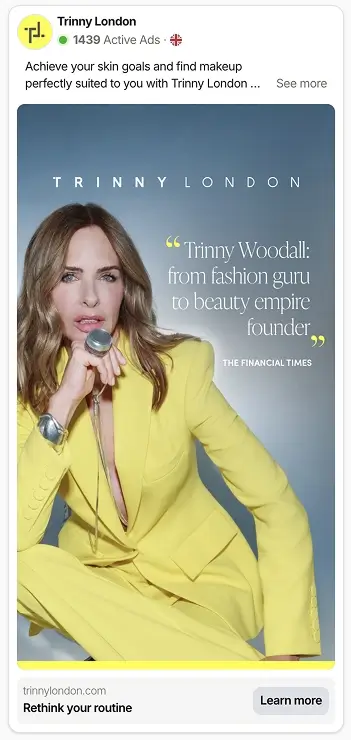
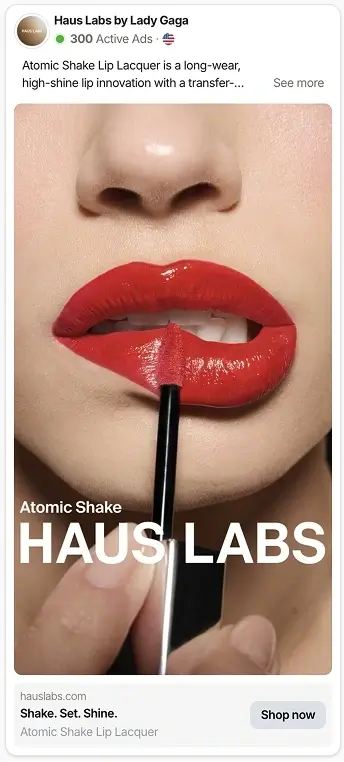
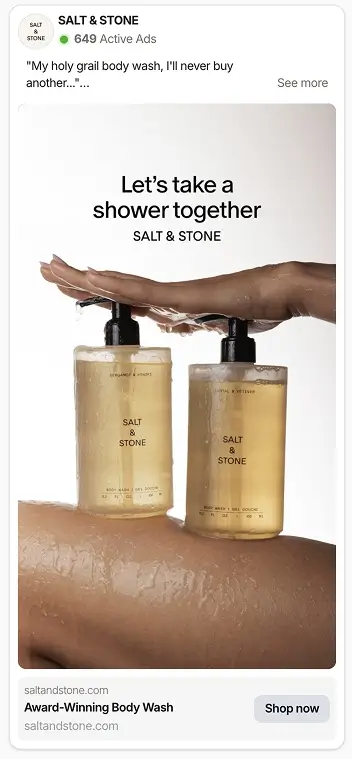
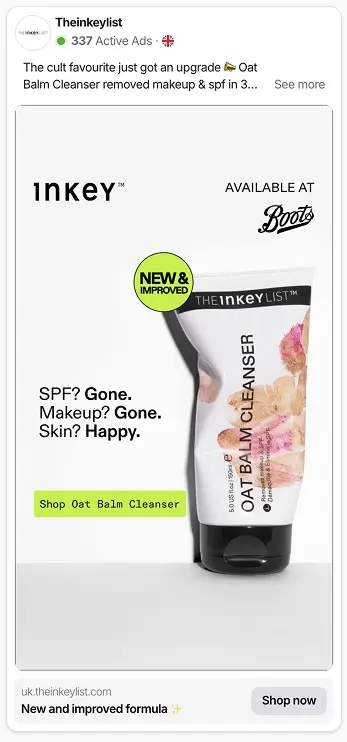
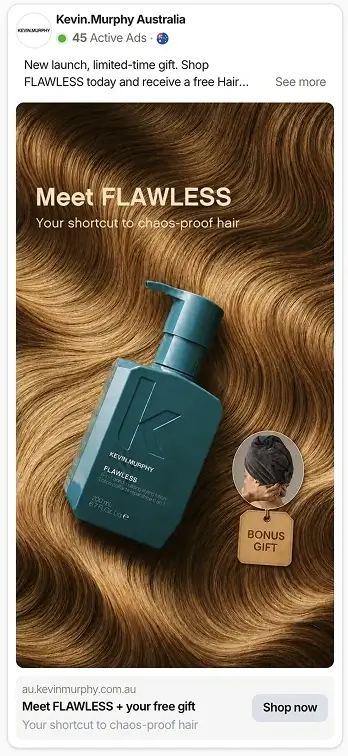
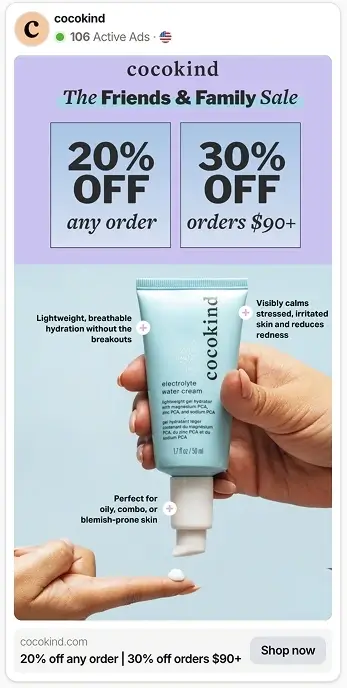
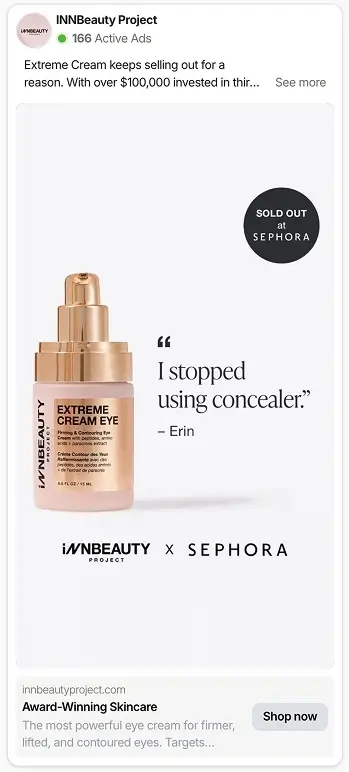
Top performing Trinny London, Haus Labs and SALT & STONE static ads from the ad library.
We know which ads have already been switched off (549 of them) and which are still running (451). That lets us model survival properly, instead of guessing.
We wanted to answer three questions:
- Why do some beauty ads run for months while others stop within a week?
- Which creative choices keep an ad running, and which kill it early?
- Can you tell whether an ad will last before you spend money on it?
Let’s get into it.
/ You can read more about the Methodology at the end of this article /
SPOILER: Problem callout is the best-performing hook in beauty, and one of the least used (5.8% of ads). More findings below.
The Brands Behind the Data
The 100 brands weren’t picked at random. Every one of them runs Meta ads consistently, tests creative at volume, and shows up in the saved libraries of performance marketers who watch this category closely.
They cover the full map of modern beauty: color cosmetics (Rare Beauty, Fenty, NARS, Kylie Cosmetics, Makeup by Mario), clinical and ingredient-led skincare (The Ordinary, Paula’s Choice, Medik8, The INKEY List), K-beauty (Beauty of Joseon, COSRX, Anua, Medicube, TIRTIR, SKIN1004), prestige skincare (Charlotte Tilbury, Tatcha, Sulwhasoo, ELEMIS), haircare (Olaplex, K18, Kérastase, Davines, OUAI, Gisou), and body and sun (Sol de Janeiro, Bali Body, Bondi Sands, Ultra Violette).
Geographically, the dataset leans where the spend is. Beauty brands rarely advertise in just one market: more than half of the 100 brands ran ads in several countries at once. So a brand can appear in more than one line below:
- United States — 592 ads, from 77 brands
- United Kingdom — 82 ads, from 27 brands
- France — 37 ads, from 14 brands
- Italy — 28 ads, from 11 brands
- Canada — 28 ads, from 14 brands
- Australia — 18 ads, from 10 brands
The rest spread across more than 30 other markets, from Ireland and Germany to India, Brazil and Taiwan. Beauty is more global than supplements. The same brand often runs localized versions of one creative in five or six markets at once.
Geographically, the dataset leans where the spend is. Beauty brands rarely advertise in just one market: more than half of the 100 brands ran ads in several countries at once. So a brand can appear in more than one line below:
- United States — 592 ads, from 77 brands
- United Kingdom — 82 ads, from 27 brands
- France — 37 ads, from 14 brands
- Italy — 28 ads, from 11 brands
- Canada — 28 ads, from 14 brands
- Australia — 18 ads, from 10 brands
The rest spread across more than 30 other markets, from Ireland and Germany to India, Brazil and Taiwan. Beauty is more global than supplements. The same brand often runs localized versions of one creative in five or six markets at once.
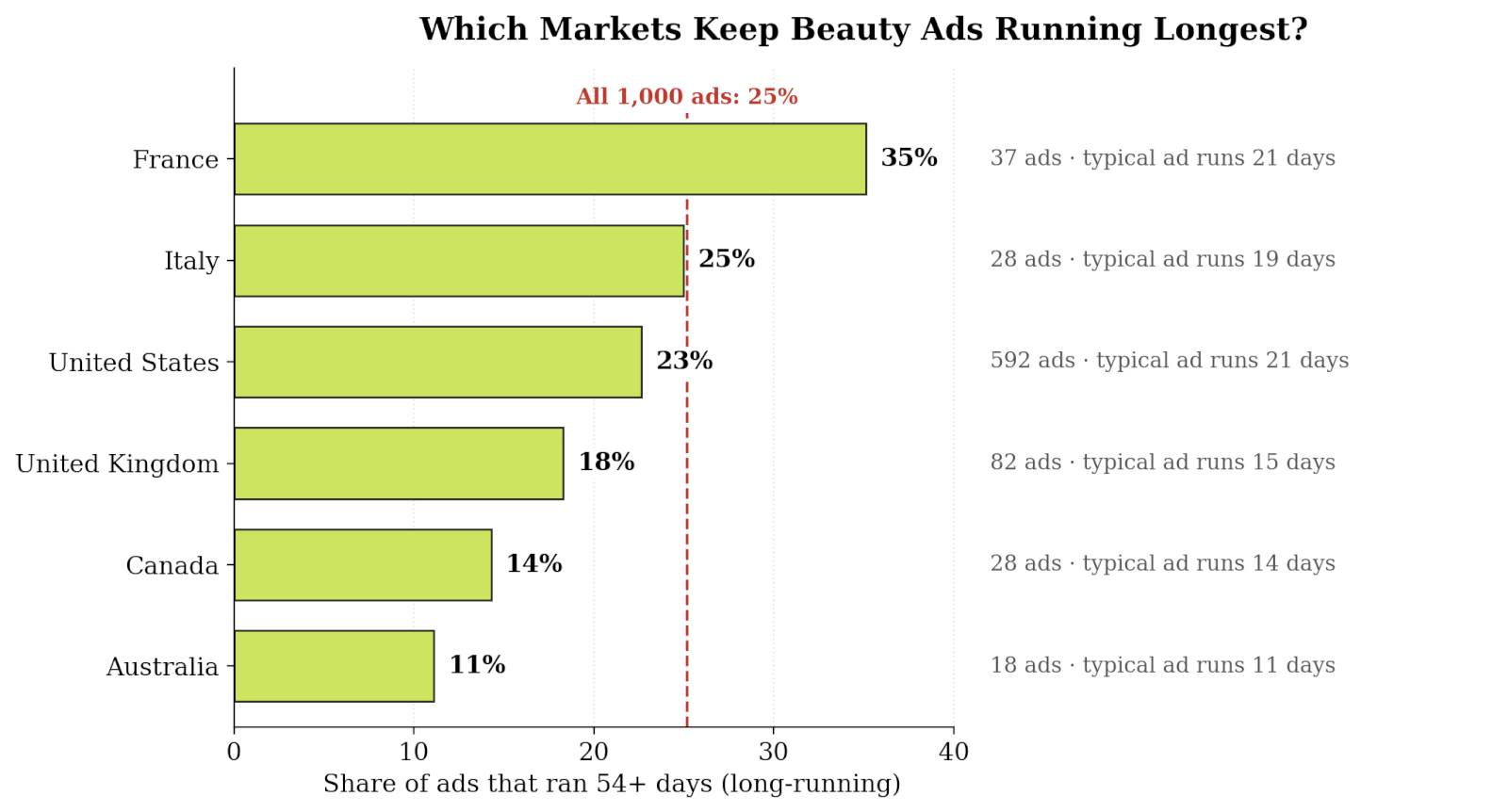
A horizontal bar chart showing the share of beauty ads that ran 54 days or more, by market, against a 25% average for all 1,000 ads.
The US dominates the volume, but it doesn’t dominate on ad longevity. The typical US ad runs about 21 days. French ads have the widest spread and some of the longest runs in the set. We come back to country in Pillar 3.
Unlock our curated library of 1,000 top beauty ads from brands like Haus Labs, Olaplex, Caudalie, Rituals, Davines, OSEA, The INKEY List and more. See what’s actually working, from UGC hooks to high-converting landing pages.
Want to see every ad, with its copy, visuals and videos? Drop your name and email below, and we’ll send you a private link to browse our exclusive winner ad library, curated by our performance team.
Pillar 1 — A Snapshot of All 1,000 Ads
Before we model what makes an ad last, here’s what the 1,000 ads look like: every choice these brands made, before we ask which ones paid off.
Duration. The average ad ran 46 days, but the median is 20. That gap is the following: a large mass of ads dies in the first two to three weeks, and a small group runs for months. A handful passed the one-year mark, the longest at 848 days (a Davines video). The top quarter of ads ran 54 days or longer. That’s our “long-running” line for the rest of this report.
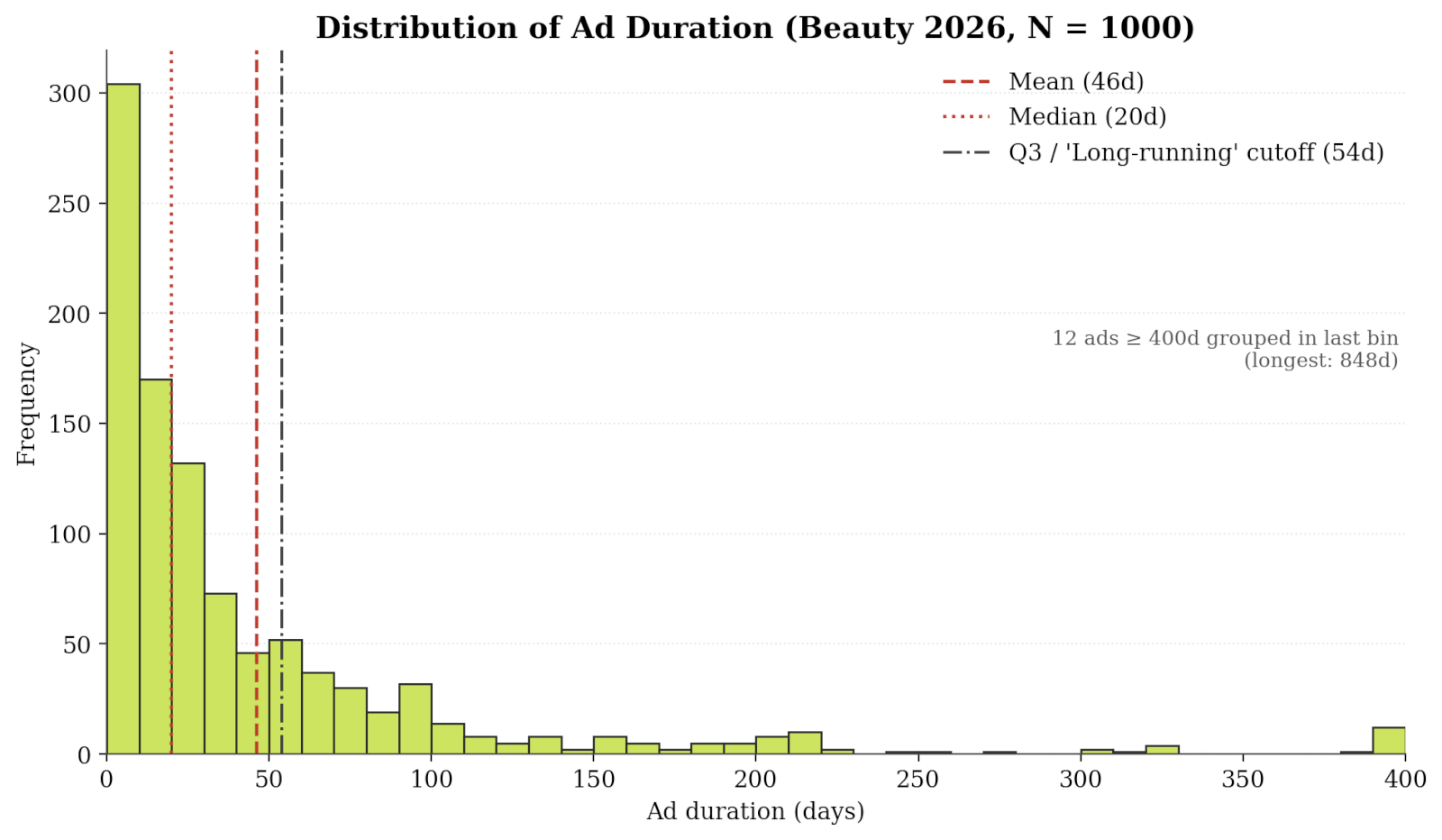
A histogram of how long 1,000 beauty ads ran, heavily skewed toward short runs. About 300 ads ran under 10 days. The median is 20 days, the mean is 46 days, and the long-running cutoff is 54 days.
Creative format. Single image leads at 48.2%, then video at 30.8% and UGC at 21.0%. Carousel and animation, still around in supplements, barely show up in top beauty creative.
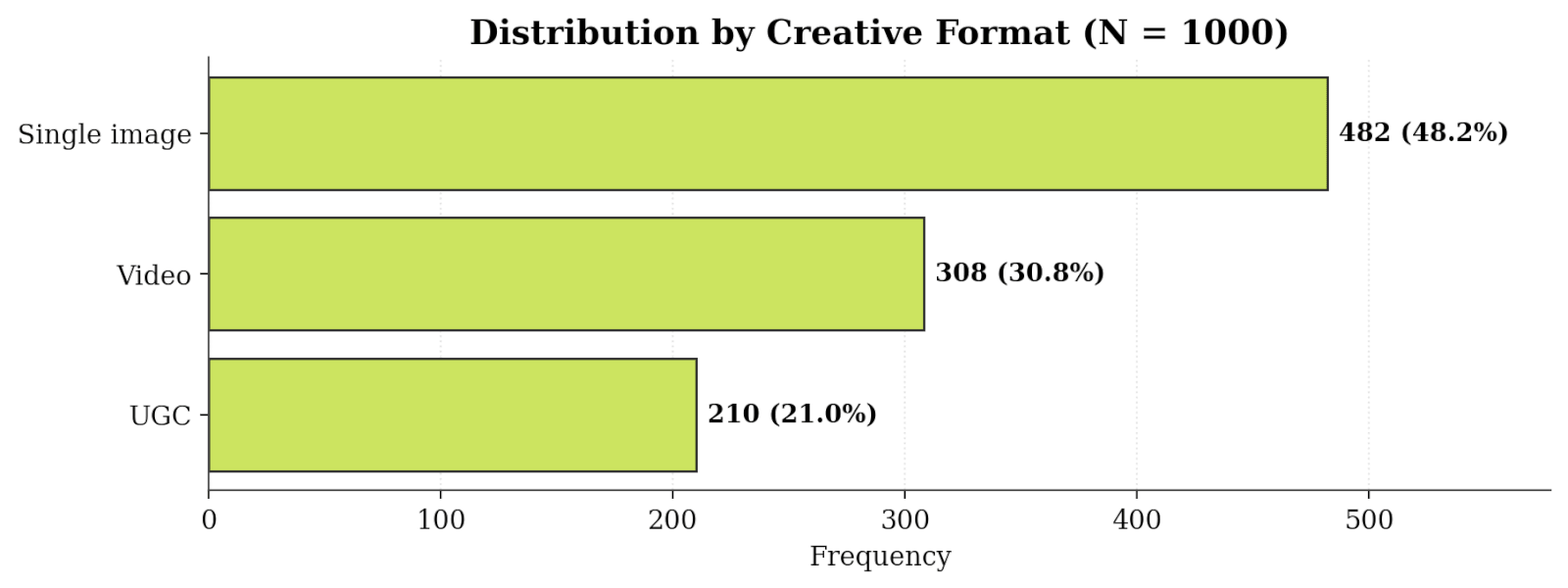
A horizontal bar chart of 1,000 beauty ads by format.
Hook type. Nearly half of all beauty ads (48.6%) open on a Bold claim: “The #1 mascara in the UK,” “Skin that keeps its promises.” Then come Customer POV (15.2%) and Offer / Discount openers (14.4%). The rest are thin: Problem callout 5.8%, Stat 4.8%, Question hook 3.8%, Pattern interrupt 3.6%, Founder POV just 1.5%. Hold on to that Problem callout number.
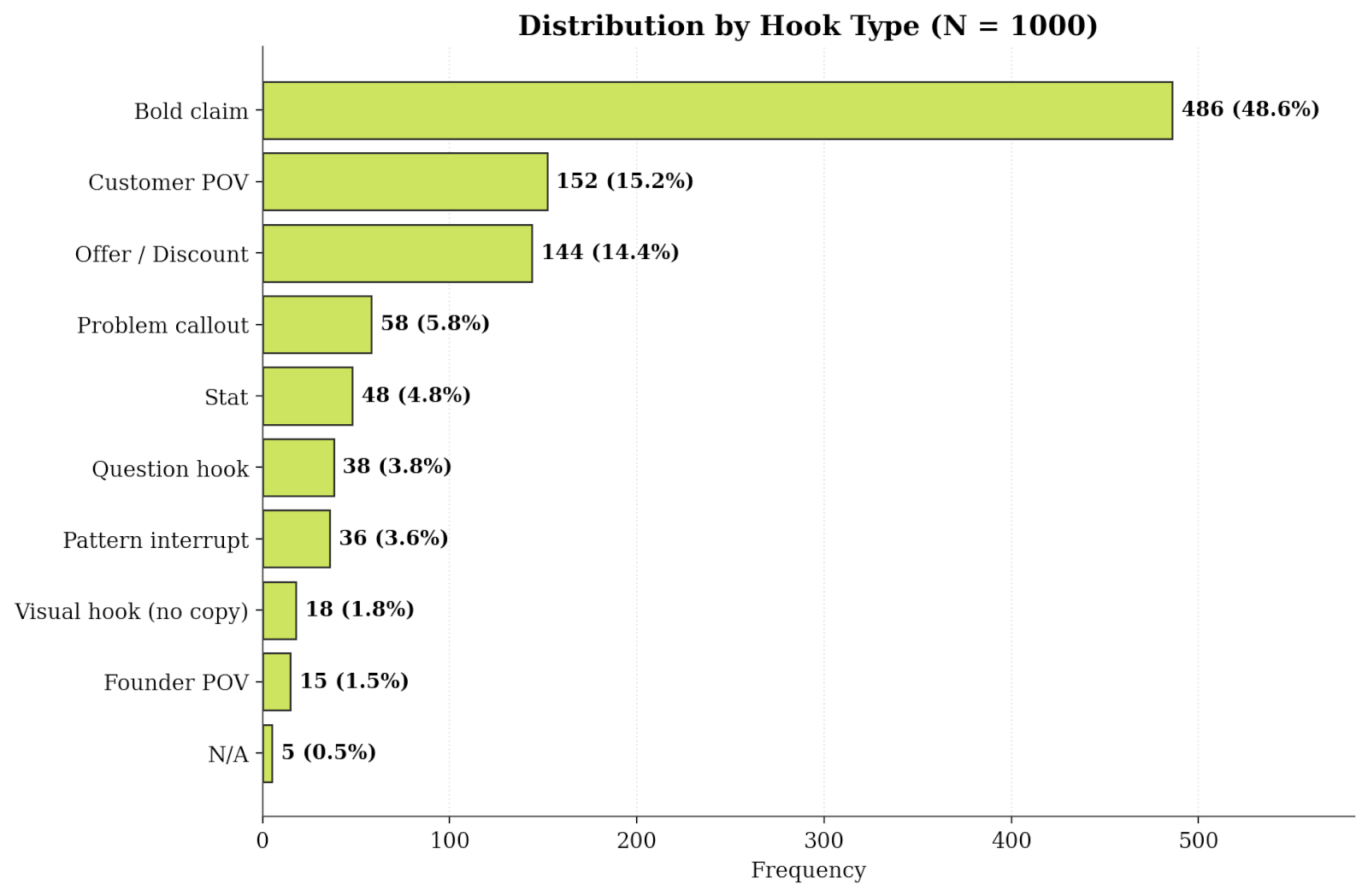
A horizontal bar chart of 1,000 beauty ads by opening hook.
Customer Voice vs. Brand Voice
At Evolut, we face this dilemma often, especially with new clients: should we keep the brand voice the client asked for at the start, or shift the tone toward the customer’s own language and direct response? In most cases, the data tells us to do the latter. The customer’s voice usually wins.
Don’t push elevated, aspirational messaging if it doesn’t sell. Listen to your data instead, and speak clearly and simply. Customers are less sophisticated than you think.
Landing page. Product pages dominate at 48.1%. The surprise is the next two: dedicated landers (16.5%) and retailer links (16.1%), mostly Sephora, Amazon and Ulta. One in six beauty ads sends the click to someone else’s store. Main pages take 13.6%.
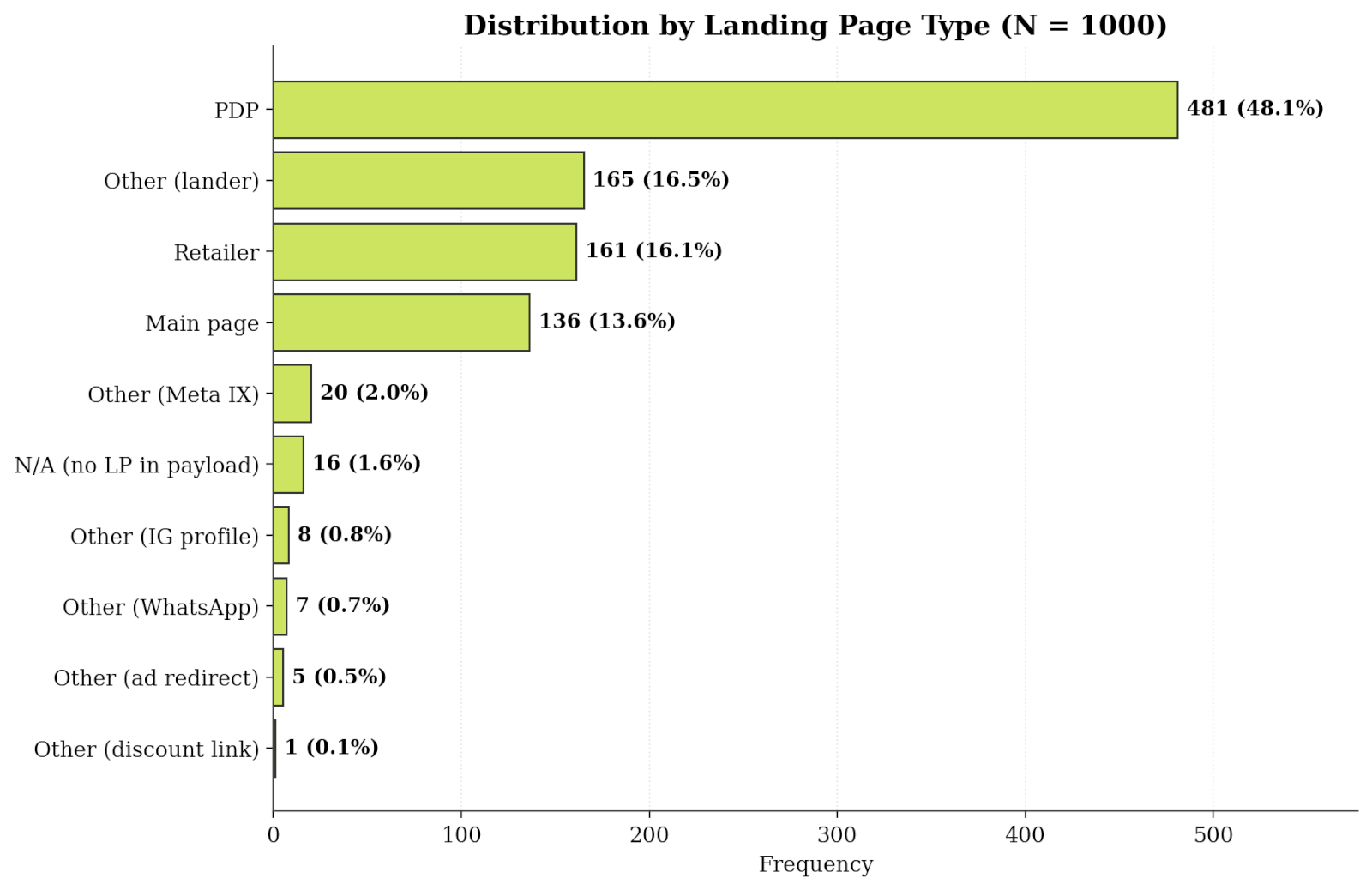
A horizontal bar chart of where 1,000 beauty ads send traffic.
Offer type. 70.9% of beauty ads carry no offer at all. Percentage discounts appear on 15.2%, bundles on 6.5%, free gifts on 4.5%, free shipping on 1.8% and buy-one-get-one on 1.1%. Top beauty brands mostly sell on desire, not on price.
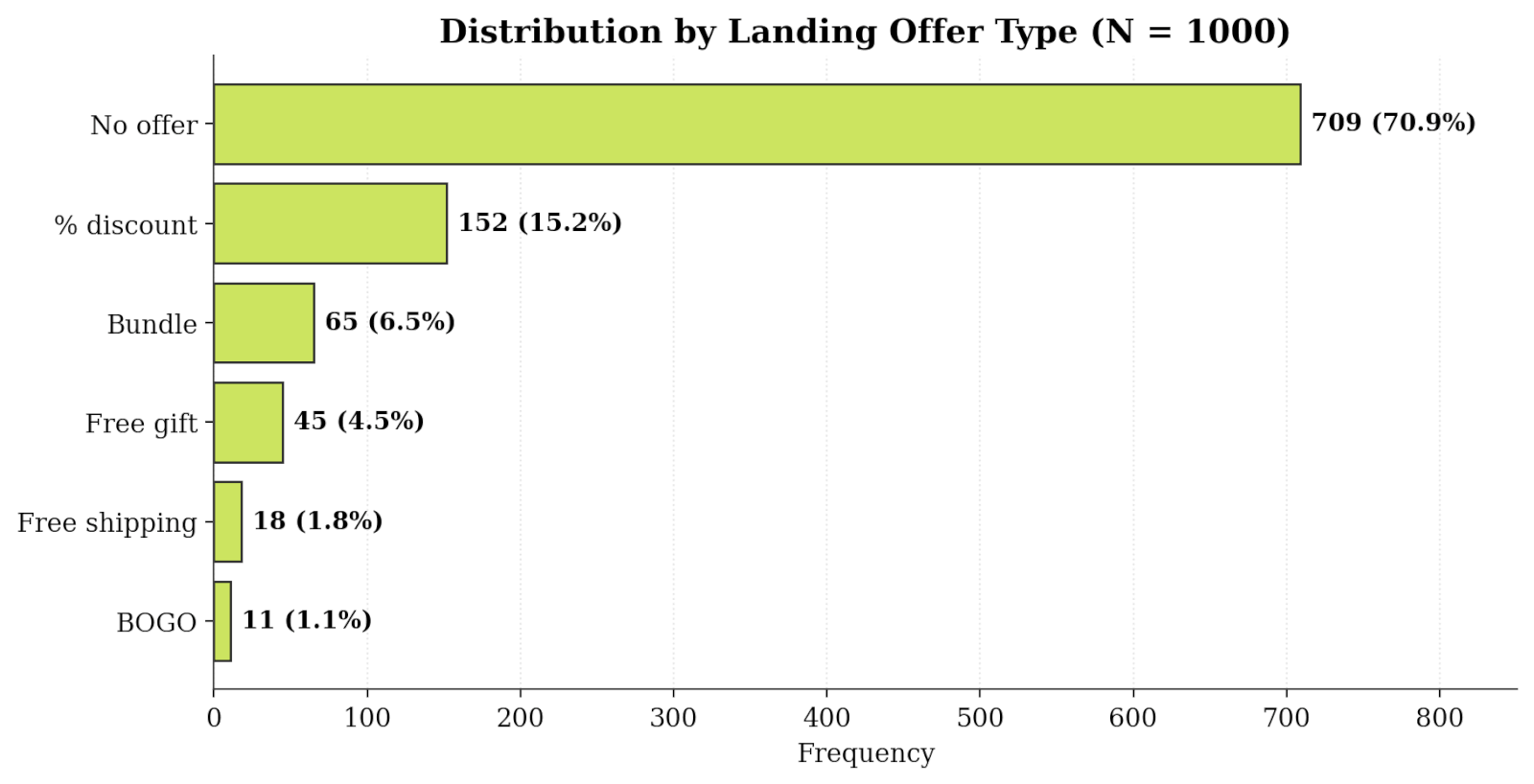
A horizontal bar chart of the offers used in 1,000 beauty ads.
Brand by brand. The spread between brands is huge. Ten brands keep their ads running over 100 days on average: Davines (240), Medicube (208), Kylie Cosmetics (159), Gisou (140), KORA Organics (134), Prose, Oribe, Kiehl’s and more. At the other end, 17 brands average under 15 days, with cocokind and Anua at four. The thin black line on each bar shows how consistent a brand’s ads are. Short line: its ads run for similar lengths, so trust the average. Long line: one or two outlier ads are pulling the average up.
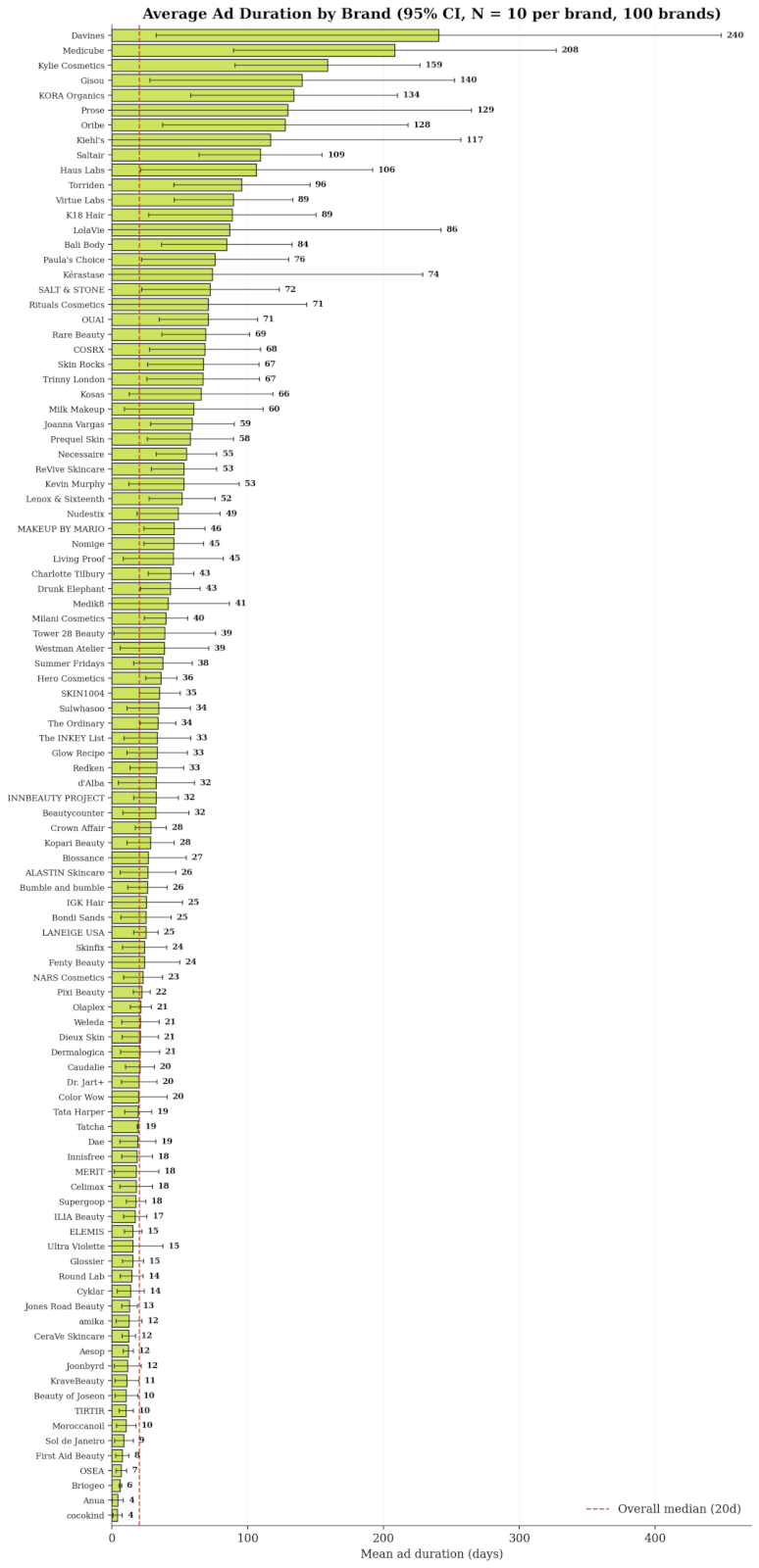
A tall bar chart ranking 100 beauty brands by the average run time of their top 10 ads, against an overall median of 20 days.
None of this tells you what works. It tells you what brands are doing. The next six pillars are about the gap between the common move and the move that keeps an ad alive.
Pillar 2 — What Makes a Beauty Ad Survive
Here we switch from description to evidence, using the same method as last time: survival analysis, the maths doctors use to study how long patients live, applied to how long ads live.
In plain terms: we track every ad day by day and ask, “how many are still running?” Plot that over time and you get a survival curve, a picture of how fast the ads in a group drop off.
This time, we know which ads have been switched off and which are still running, so the curve shows when ads stopped, not just a snapshot.
Across all 1,000 ads, the median survival time is 45 days. By day 45, half of all beauty ads are gone.
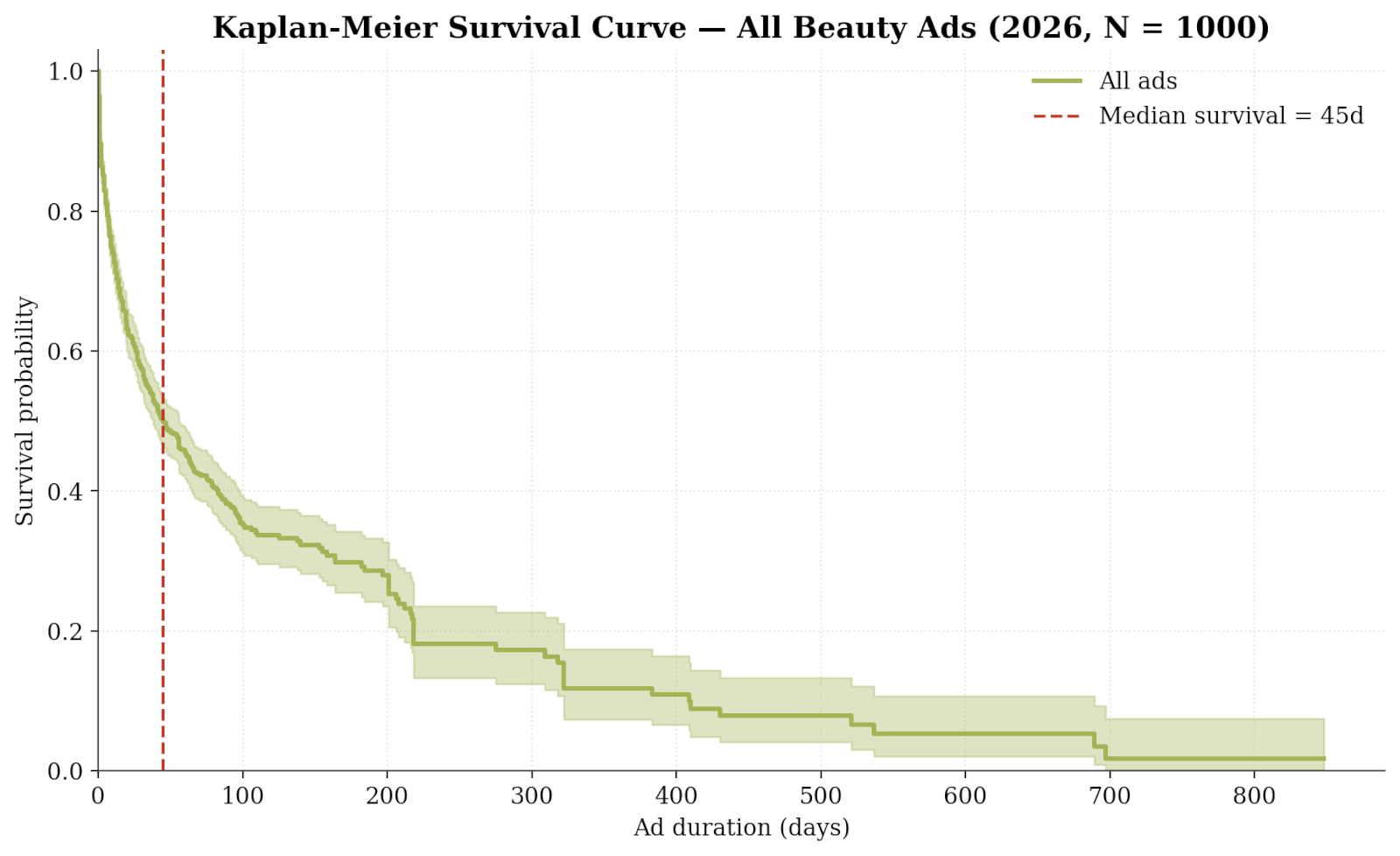
A Kaplan-Meier survival curve showing the probability that a beauty ad is still running over time, across 1,000 ads. The curve drops steeply in the first weeks, crosses 50% at a median survival of 45 days, falls to about 20% by day 220, and then flattens into a long tail that reaches past 800 days.
Look at the shape. The curve falls steeply in the first three weeks: that’s the testing phase, where most creative is killed. It then flattens into a long tail. Once a beauty ad survives its first month, its odds of running for months improve sharply. The first 30 days are the filter.
Then we tested the four structural levers every beauty team argues about: creative format, landing page, offer and hook. In supplements, only format mattered. In beauty, all four move survival.





This is the first big difference from supplements. Supplement buyers are on a long, considered journey, and the page or offer barely changed an ad’s life on its own. Beauty is an impulse category, and every structural choice leaves a mark.
Note: Each test looks at one lever at a time. The next pillar looks at them together, with all else held equal.
Pillar 3 — Your Ad's Odds Before You Launch
Pillar 2 showed which levers move survival. This pillar turns that into something you can use while you’re briefing a creative: a probability.
We drew the line at the top 25% of ads, those that ran 54 days or longer, and called them “long-running.” Then we built a model that reads an ad’s choices and predicts its odds of clearing that bar, with every other choice held constant.
By creative format. Single image comes first (27%), then video (24%) and UGC (23%). The gap is modest once everything else is controlled for, but it points the same way as the survival curves: in beauty, the clean static image is the most dependable workhorse.
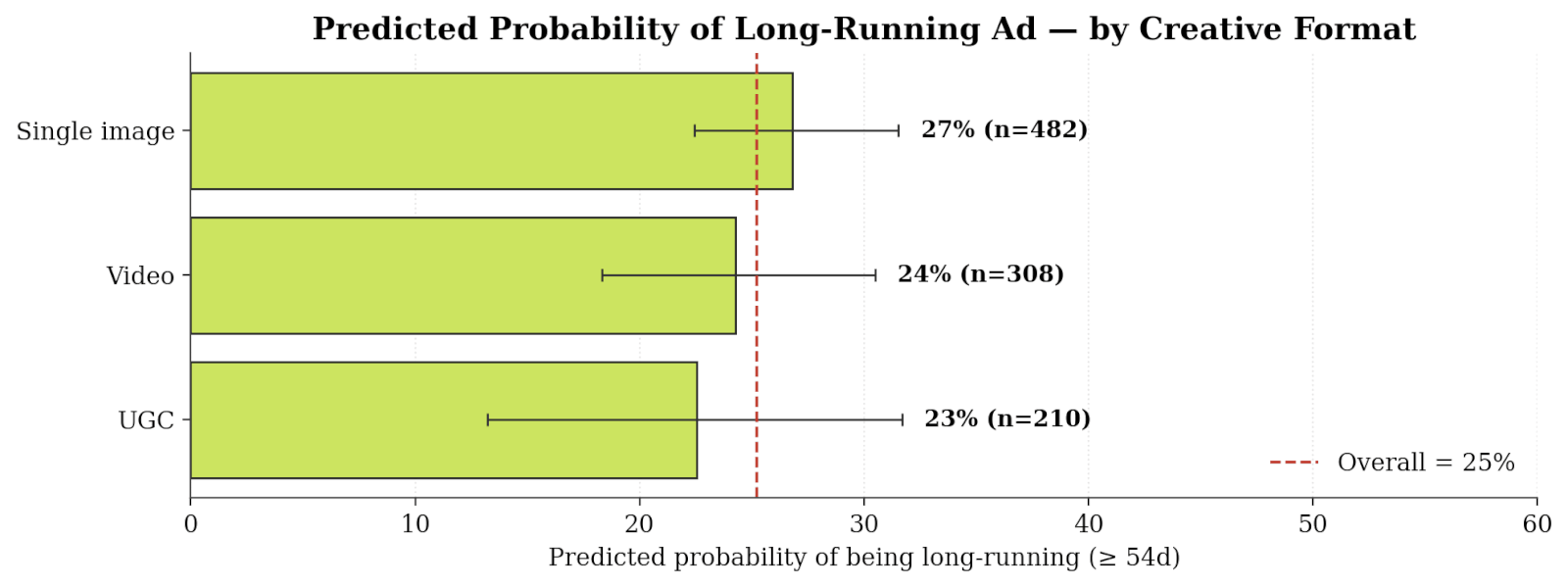
A bar chart of the predicted chance that a beauty ad runs 54 days or more, by format, against a 25% overall average.
By landing page. This is the loudest signal in the model. Ads that land on a brand-owned product page have a 29% chance of running long. Ads that send traffic to a retailer: 10%.
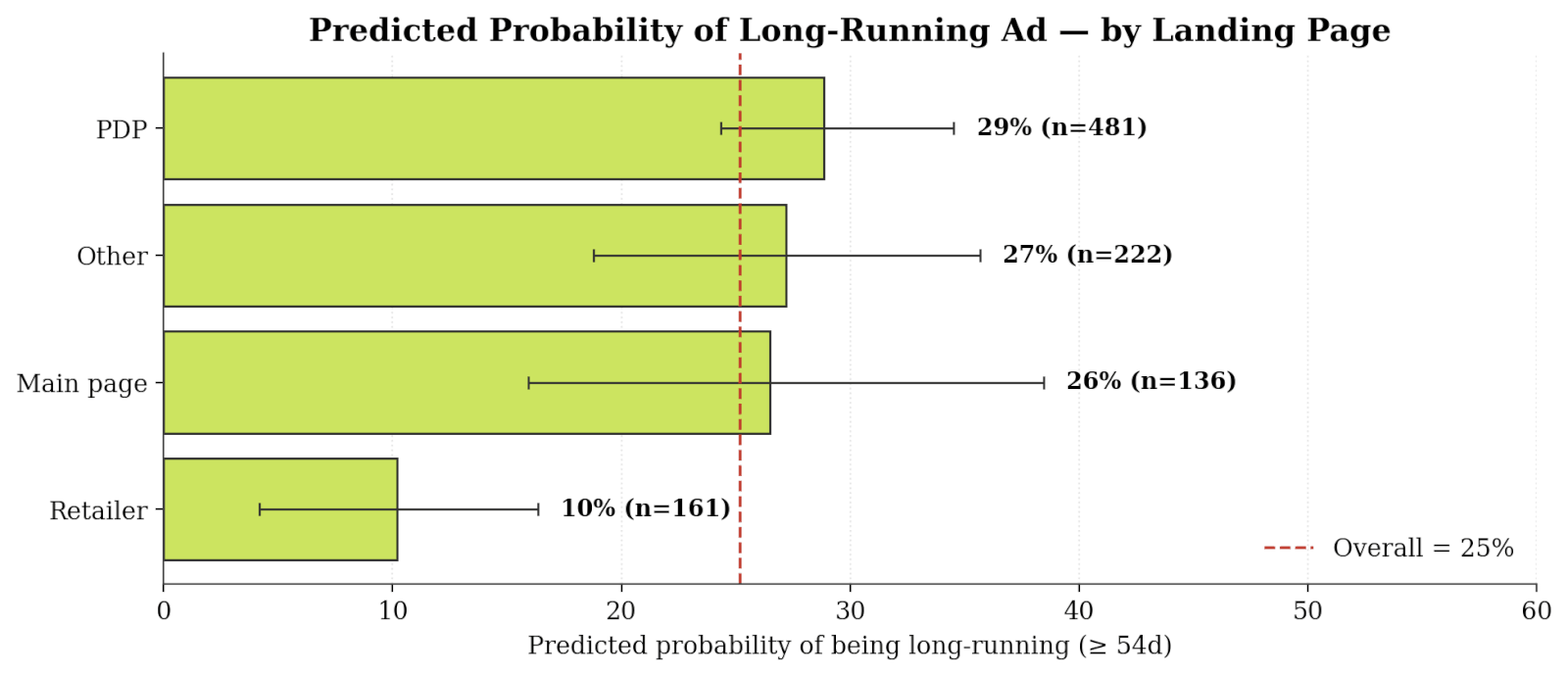
A bar chart of the predicted chance of a long-running beauty ad, by landing page.
In plain terms: a retailer ad is less than half as likely to become a long-runner as a DTC ad. The likely reason: retailer campaigns are built around launches, promotions and sell-through windows, and they’re switched off when the moment passes. Brand-owned pages are where evergreen creative lives.
By offer. The ranking is instructive:
- Free shipping — 45% (only 18 ads, so treat it as a signal, not a law)
- Bundle — 30%
- % discount — 29%
- No offer — 25%
- BOGO — 14%
- Free gift — 10%
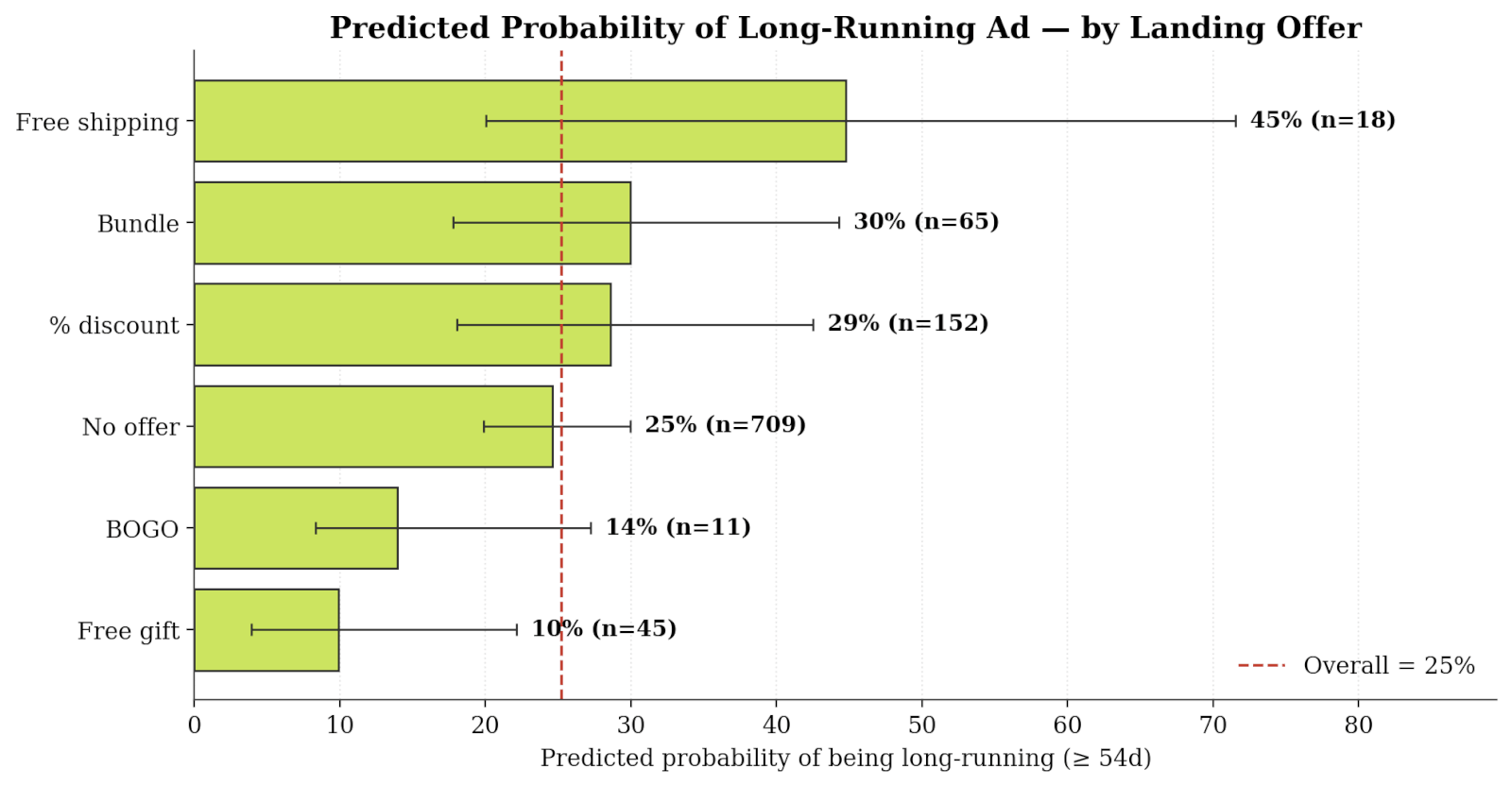
A bar chart of the predicted chance of a long-running beauty ad, by offer type. Free shipping scores highest at 45% (18 ads), followed by bundles at 30%, percentage discounts at 29% and no offer at 25%. BOGO scores 14% and free gifts are lowest at 10%.
Free gift is the weakest offer in beauty. Gift-with-purchase campaigns are almost always tied to a calendar moment: holiday sets, event gifts, “while stocks last.” They’re built to end, and they do.
Note: The 25% baseline is relative to this group of top brands, not the average ad in your account. Some ads that are still running and under 54 days will go on to become long-runners, so these odds are, if anything, conservative.
Pillar 4 — Persuasion Angles: No Magic Words, One Clear Warning
Every ad makes an argument for why you should care. We tagged all 1,000 ads for the same seven persuasion angles:
- Social proof — reviews, ratings, “#1 bestseller,” creator testimonials
- Authority / Expert — dermatologists, clinical results, salon professionals
- Problem-aware — naming the pain (breakouts, frizz, dark spots) before the fix
- Outcome-focused — the result you’ll get
- Urgency / Scarcity — limited time, sale deadlines, “while stocks last”
- Founder story — the person and the why behind the brand
- Ingredient-led — peptides, PDRN, niacinamide, snail mucin, bond-building tech
BIOSSANCE top performer back to school video ad
Dermalogica top performer video ad
Trinny London founder video ad
Outcome-focused is close to universal: 73% of beauty ads promise a visible result. Social proof appears in 35%, urgency in 30%, problem-aware and ingredient-led in about 25% each, authority in 19%. Founder story is rare at under 5%.
First question: does any single angle make an ad last longer?
No angle significantly extends an ad’s life. One comes close to shortening it.
We measured each angle’s effect on duration while holding the other six constant. Most landed close to a Time Ratio of 1.0, meaning no measurable effect. The exception is Urgency / Scarcity: Time Ratio 0.59 (p = 0.055). Ads leaning on urgency tend to run about 40% shorter, just outside the usual threshold for statistical significance.
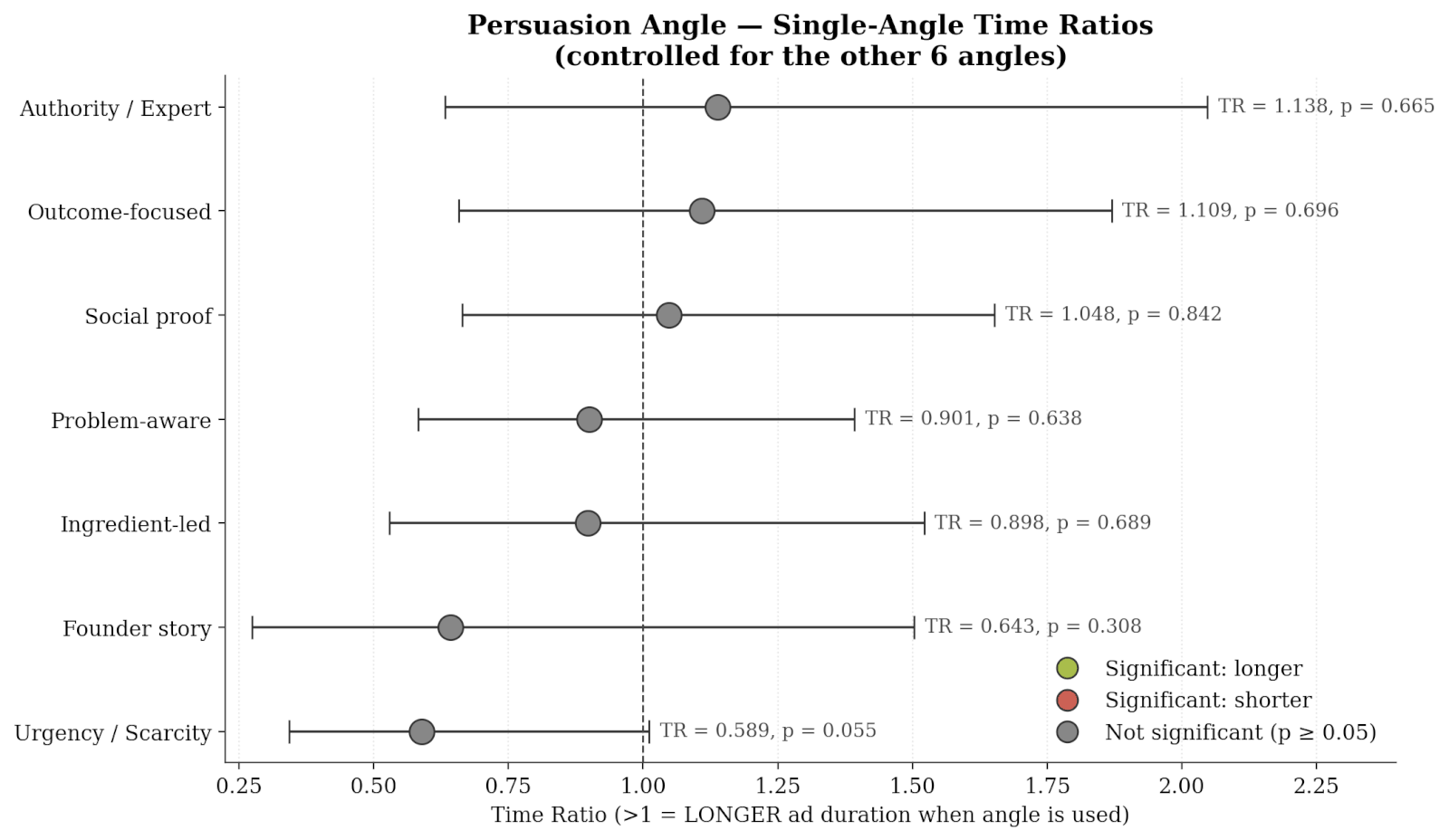
A dot plot of how each persuasion angle affects ad lifespan, where values above 1 mean longer runs. Authority, outcome-focused and social proof sit slightly above 1. Problem-aware, ingredient-led, founder story and urgency sit below 1, with urgency or scarcity lowest at 0.59. None of the results is statistically significant.
In plain terms: a Time Ratio of 1.0 means “no effect on how long the ad runs.” Adding “mention the dermatologist” or “add the review count” doesn’t buy extra days on its own. Adding urgency tends to cost them. That matches our supplement finding exactly, so across two categories and 1,500 ads, urgency is the most consistent drag on ad lifespan.
The predicted-probability view points the same way:
- Ads using urgency: 20% chance of running long; without: 27%.
- Ads using founder story: 32%; without: 25%.
- Ads using social proof: 29%; without: 23%.
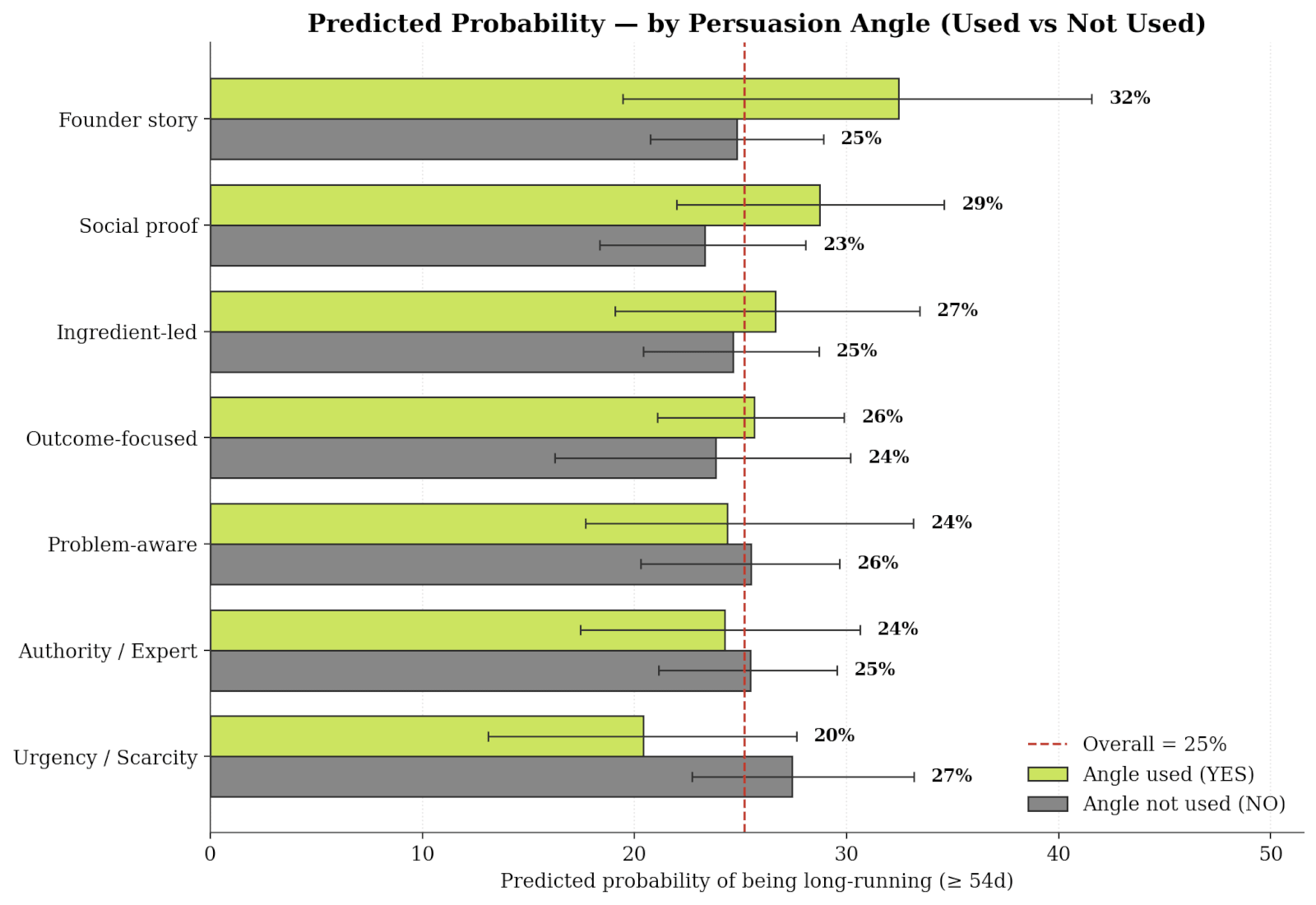
A paired bar chart comparing the predicted chance of a long-running beauty ad when each persuasion angle is used versus not used. Founder story (32% vs 25%) and social proof (29% vs 23%) show the biggest lift. Urgency or scarcity is the only angle that clearly hurts, at 20% when used vs 27% when not.
Two angles quietly help: founder story (32% vs. 25%) and social proof (29% vs. 23%). Beauty buyers respond to a real person behind the brand, and to proof that other people love it.
What matters more is how many reasons you give. Ads with no persuasion angle become long-runners only 20% of the time. Ads that combine three to five angles, for example a visible result plus reviews plus a key ingredient, get there 28–33% of the time.
In plain terms: give people more than one reason to believe. Show the result, back it with proof, and explain why it works. But don’t cram in every angle: an ad that tries to say everything loses its message.
Pillar 5 — The Hook: How the Ad Opens
The persuasion angle is why the ad exists. The hook is the first thing a person sees: the opening line, the first frame, the half-second that decides between watching and scrolling.
In beauty, one hook dominates by volume: Bold claim, 48.6% of all ads. Among the rest, Customer POV (15.2%) and Offer / Discount (14.4%) lead, and everything else is niche.
Now switch the question from how often is each hook used to how well does each hook perform.
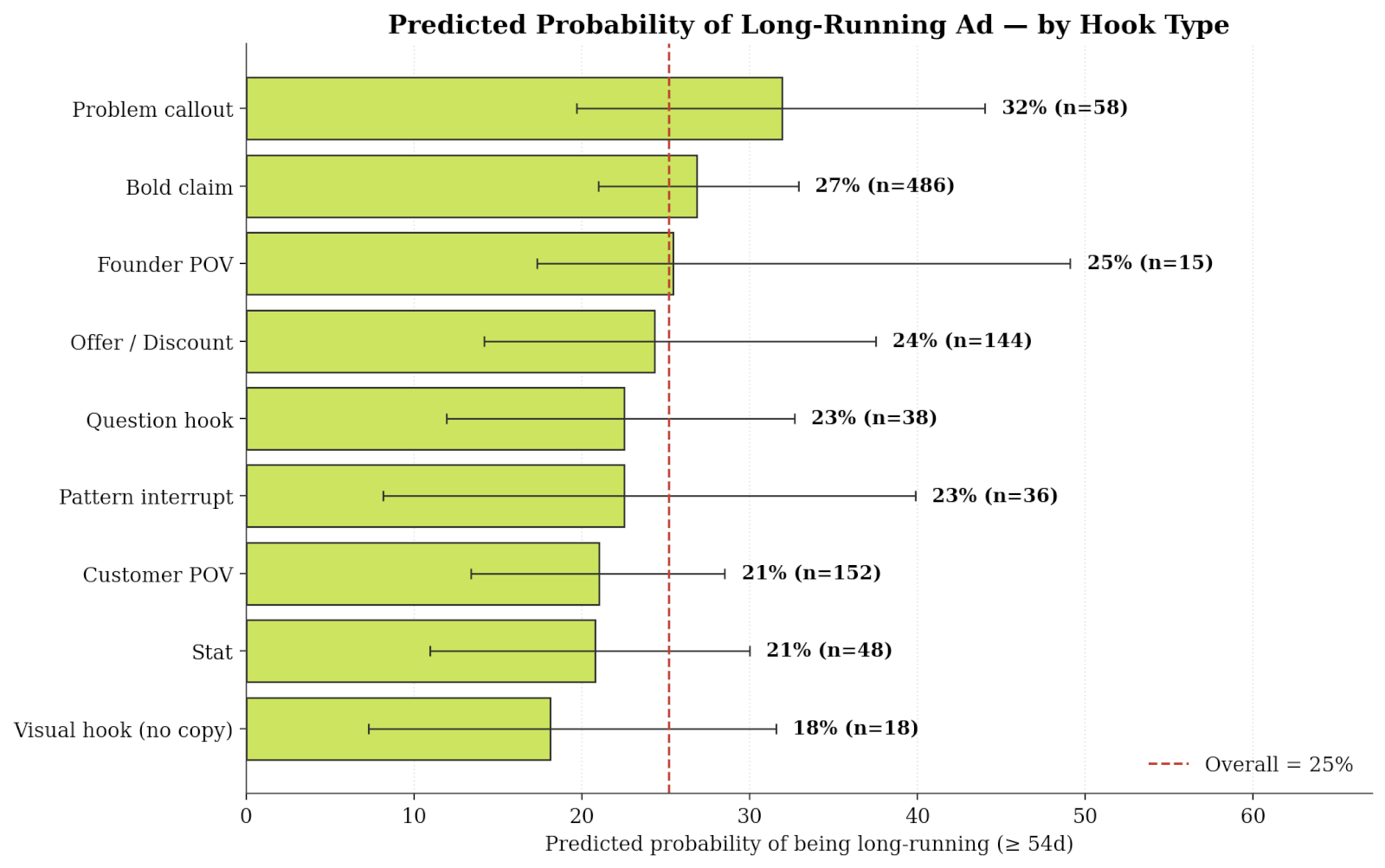
A horizontal bar chart of the predicted chance of a long-running beauty ad, by hook type, against a 25% average.
- Problem callout — 32% chance of running long
- Bold claim — 27%
- Founder POV — 25%
- Offer / Discount — 24%
- Question hook / Pattern interrupt — 23%
- Customer POV — 21%
- Stat — 21%
- Visual hook (no copy) — 18%
Problem callout is the best-performing hook in beauty, and one of the least used (5.8% of ads). That’s the same finding as our supplement study, where problem-first hooks came out on top at just 4.2% usage.
In video, the pattern is even sharper. Problem-callout videos reach the long-running bar 50% of the time, double the baseline. UGC with a problem callout reaches 44%.
In plain terms: open by naming the viewer’s problem (“Frizz by noon?”, “Still breaking out at 35?”, “Foundation settling into fine lines?”) and your ad is far more likely to still be running in two months than the average. Two categories, two datasets, same answer.
The hook with the clearest downside is Offer / Discount. Discount-first ads have a median life of just 15 days, against 62 for a bold claim. They can win hard in a sale window, but they’re built to expire.
And the most common creator format, the Customer POV opener (“I’ve been using this for three weeks…”), sits below baseline at 21%. Creator testimonials are everywhere in beauty and they perform, but they fatigue fast. They’re a rotation tool, not an evergreen one.
Note: Problem callout ads behave in an interesting way. More of them become long-runners, but the ones that don’t are cut early. A problem-first hook either connects fast or fails fast, which makes it cheap to test and quick to judge.
Unlock our curated library of 1,000 top beauty ads from brands like Haus Labs, Olaplex, Caudalie, Rituals, Davines, OSEA, The INKEY List and more. See what’s actually working, from UGC hooks to high-converting landing pages.
Want to see every ad, with its copy, visuals and videos? Drop your name and email below, and we’ll send you a private link to browse our exclusive winner ad library, curated by our performance team.
Pillar 6 — The Page and the Offer Are One Decision
In supplements, the landing page and the offer only mattered in combination. In beauty they matter on their own (Pillar 2), but the pairing still changes the answer. Here are the combinations with at least 10 ads:
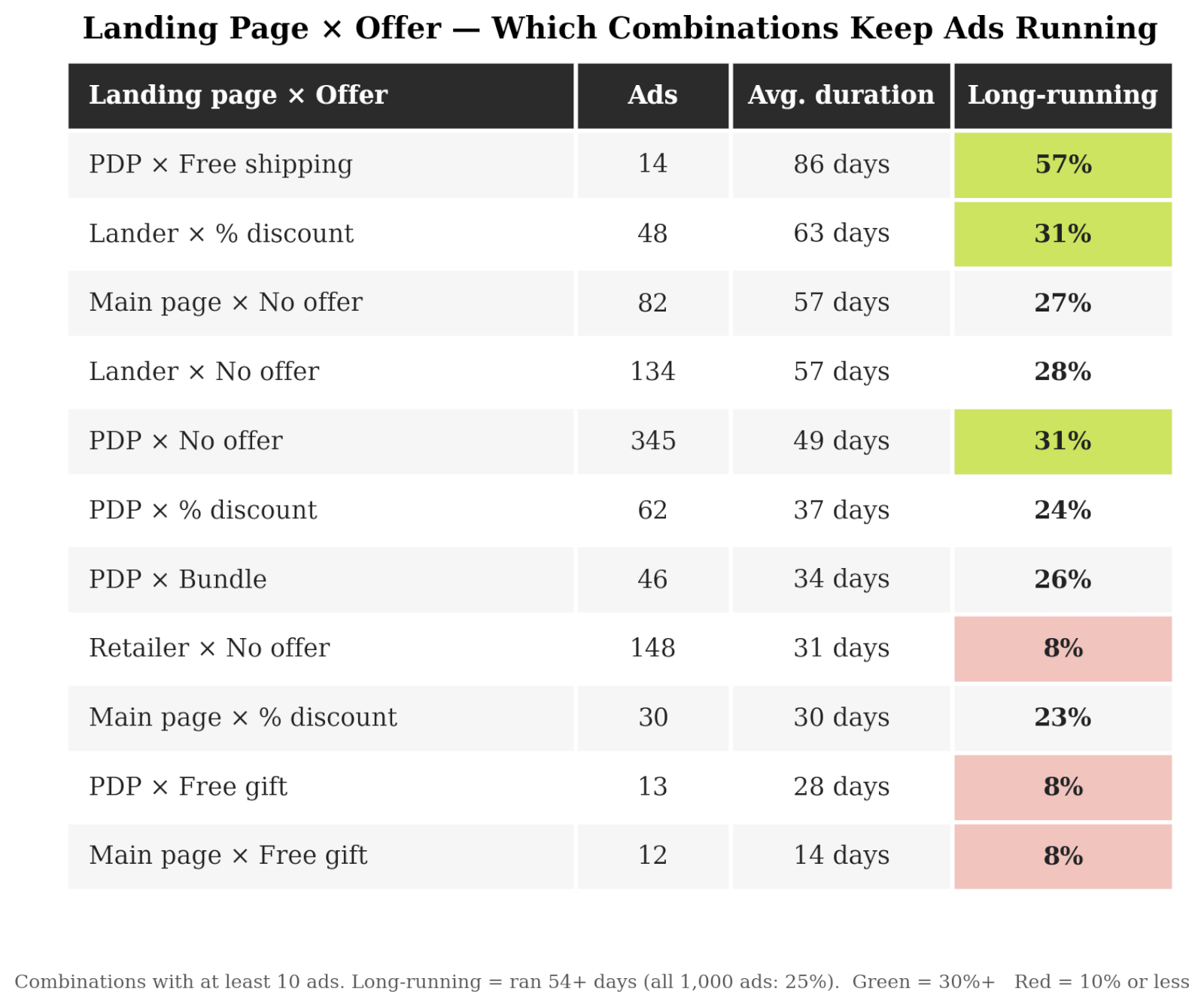
Three lessons stand out.
- A discount needs a dedicated page. A % discount sent to a campaign lander runs 63 days on average, one of the best combinations in the study. The same discount on a standard product page runs 37 days, and on a main page 30. Supplements showed the same thing: a discount works when the page is built to explain, justify and close. Dropped onto a thin product page or a homepage, it just teaches people to wait for the next sale.
- The quiet workhorse is still PDP × No offer. It’s the most common pairing in the dataset (345 ads) and reaches the long-running bar 31% of the time. A clean hero-product ad pointing to its product page, with no discount, is the most dependable evergreen setup in beauty.
- Free gifts don’t last anywhere. Whether they land on a PDP, a main page or a lander, gift-with-purchase ads sit at 5–8% long-running. Use them for moments, never for your evergreen layer.
In plain terms: before asking “should we run a discount?”, ask “where does the discount land?” If you can’t build a page for it, you’re probably better off with no offer.
Note: Retailer links are the one structural choice that consistently shortens ad life (8% long-running with no offer). If you run retailer-routed campaigns, budget for them as short bursts and keep your evergreen creative on your own site.
The K-Beauty Exception
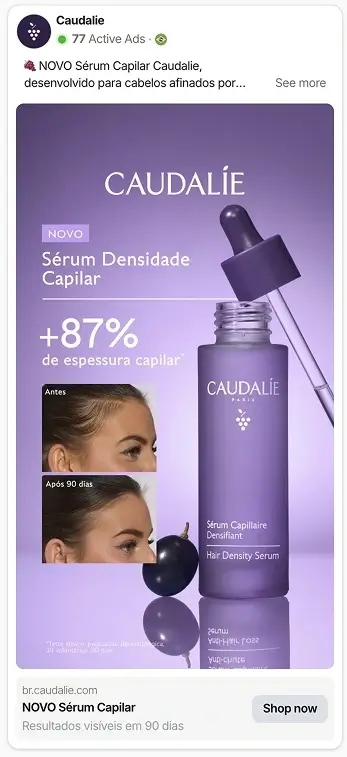
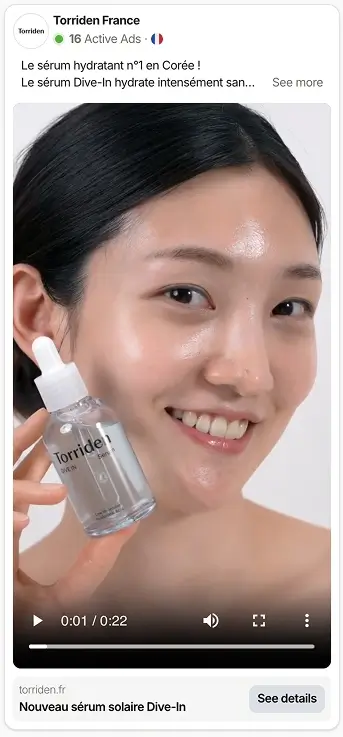
Thirteen brands in the study are Korean skincare labels: Beauty of Joseon, COSRX, Anua, Medicube, TIRTIR, SKIN1004, Round Lab, Torriden and others. They play a noticeably different game:
- Twice as ingredient-led: 48% of their ads lead with an ingredient or technology (PDRN, snail mucin, centella, rice), against 22% for everyone else.
- Heavier on UGC: 35% of their creative is creator content, against 19%.
- Faster rotation: median survival of 27 days, against 48 for the rest.
K-beauty brands run beauty the way fast fashion runs apparel: high creative volume, ingredient-first storytelling, creator-heavy, rotated quickly. The notable exception is Medicube, the second-longest-running brand in the entire study at a 208-day average, built on long-lived device and PDRN videos in Asian markets. Speed is the default, but a hero ad can still become an evergreen.
The 2026 Beauty Playbook
The findings, turned into rules you can brief against:
- Win the first 30 days. Most beauty ads are cut in the first three weeks. Build your testing cadence around that window, and treat any ad past day 30 as a candidate evergreen.
- Default to the static image. Single image is the most-used format and the most durable (median 55 days). Use UGC to rotate and refresh, not as your evergreen layer.
- Open with the problem. Problem callout is the best-performing hook (32%; 50% in video) and almost nobody uses it. It’s the cheapest test you can run next month.
- Keep evergreen creative on your own site. Brand-owned product pages give 29% odds of a long run; retailer links give 10%.
- Brief the page and the offer together. Discounts work on dedicated landers and underperform on product pages and homepages. Free gifts expire everywhere.
- Go easy on urgency. Across two categories and 1,500 ads, urgency is the most consistent drag on ad lifespan (Time Ratio 0.59 in beauty).
- Build a richer argument, not a checklist. Three to five persuasion angles beat zero or one. Past five, the message blurs.
How We Did This — Methodology
1,000 ads. 100 brands. Ten ads per brand, saved in our Trendtrack research library and coded by hand.
We know which ads died. Unlike our supplement study, where every ad was still live, this dataset includes 549 ads that had already been switched off and 451 still running. Stopped ads count as events and live ads as censored, so the survival estimates reflect real ad deaths. The still-running ads will add days, so the true durations are somewhat higher than reported.
We grouped the ads by brand. Ten ads from one brand share a team, a budget and a playbook. Every model resamples whole brands, so a few busy advertisers can’t tilt the findings.
We read every ad, not just the metadata. Hooks, angles, on-image copy and video scripts were coded from the ad copy, from screenshots of every creative, and from the transcript of every video ad.
These are top brands, not average advertisers. When we call something “underperforming,” we mean relative to this group, not to the average ad in your account.
Methods used: Kaplan–Meier survival curves with log-rank tests; regularized (elastic-net) logistic regression for predicted probabilities, with brand-level bootstrap confidence intervals; Weibull accelerated-failure-time models for persuasion-angle time ratios; brand-level means with 95% confidence intervals.


