


Longevity stopped being a trend in beauty some time ago. In 2026 it is the operating context, and INNOCOS Zurich showed what comes next and which fields longevity has worked its way into. Leaders from half-billion-ARR beauty brands, major longevity investors, scientists, MDs, surgeons, and a few beauty marketers like myself gathered in Switzerland to share what we are seeing in the market.
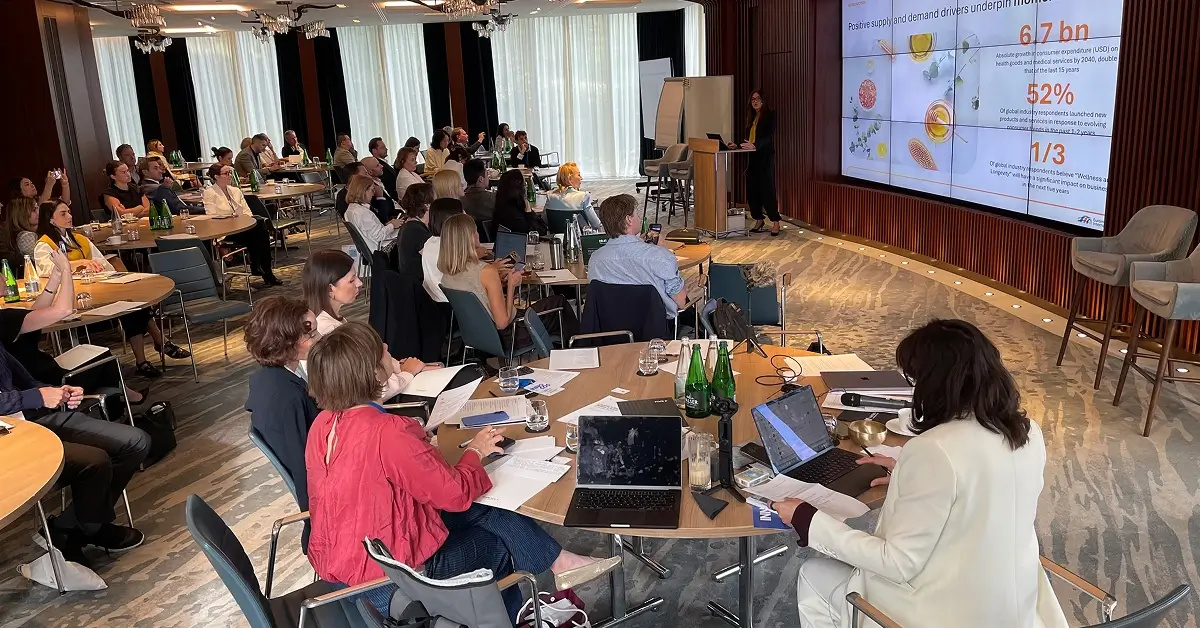
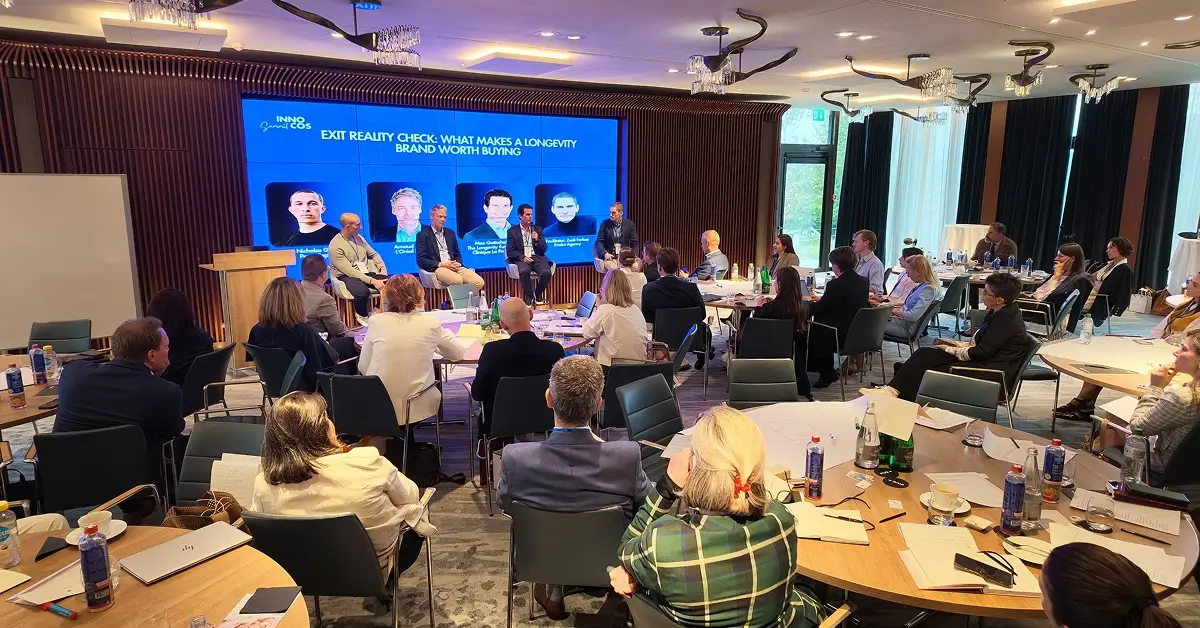
INNOCOS Zurich 2026 ran as a working session rather than a conference in FIVE Hotel Zurich.
Two days of talks, panels, and interviews made one thing repeatedly clear. The language has been adopted faster than the evidence behind it. Clinicians are drawing boundaries around what belongs in a clinic. Retailers are applying tougher scrutiny to anything labelled longevity than to conventional beauty. Investors are treating an unsupported claim as a reason to end a meeting. And the consumer arrives at the treatment holding their own data, a wearable, and a second opinion from “Dr. OpenAI”.
To build this report, I transcribed and analysed every talk, panel, and interview from the summit, including the investor panel I facilitated on what makes a longevity brand worth buying.
This Evolut trend report goes past the headlines to examine:
- what consumers now demand and how that has shifted,
- what the science makes possible today,
- how brands are restructuring around it,
- what capital rewards and what it walks away from,
- and where the real opportunities sit for brands willing to act.
1. The Consumer Landscape: What People Are Actually Buying
The nine-year gap
The most useful consumer data in INNOCOS Zurich came from RoC, and it should change how you write your product copy. Marie Renault (the global CMO of the brand) presented a study of nearly 7,000 women, aged 35 to 75, across 12 countries. It measured one thing: the distance between the age on a woman’s passport and the age she feels in her head. The average gap was nine years. It showed up in every region they tested, not only in Europe or the US.
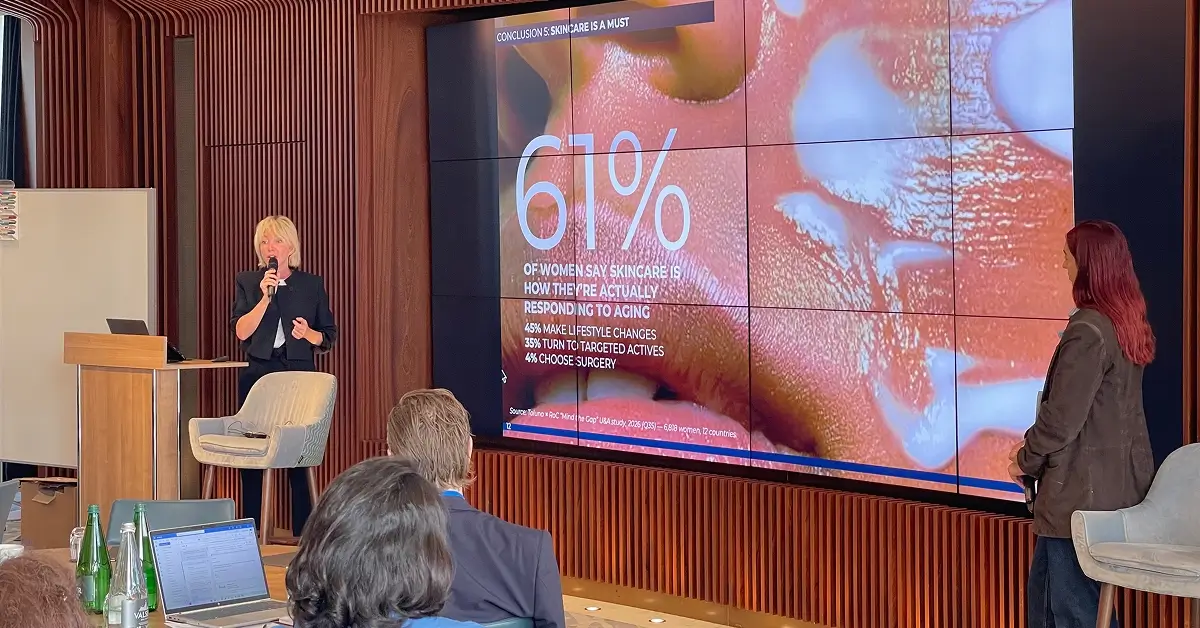
Marie Renault presenting RoC’s Mind the Gap study at INNOCOS Zurich
Renault put it personally on stage. “I’m 51, but in my head, I have the exact same age” as her 14-year-old daughter. Her conclusion is the part worth acting on. Women are not asking to look younger than they are. They are asking to look as young as they feel. That is a smaller promise, and a deliverable one.
"Aging well" beat "anti-aging" in every market
The same study tested the words. Respondents chose “aging well” over “anti-aging,” and ranked staying healthy above looking younger. 78% said they were proud of their age. RoC has now dropped anti-aging from its own language.
Pride in age varied sharply by market, which matters if you run global campaigns. In India, 95% of women said they were proud of their age. In Korea, 51%. Same product, same claim, two very different cultural starting points.
One number keeps skincare in the game: 61% said they respond to visible aging through skincare, ahead of lifestyle changes, targeted actives, or surgery. Skincare is still the first thing people reach for. The message around it is what has expired.
They want the next step, not the number
Dominik Thor of the Geneva College of Longevity Science presented research showing 42% of consumers will pay more for insights they can act on. A biological age score with no instruction attached is worth little. The same applies to a diagnostic reading, a skin scan, or a genetic result. If your product returns a number, the value sits in what you tell the customer to do next.
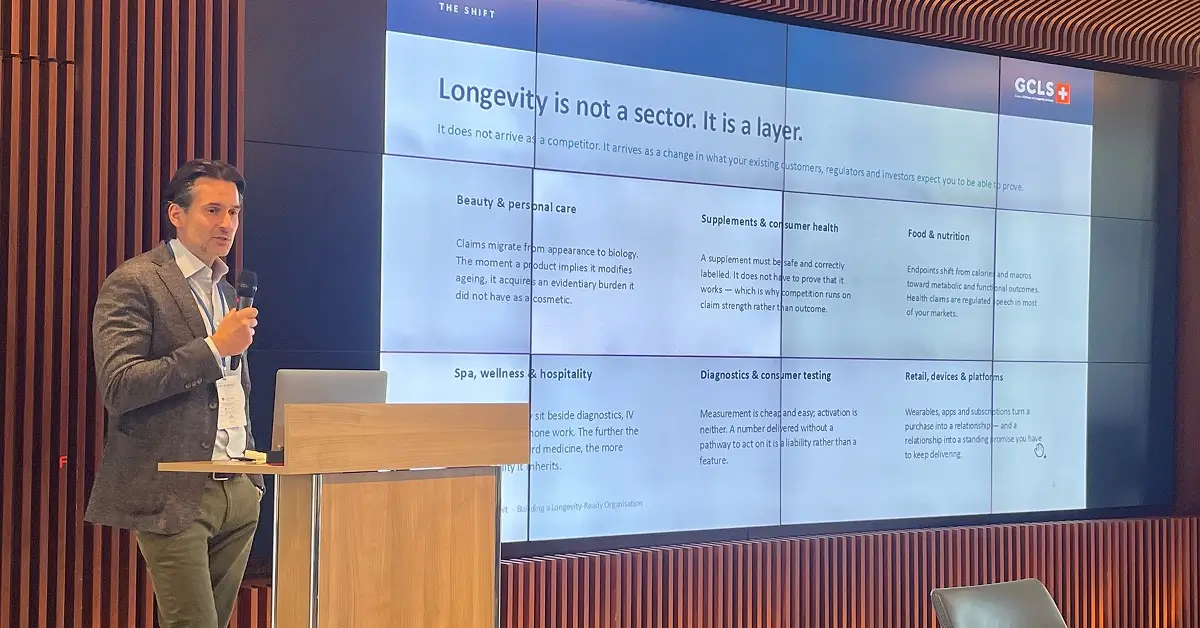
Dominik Thor (GCLS): longevity is not a sector but a layer, changing what six different industries are expected to prove
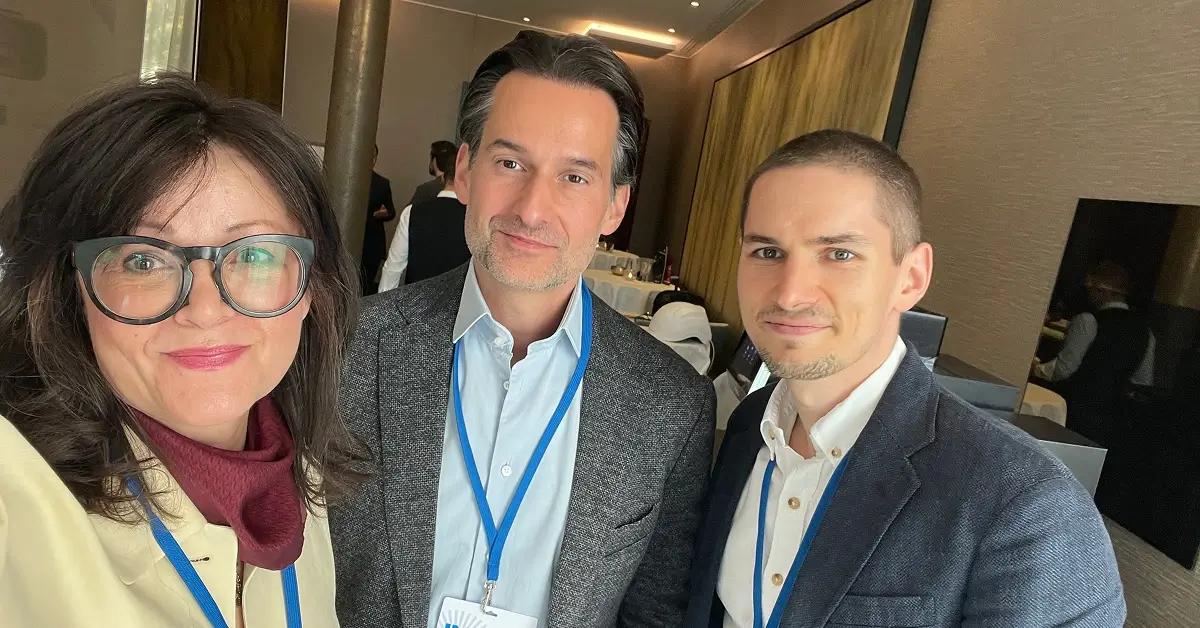
With Iryna and Dominik
2. The Science: Skin as a Signal, Not the Problem
The 40-year-old patient who came in about acne
The strongest scientific argument in INNOCOS Zurich was that skin problems usually start somewhere else. Natalia Trpchevska, medical and scientific director at a longevity clinic in Zurich, described a case she sees constantly.
A woman in her early 40s comes in about adult acne or dull skin. Somewhere in the conversation she mentions that she sleeps badly and feels tired all the time. Her blood tests come back showing two things nobody had looked for: her body is struggling to handle blood sugar, and her hormones have started shifting into early perimenopause.
Her instruction to the industry was four words: “test before you treat.” And test the right things. Most blood panels check HbA1c, which shows the average blood sugar over the past three months. The problem is that blood sugar only rises once the body can no longer keep up, and by then the trouble has been building for years. Measuring insulin directly catches it much earlier. Her blunt version: no amount of active ingredients makes up for a bad night’s sleep, and none of them work if the body has nothing to build collagen from.
Why two people with the same redness need different products
Barbara Geusens of Nomige came to the same place through DNA. Her published work covered more than 5,000 people, combining genetic data, visible skin condition, and a detailed lifestyle questionnaire. Remove the DNA from the model and diagnostic accuracy drops sharply.
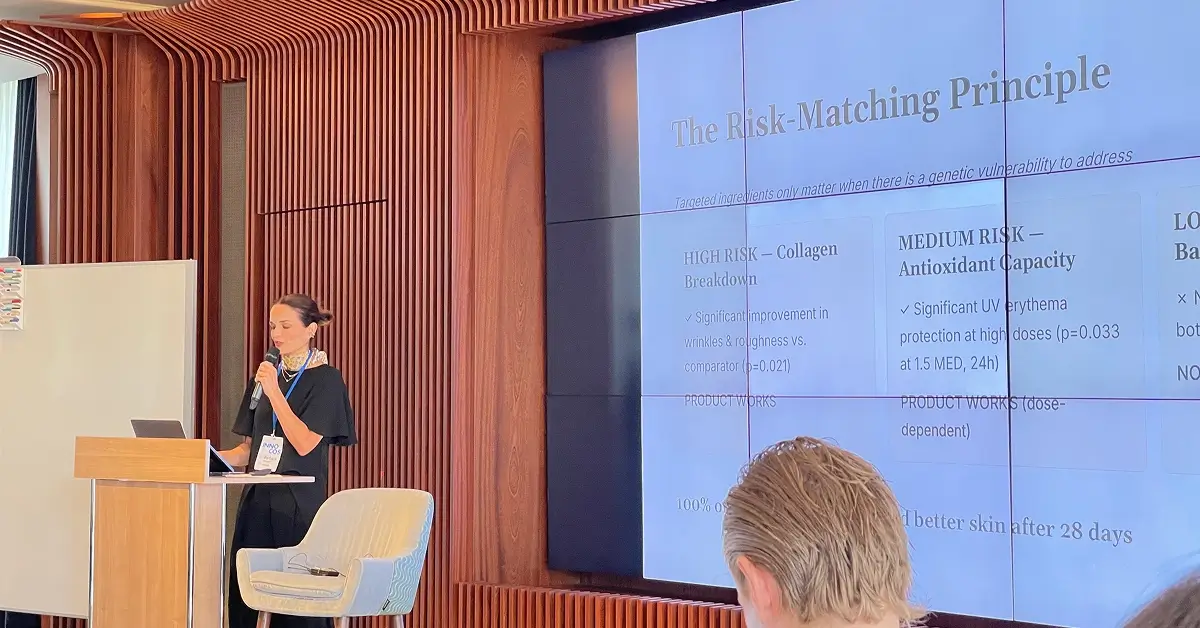
Barbara Geusens on why the same active performs differently depending on genetic risk
Her “silent burn” concept is the commercially useful part. Everyone has a different threshold. Damage accumulates invisibly for years, and symptoms only appear once that threshold is crossed. Two women with identical redness can have completely different causes underneath, which means they need different formulas. In her trial, matching ingredients to genetic risk produced measurably better results than a generic product. Treating the symptom alone treats the last step in a long chain.
Reading health from a photograph
Dr. Fudi Wang works in the other direction, reading the body from the face. Her team’s published study found that people who sleep badly look about three years older than they are.
The part brands should watch is her camera work. A special camera picks up changes in blood flow under the skin before any redness shows up to the eye or in a normal photo. That means detecting a problem before it appears, which is a very different product to sell than a cream that fixes it afterwards. Her own framing was simple: aging is a direction of travel, so the job is to keep people healthy along the way rather than fight each new line as it arrives.
3. The Proof Problem: Claims, Tiers, and the Credibility Backlash
The verb carries the legal risk, not the ingredient
Dominik Thor of the GCLS gave the most practical framework of the summit, and it costs nothing to apply. Sort every claim you make by what your evidence can carry. Some claims are hypothetical, interesting in a lab and unusable in marketing. Some are plausible. Some are demonstrated. Then look at the verb, because that is where the exposure sits. Targets, supports, and treats are three different promises with three different burdens of proof, and most brands use them interchangeably.
Longevity Marketing in 2026
Most longevity marketing fails on phrasing, not science, because regulators react to wording rather than intent. A breakdown of what converts, what triggers scrutiny, and why evidence-informed messaging beats “clinically proven.”
His advice was procedural rather than scientific. Appoint one person inside the company who owns the claims, fix the wording, and review it, because the failure almost never happens in R&D. As he put it:
“you could get it all right in the R&D department, and then marketing sort of makes it a problem for you.”
He also named the structural reason this keeps happening: in longevity, consumer interest and spending power are highest exactly where evidence is weakest and marketing strongest, and the enforcement comes from competitors rather than regulators.
Opinion data is not proof, and buyers now know the difference
Kevin Slawin, a physician with more than 500 peer-reviewed publications behind him, drew the line clearly. Satisfaction scores and self-assessment questionnaires measure one thing: what people think they see.
The difference looks like this. A standard cosmetic study asks 100 women whether their skin feels firmer after eight weeks, and 80 say yes. A biological study measures something the participant cannot influence. Slawin’s own human work took blood samples at 14 days and measured markers of cellular senescence, the process where cells stop dividing and start pushing inflammation into the tissue around them. One result tells you how people felt. The other tells you what happened.

Kevin Slawin presenting the MitoXcel™ geropeptide platform, built around mitochondrial membrane potential as a universal hallmark of aging
That worked while regulation kept cosmetics out of biology. It stops working the moment you claim your product acts on the biology underneath. His rule is that a biological claim needs a measurement sitting beside the questionnaire: dermal density, barrier function, a marker in blood. The deeper point was about order. He ran the science first and decided what he could claim afterwards, which is the reverse of how most launches are built.
Carrie Gross of Dr. Dennis Gross reached the same discipline from the commercial side, including clinical testing on categories most brands skip entirely. Testing a cleanser makes little economic sense when it sits on the face for 90 seconds, which is precisely why the results surprised them. Marie Renault’s version at RoC is a single sentence: no proof, no ingredient in the formula.
The backlash is already here
Michael Schummert (Interim CMO of Reviderm) was the least diplomatic voice at the summit, describing traditional brands swapping anti-aging for skin longevity on existing packaging as neither authentic nor credible. His objection was commercial, not ethical: if everyone rides the same train, the category returns to a sea of sameness, and the repositioning budget buys no differentiation at all.
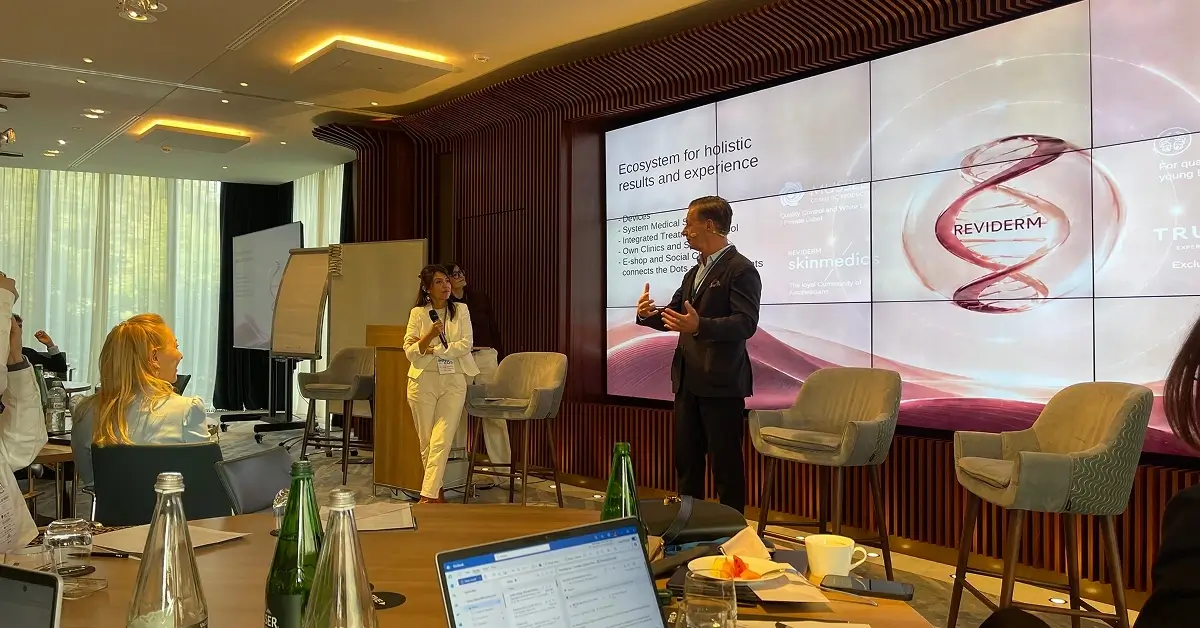
Michael Schummert on Reviderm’s ecosystem model: devices, protocols, clinics, schools, and community as one connected structure

With Michael in Zurich
Retail agrees. Cristo Stuart (Buyer of Harrods) said the scrutiny applied to a longevity claim at Harrods is deliberately higher than for conventional beauty, because a bigger promise carries a bigger burden of review. He also named where brands waste money, and it was not R&D or marketing alone but the imbalance between them. You can hold the best science in the category and still fail to land.
Clinicians are drawing the boundary hardest. Ivana Gajic Hoffman of AUMAR Longevity Aesthetics argued that not every aesthetic clinic should become a longevity clinic, because that expansion requires diagnostic infrastructure, evidence-based interventions, and the ability to follow up. Without those, in her words, “longevity just becomes another marketing label.”
4. The Business Model: From Products to Protocols to Ecosystems
Build the protocol before you build the product
Paul Du Bois of Light Tree Ventures, one of the largest manufacturers of red light and LED devices, sees what happens when brands skip this step. The protocol has to exist before the product does, because irradiance and wavelength decide what a customer can realistically achieve, and no clinical result comes from a single use. Studies typically require three to four sessions a week over months. If your product cannot deliver that pattern, your claims cannot either.
His sharper point was about verification. A consumer buying an LED mask has no way to check wavelength or output, and neither do most brands buying from a factory. His rule: if it is not a Class II medical device, treat the claims as marketing.
Joanna Bensz of Longevity Center put the same warning more bluntly, describing much of what reaches the market as “Christmas tree lights under a plastic mask.” For anyone sourcing devices, that distinction is now a commercial advantage rather than a compliance detail, because it is one of the few things a customer can be taught to check.
The consumer is overloaded, and it is measurable
Mintel’s Nicole Bensi presented the numbers behind the confusion. 49% of UK consumers say conflicting information makes it hard to be healthy. 43% of Chinese consumers don’t know how to pair products together. People are building stacks they don’t understand.
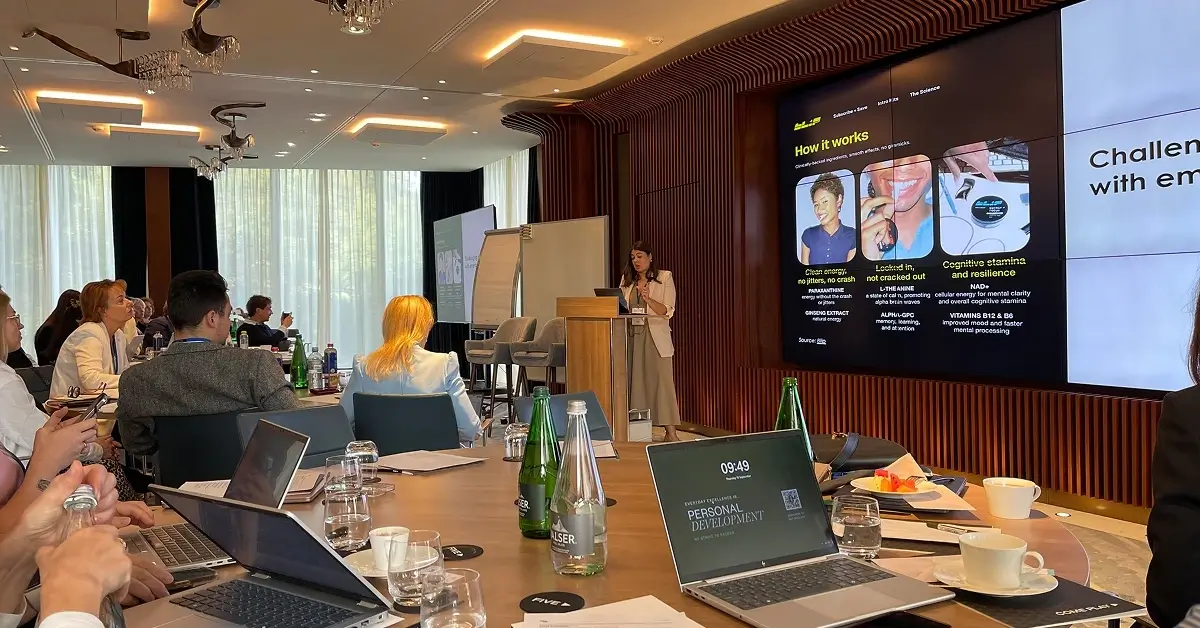
Nicole Bensi (Mintel) on format innovation, using Blip’s pouch-based energy and focus product as an example of challenging category norms
Her conclusion is that the next wave of products will remove steps rather than add them. Her example was oral care.
- 52% of US users already look for oral microbiome claims.
- Brands like Dayly now split 23 vitamins across a morning and an evening toothpaste.
- Mintel projects global oral care to reach $72.98bn by 2033.
Christophe Lesueur of Swiss Line described trust as a ladder: day one they feel something, after weeks they see something, after months you can measure something. Most brands promise step four and deliver step one.
5. The Channel Shift: Clinics, Services, and Experiences
The money is moving from products to experiences
Euromonitor’s numbers make this concrete. 46% of global consumers now prefer spending on experiences rather than things. Experiential luxury is forecast to grow 52% between 2025 and 2030, against 34% for luxury beauty and 28% for personal luxury. Wellness tourism sits at roughly $114bn in 2026 and is projected to reach $157bn by 2031, with spas growing fastest inside that.
Irina Barbalova‘s read is that wellness real estate, longevity clinics, and fitness hubs are scaling faster than product retail, and that building this capability usually means partnership or acquisition rather than starting from scratch. Her examples included Estée Lauder’s Skin Longevity Institute, which turns product science into treatments and diagnostics in travel retail, and Nestlé Health Science’s stores in South Korea, where a facial scan reads more than 25 health metrics and drives the supplement recommendation. In that market, 32% of consumers already use personalised nutrition recommendations.
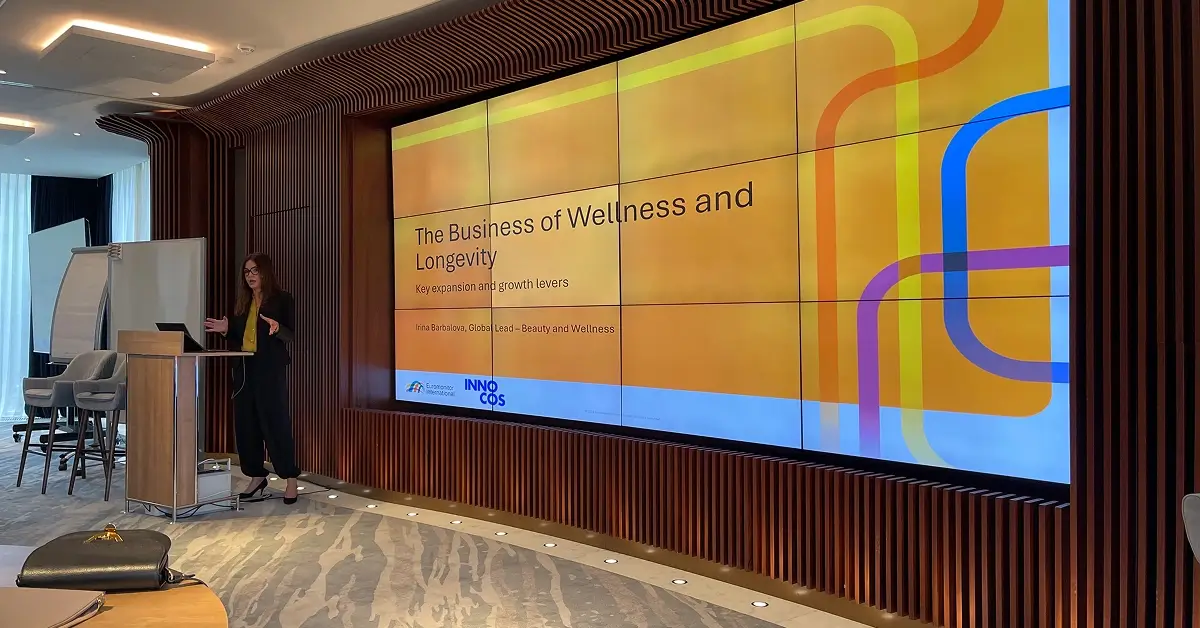
Irina Barbalova, Global Lead for Beauty and Wellness at Euromonitor International, opening her session on where wellness growth is moving
The practitioner now holds the recommendation
Olivia Schmid, co-founder of Beauty Rep and previously in commercial operations at Galderma and Allergan, explained why the professional channel gained ground. When a consumer asks for one named treatment, the brand controls the story. When the conversation covers hormones, metabolic health, and how to sequence products and procedures, the practitioner sits at the centre, and their recommendation carries more weight than the advertising.
That changes the brand’s job.
Nobody can be expert across everything longevity now covers, so how a brand educates practitioners becomes a core function rather than a support activity.
Her two conditions for partnerships that last: pay the clinic for the business it actually drives, and share data in both directions.
What a brand learns by crossing over
Christophe Lesueur gave the most honest account. Swiss Line bought a spa expecting extra revenue and took about a year to understand what it had bought. The treatment room turned out to be an intelligence centre, showing how clients arrive, react, and behave between appointments, which is the part brands never see.
6. AI as Gatekeeper, Translator, and Liability
Your next buyer may be an algorithm
The most uncomfortable number of the summit came from Euromonitor. Referrals from generative AI platforms grew 302% in 2025, and beauty accounted for 45% of that total.
Consumers now rank generative AI as their third most important source of health information, behind doctors and pharmacists, and ahead of anything a brand publishes about itself.
Use is close to universal: 81% of consumers used GenAI for help with daily tasks in 2026, up from 71% the year before.
Irina Barbalova’s conclusion is that clarity now has two audiences. Your ingredient and outcome language has to satisfy a consumer and a model at the same time, and brands that write for engagement rather than legibility lose the second one. Mintel’s data shows how far this has gone in practice: 47% of UK consumers already use AI assistants for nutrition advice.
Clinicians are handling the fallout
Dominik Thor and Joanna Bensz both used a version of “Dr. OpenAI” without coordinating, describing patients arriving with a shopping list assembled elsewhere and expecting the doctor to approve it. Dominik’s point was that the format shapes the information. There is a limit to how much sensible aging science survives a thirty-second video, and the industry inherits responsibility for what consumers believe, because it reaches them far more often than scientists do.
Mintel found a related risk worth knowing about. 56% of UK smartwatch owners believe their device is as clinically accurate as a medical one. Consumers are treating consumer-grade readings as diagnoses.
Brands are building their own translators
Caroline Messner described how Coty borrowed a technique from its fragrance business. Rather than asking consumers whether they like a product, it measures heart rate and brainwaves while they use it, because people struggle to put a feeling into words. Coty also uses AI to show a consumer her own face at the improvement level the clinical data supports.
Natalie, founder of the microbiome brand Fjor, showed the version a small brand can afford. She records customer interviews with consent, feeds the transcripts into an AI tool, and uses it as a stand-in audience to test ads and packaging before they go out. Her reason: consumers notice when a brand’s ad and its website sound like two different companies.
The endgame is the ecosystem
Nicole Bensi described where this leads. Brands are already spending research budget to prove they move the numbers on a wearable. Ultra’s sleep pouch advertises 93% of users improving their sleep score and 14% more time in REM and deep sleep, sitting alongside 50+ published studies. Whoop’s own positioning is the clearest signal: trackers tell you what you did, Whoop tells you what’s next. Its partnership with AG1 lets users log the supplement in the dashboard, and the connection between the two forms in the customer’s head whether or not the brand claims it.
Her warning is worth repeating. Claiming your product moved someone’s score is a legal exposure, not just a marketing angle.
7. The Capital View: What Investors Are Actually Buying
The team, not the product
I facilitated the investor panel in Zurich, and the gap between what founders pitch and what gets funded came up within minutes. Nicholas Gnan of Peers Capital, whose firm reviews at least a hundred companies a month, said the recurring mistake is leading with the product. His team had seen almost every business model in the room before. At pre-revenue stage there is little to model, so the decision rests on the team and on why these specific people can bring this specific thing to market.
His second point is the practical one. Roughly half the founders they back could have removed more risk before raising and did not. You rarely need much capital to test customer satisfaction, run acquisition maths, or find your real cost base. The problem is not the gap itself. It is arriving unaware the gap exists.
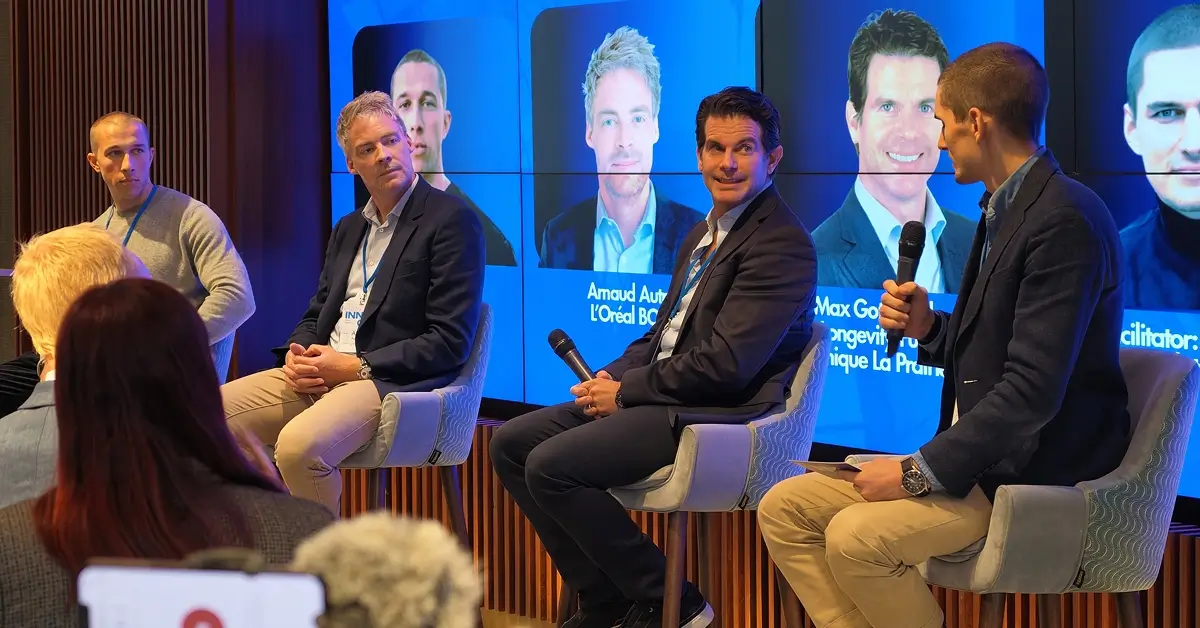
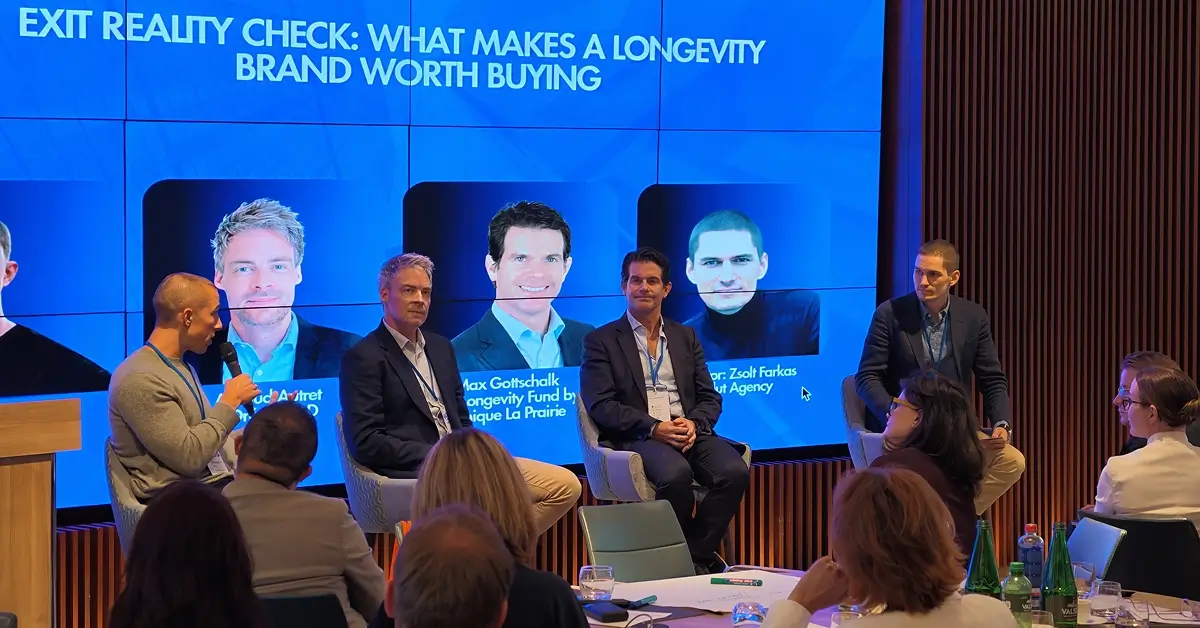
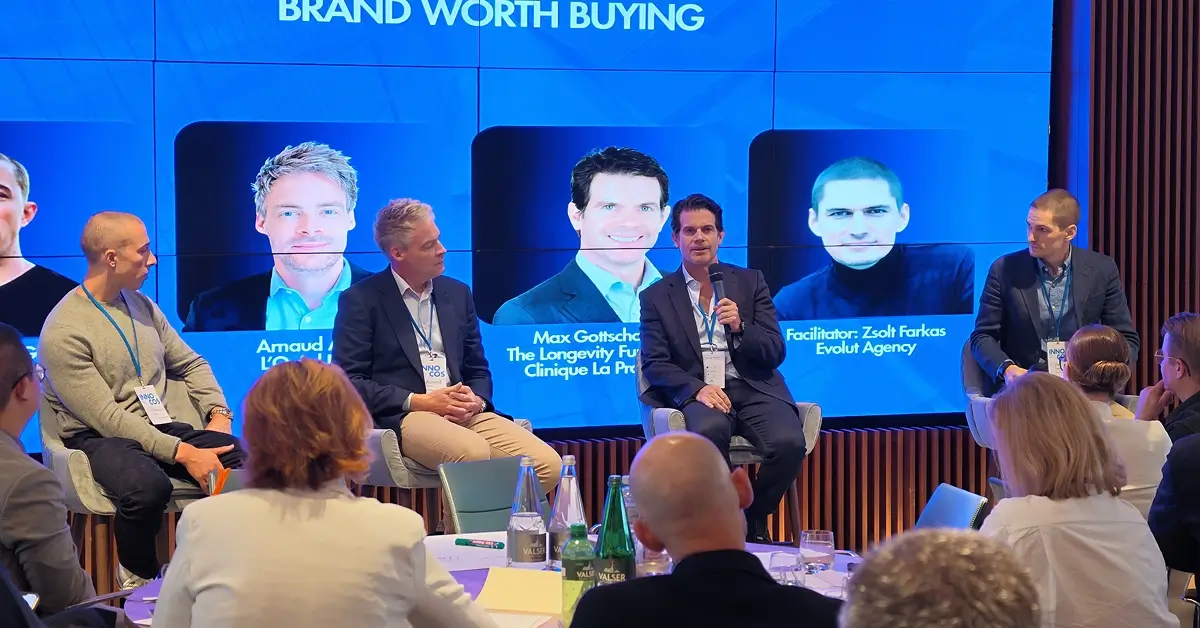
The “Exit Reality Check” panel on what makes a longevity brand worth buying, with Nicholas Gnan (Peers Capital), Arnaud Autret (L’Oréal BOLD) and Max Gottschalk (The Longevity Fund by Clinique La Prairie)
Science only counts when it changes the commercial path
Arnaud Autret of L’Oréal BOLD Ventures drew the distinction most founders miss. Science creates value when it supports a higher price, creates a difference competitors cannot copy, or opens a market that was closed. Science pursued for its own sake is a cost, not an asset, and a company in that position may do better licensing its technology than building a brand around it. His view on building versus buying was that big companies are mostly buying time rather than assets.
Max Gottschalk answered the longevity bubble question. Not as a whole, he said, because the demographics and demand are real. But some companies are priced far above what their results support, so he values a business on what a buyer would realistically pay. Nick added the part founders should act on: the biggest players can only justify their valuations by acquiring over the next decade, which tells you who might buy you and what to build toward.
The fastest way to lose the room
Both investors named the same thing: claims the science cannot support. Autret said a mismatch between claim and evidence ends the meeting, and the damage is permanent rather than a setback. Gottschalk gave the commercial version, pointing to brands that bought their way into a market with marketing and collapsed when customers had no reason to return.
If anyone can buy your active, nobody will buy your brand
Herna de Wit, a biochemist and IP strategist, sees this from inside the data room. A brand licenses a peptide or postbiotic from a major ingredient supplier, builds a story around it, and markets it as cellular rejuvenation. When an acquirer looks at that business, the question is simple: why pay a premium for the packaging when you can buy the same ingredient from the same supplier?
Her rule is to decide early between patenting and trade secrets, because the two are mutually exclusive. A patent requires full public disclosure in exchange for 20 years of protection, and the moment you file, your right to a trade secret is gone. She pointed to the Olaplex and L’Oréal case as the warning: even information shared under an NDA lost its protection because it was already patent-pending and the underlying acid was known in prior art.
What This Means For Your Brand
Fix the claims before you spend on anything else
The cheapest thing you can do after reading this is an audit that costs nothing but attention. Put one person in charge of claims. Sort every claim by what your evidence can carry. Check the verbs, because targets, supports, and treats are three different legal promises. Most failures happen after the science leaves the lab, in a marketing department optimising for search performance.
Then check the sequence. Kevin Slawin ran the science first and decided what he could claim afterwards. Most brands do the opposite, and it shows the moment a retailer, clinician, or investor applies pressure.
Decide whether you are a product company or a service company
Most brands are trying to be both and funding neither properly. The data says pick. Experiential luxury is growing 52% to 2030 against 34% for luxury beauty, and clinics and spas are scaling faster than product retail.
If you go toward services, Ivana Gajic Hoffman’s condition applies to brands as much as clinics: diagnostics, evidence, and follow-up. Without all three you have bought cost, not credibility. Christophe Lesueur needed a year to understand what his spa was actually worth to him.
If you stay a product company, your leverage sits in the professional channel, which makes your education the product. Pay the clinic for the business it drives, and send data back the other way.
And if you sell devices, ask your factory one question: is this a Class II medical device? If not, your protocol claims are marketing, and a clinician will say so in front of your customer.
Write for two readers
Generative AI is now the third most trusted health information source, ahead of anything you publish about yourself, and AI referrals grew 302% last year with beauty taking 45% of them. Your product pages have to be legible to a model, not only appealing to a person. That is a content and structure problem, and most brands have not started on it.
Then measure the thing that actually matters
Christophe Lesueur tracks whether clients follow the routine, whether the analysis moves, and whether they return. Very few brands measure any of that, which is why so many promise outcomes over years and can only prove a feeling on day one.
INNOCOS Zurich’s conclusion was simple. Longevity will not reward the companies with the best science. It will reward the ones people trust, and trust is assembled from unglamorous parts: someone owns the claims, the evidence comes before the story, and the results hold up when a customer returns a year later to check.
—
INNOCOS Zurich was one of several events we covered this year next to In-cosmetics Global, Vitafoods Europe and Future50 by Beautymatter. We publish a trend report after each one, built the same way: full transcripts, analysed, with the commercially useful parts pulled out.
But in most of our time, we drive growth for beauty, supplement, and longevity brands across the EU and US, and we spend most of our time on exactly this problem: turning real science into something a customer understands and acts on.


